
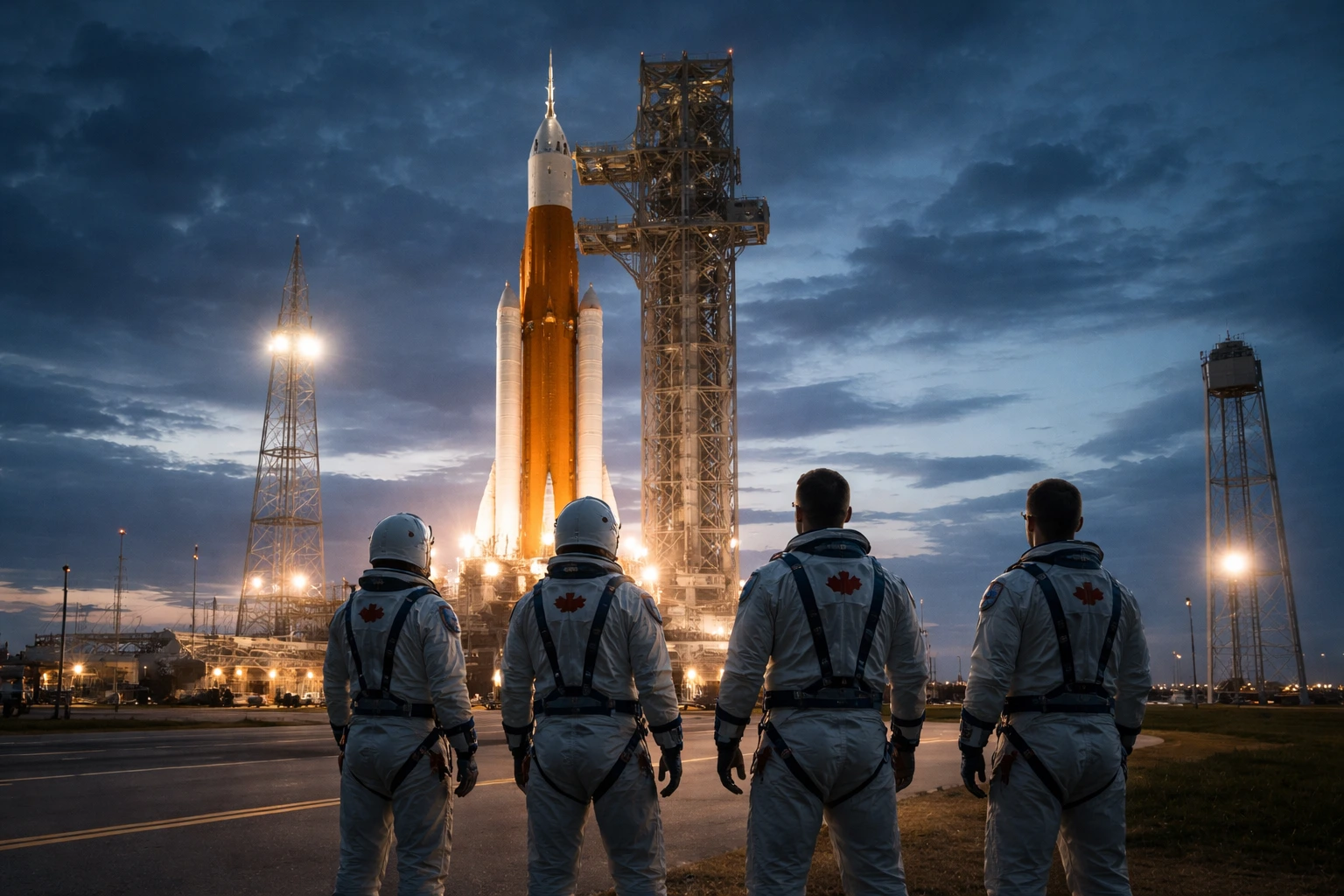
After decades confined to low Earth orbit, human spaceflight is again pushing outward. The Artemis II mission 2026 is expected to send astronauts around the moon for the first time in more than half a century, marking a crucial test of NASA’s next generation lunar program as global competition accelerates.
The mission, now targeted for early 2026 pending final readiness reviews, comes amid shifting political priorities, technical challenges and a revived race with China to return humans to the lunar surface.
“Space exploration doesn’t move on headlines or deadlines,” said Dr. Elaine Foster, a former NASA flight dynamics officer. “It moves when the hardware, the physics and the people are ready.”
The Artemis II mission 2026 will carry four astronauts aboard NASA’s Orion spacecraft on a ten-day journey looping around the moon before returning to Earth.
The crew includes NASA astronauts Reid Wiseman, Victor Glover and Christina Koch, along with Canadian Space Agency astronaut Jeremy Hansen.
If successful, the flight will mark the first time humans have traveled beyond low Earth orbit since Apollo eight in 1968.
NASA officials have described Artemis II as a proving mission designed to validate life support systems, navigation and heat shield performance before attempting a lunar landing.
Orion completed its uncrewed Artemis I test flight in late 2022. Since then, NASA has focused on system upgrades, safety modifications and crew readiness.
“This mission is about confidence,” said NASA Associate Administrator Jim Free. “We need to know Orion can safely carry people before we go any farther.”
The Artemis II mission 2026 arrives as NASA faces growing uncertainty over Artemis III, the planned lunar landing mission. That effort relies on SpaceX’s Starship vehicle, which has faced repeated test setbacks and engineering challenges.
Meanwhile, China has publicly reaffirmed its goal of landing astronauts on the moon before 2030. In recent months, Chinese officials confirmed additional ground testing of their Lanyue lunar lander and next generation launch systems.
“Artemis II is symbolic,” said space policy analyst Marcus Chen of the International Space Institute. “It signals capability and intent, even if landing timelines remain fluid.”
NASA estimates the Artemis program will cost more than ninety billion dollars through the late 2020s, according to congressional budget data. By comparison, China does not release full program costs, though analysts believe its lunar spending is significantly lower.
The Artemis II mission 2026 mirrors Apollo eight in trajectory but differs in complexity. Orion carries modern avionics, radiation protection and automated docking systems designed for long duration missions.
In parallel, Blue Origin plans an uncrewed lunar landing in 2026 using its Blue Moon MK1 lander. A successful demonstration could provide NASA with an alternative option for future missions.
For communities near NASA facilities, the mission carries local meaning. “We’ve watched this program grow for years,” said Laura Martinez, a technician at Kennedy Space Center in Florida. “Seeing astronauts head back toward the moon reminds us why we do this work.”
In Houston, astronaut trainers emphasize patience. “There’s pressure, but there’s also pride,” said retired astronaut Karen Douglas. “Everyone remembers what happens when schedules outrun safety.”
Beyond human spaceflight, 2026 will also bring a rare astronomical event. On Aug. twelve, a total solar eclipse will cross parts of the Arctic, Greenland, Iceland and northern Spain.
Scientists expect heightened global interest, particularly as space based observatories coordinate new studies of the sun’s corona.
For NASA, the Artemis II mission 2026 remains the linchpin.
Success would clear the path for future missions, even as landing targets shift toward the latter part of the decade. “Progress in space is rarely linear,” said Foster. “But every safe mission builds momentum.”
As 2026 approaches, the Artemis II mission 2026 stands as a measured step forward rather than a dramatic leap. It reflects a space program balancing ambition with caution, competition with cooperation and timelines with technical reality.
Whether it ultimately accelerates or delays humanity’s return to the lunar surface, the mission is expected to redefine what comes next beyond Earth’s orbit.


