
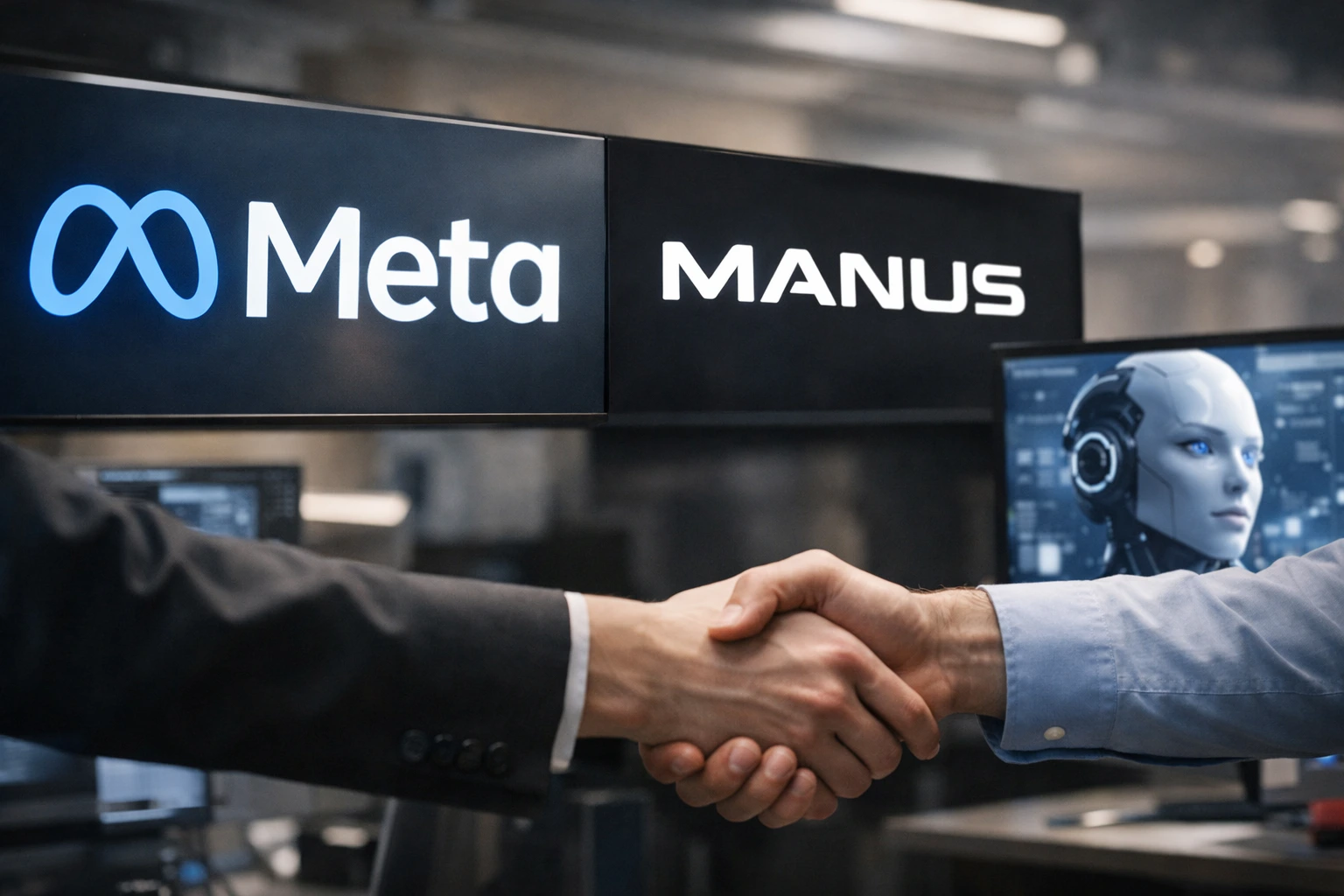
Meta Platforms Inc. said Monday it would acquire Manus, a Chinese founded artificial intelligence startup now based in Singapore, as the Facebook owner steps up efforts to expand advanced AI capabilities across its ecosystem.
The acquisition, which comes amid a surge of global investment in autonomous AI agents, reflects Meta’s strategy to integrate tools that can independently perform complex digital tasks. Financial terms of the deal were not disclosed.
Meta said it would operate and sell the Manus service and embed its technology into consumer and business facing products, including Meta AI.
The move to Meta acquire Manus follows a series of high-profile investments by the company aimed at strengthening its position in the fast-moving AI sector.
Earlier this year, Meta invested in data labeling firm Scale AI in a deal that valued the startup at about $29 billion and brought its founder and CEO Alexandr Wang into closer collaboration with the company.
Manus, founded by engineers affiliated with Beijing Butterfly Effect Technology Ltd Co, develops general purpose AI agents designed to function like digital employees. The tools can conduct research, manage workflows and automate tasks with limited human prompting.
The company relocated key operations to Singapore, joining a growing number of Chinese technology firms that have shifted headquarters to the city state to mitigate risks linked to rising US China geopolitical tensions.
Industry analysts said the decision to Meta acquire Manus highlights how large platforms are increasingly betting on AI agents rather than narrow chat based tools.
“Autonomous agents represent the next stage of AI commercialization,” said Daniel Wu, a senior analyst at Horizon Digital Research in Hong Kong.
“For Meta, Manus offers a ready made system that can scale across social media, advertising and enterprise services.”
Wu added that integrating agent based AI into Meta’s products could improve productivity tools for small businesses that rely on Facebook and Instagram for operations.
Still, experts cautioned that regulatory scrutiny may follow, particularly given Manus’ Chinese origins and the sensitive nature of AI automation.
Meta is not alone in pursuing AI agents. Microsoft has embedded similar tools into its Copilot ecosystem, while Google has rolled out experimental agent based features across its Workspace products.
Manus gained attention earlier this year when it launched its AI agent publicly, claiming its performance exceeded that of OpenAI’s DeepResearch agent.
The company promoted its capabilities by completing dozens of tasks for users on X at no cost, a strategy that quickly drew global attention.
According to market research firm AI Index Global, spending on AI agent technology is expected to grow more than thirty percent annually through the end of the decade, driven by demand for automation in research, marketing and software development.
Employees and users said the acquisition could bring both opportunity and uncertainty.
“For startups like Manus, being acquired by Meta provides access to infrastructure and scale that would be impossible otherwise,” said Li Wen, a Singapore based venture investor who has followed the company’s growth.
A small business owner in Jakarta who tested the Manus agent earlier this year said the tool saved hours of manual work. “It handled competitor research and summaries faster than my team could,” said Arif Pratama, who runs an online retail firm.
“If Meta improves it further, it could change how small companies operate.” Meta declined to comment on whether Manus employees would relocate or how the product would be priced under Meta’s ownership.
As Meta integrate Manus technology into Meta AI, analysts expect the company to position the agent as both a productivity assistant for consumers and an automation tool for advertisers and enterprises.
The decision to Meta acquire Manus also signals continued consolidation in the AI sector, where talent, data and computing power are becoming increasingly centralized within a small number of global firms.
Regulators in the United States and Asia are likely to monitor how Meta handles data governance and cross border operations tied to the acquisition.
Meta’s acquisition of Manus marks another step in the company’s effort to expand beyond social networking into advanced artificial intelligence services.
The deal reflects broader industry trends toward autonomous AI agents and highlights the growing role of Singapore as a hub for globally focused Chinese technology firms.
How successfully Meta integrates and scales the Manus platform will be closely watched by competitors, regulators and users alike.


