
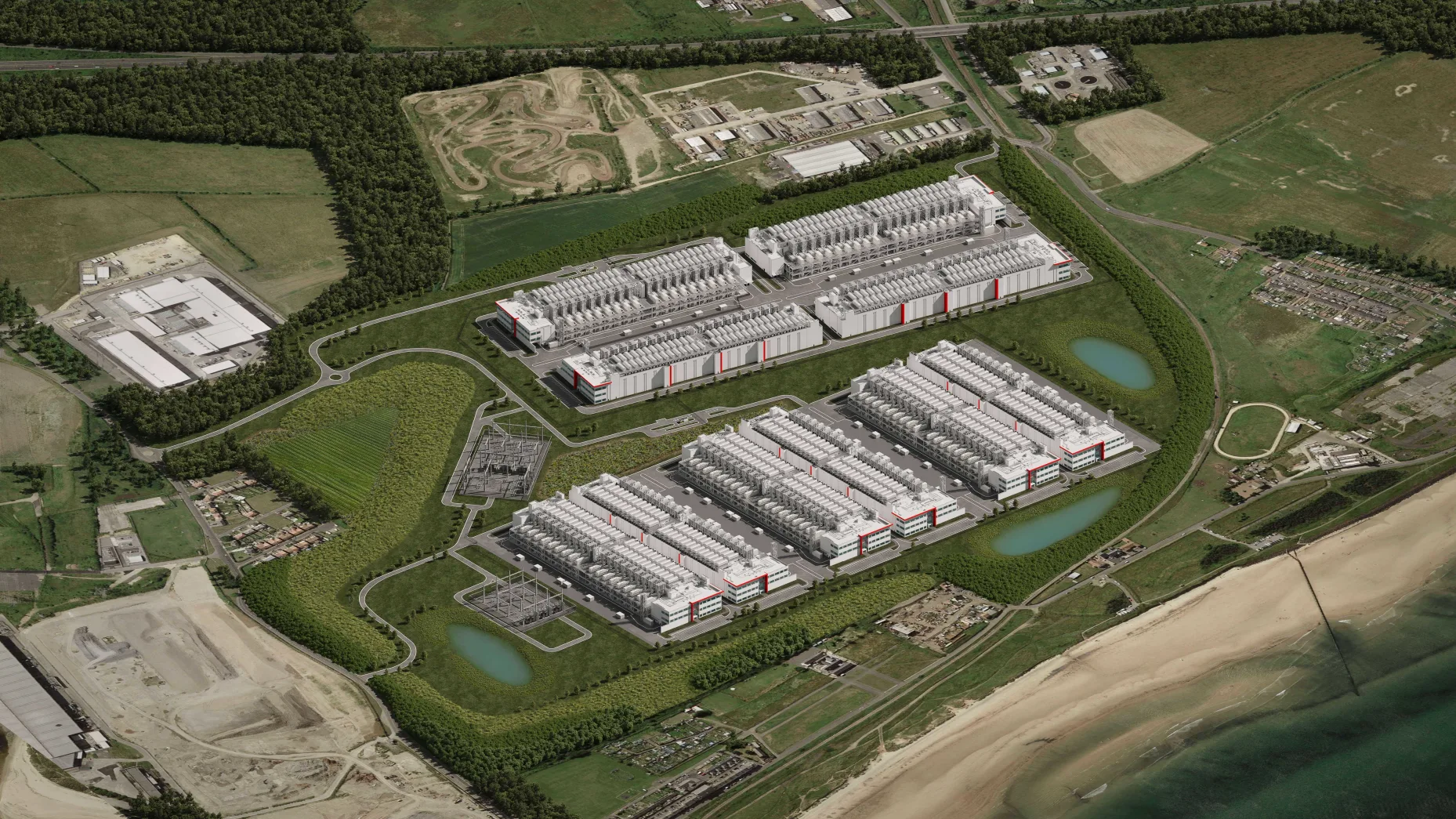
LONDON — Nearly a year after the UK government unveiled its AI Opportunities Action Plan, the country’s effort to become a global technology leader is showing both progress and pressure points.
While billions of dollars in private investment have flowed into data centers and computing capacity, persistent constraints in the national power grid are slowing the pace of development.
Prime Minister Keir Starmer described the plan last January as a pathway to making Britain an “AI superpower.”
Central to that ambition was a rapid UK AI infrastructure buildout, designed to support the vast computing needs of artificial intelligence across the economy.
The strategy introduced a network of “AI growth zones,” areas with streamlined planning approvals and enhanced access to electricity.
Four such zones have since been announced, spanning England and Wales, with government targets calling for at least five hundred megawatts of AI-related demand by 2030.
Major technology companies including Nvidia, Microsoft and Google have committed billions toward expanding compute capacity in the UK.
The government has highlighted these pledges as evidence that the UK AI infrastructure buildout is gaining international confidence.
However, most projects remain in early stages. Several sites are still seeking delivery partners or investors, while others have only begun preliminary ground work.
Industry leaders say the biggest obstacle is power. “The ambition is clear, but delivery is lagging,” said Ben Pritchard, chief executive of data center power supplier AVK. He said grid connection delays of up to a decade are now common, particularly in and around London.
Artificial intelligence workloads require far more electricity than traditional computing, adding stress to an already constrained system.
Pritchard said the UK AI infrastructure buildout is increasingly shaped by energy availability rather than capital or land. Government officials acknowledge the challenge.
A spokesperson for the Department of Science, Technology and Innovation said reforms to grid access rules are underway to ensure strategic projects move faster.
The National Energy System Operator reported hundreds of pending connection requests tied to data centers and advanced computing.
Comparable markets such as the United States and parts of Asia benefit from larger grids and faster permitting timelines.
Britain currently lags behind global rivals in deployed AI compute per capita, according to figures compiled by independent energy analysts.
While investment announcements place the UK among Europe’s leaders, actual operational capacity remains limited.
Microsoft alone plans to deploy tens of thousands of advanced chips in new facilities over the next several years, while homegrown firms like Nscale aim to bring large scale AI factories online by 2027.
Local communities near proposed growth zones express mixed views. In Oxfordshire, where one site has yet to begin construction, resident Sarah Whitcombe said expectations remain cautious.
“We hear about these big plans, but on the ground it is still farmland and survey teams,” she said.
In northeast England, where preparatory work has started, council leader Mark Ellison said the project could bring long term jobs.
“There is excitement, but also concern about whether the power and transport links will keep up,” he said. Technology workers echo similar sentiments.
“The talent is here,” said London based software engineer Adeel Khan. “The question is whether the infrastructure catches up fast enough.”
To overcome grid delays, some developers are turning to alternatives such as microgrids, which combine generators, renewable energy and battery storage.
These systems can be built more quickly but currently cost more than grid power.
Others advocate placing data centers near existing power sources rather than undeveloped sites.
Stuart Abbott, managing director for the UK and Ireland at VAST Data, said co location could accelerate the UK AI infrastructure buildout while easing strain on the grid.
The government has also pledged investment in national research supercomputers and so called AI gigafactories, aimed at supporting public sector research and domestic innovation.
One year after its launch, the UK’s AI strategy has attracted substantial investment and global attention, laying important foundations for future growth.
Yet the gap between announced projects and operational capacity highlights structural challenges, particularly around energy supply.
As reforms to grid access and planning continue, the success of the UK AI infrastructure buildout will depend on how quickly electricity, compute and skills can be delivered together. For now, Britain’s AI ambitions remain firmly in motion, but not without friction.


