
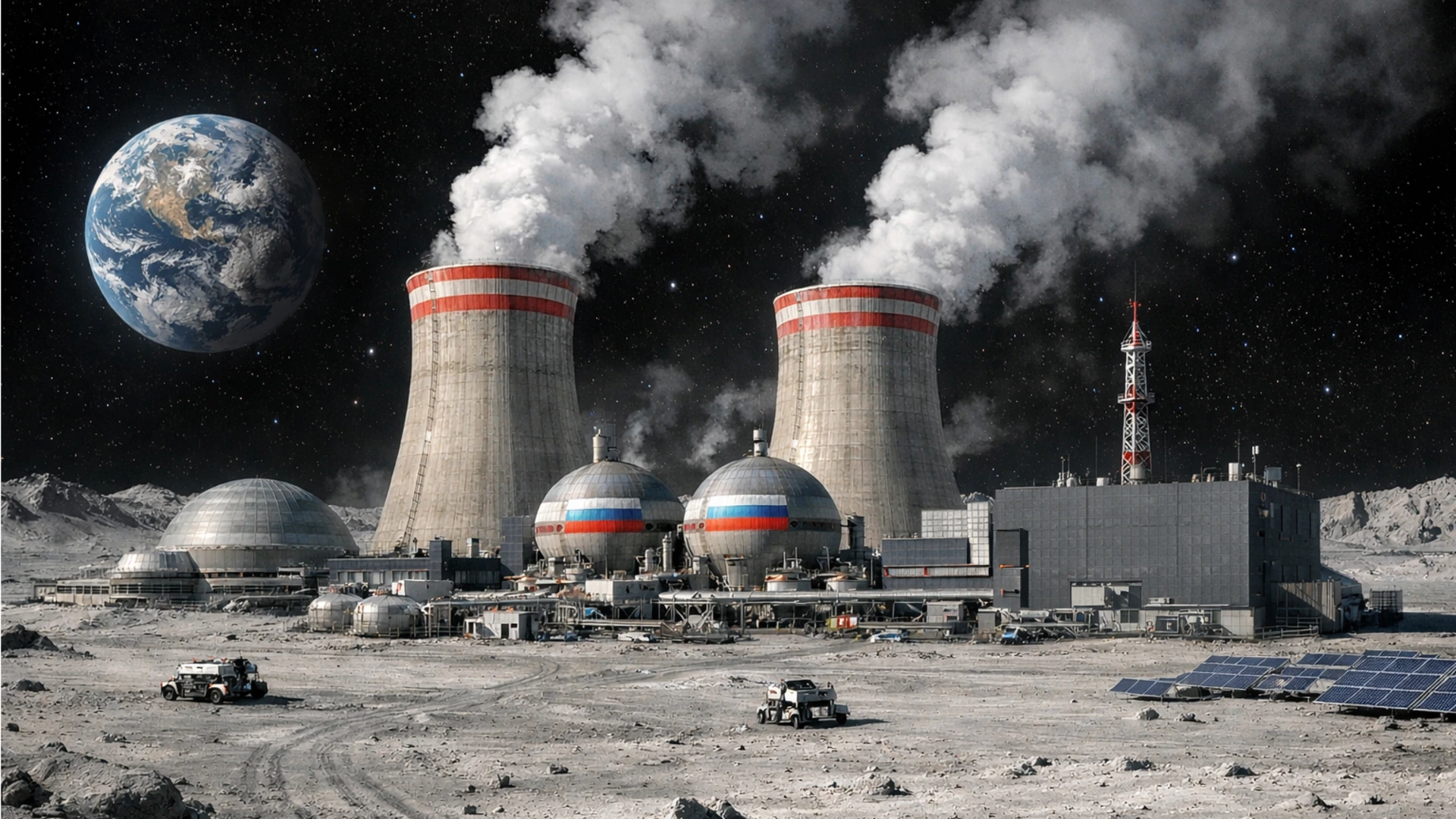
MOSCOW — Russia has announced plans for a moon nuclear project within the next decade to support its lunar space program and a joint research station with China, highlighting the country’s renewed push in space exploration amid growing international competition.
Russia’s space agency, Roscosmos, signed a contract with the Lavochkin Association aerospace company to develop the project, with participation from the Russian state nuclear corporation Rosatom and the Kurchatov Institute, the nation’s leading nuclear research organization.
While officials did not explicitly confirm the plant’s nuclear nature, the involvement of these institutions strongly indicates it will rely on nuclear energy.
The moon nuclear project is designed to provide power for rovers, observatories, and infrastructure at the International Lunar Research Station, a joint Russian Chinese initiative.
Dmitry Bakanov, head of Roscosmos, said in June that the agency also plans to use nuclear technology for further deep space missions, including exploration of Venus.
Russia’s lunar ambitions have faced setbacks. In August 2023, its unmanned Luna-25 mission crashed during a landing attempt, underscoring the challenges of space exploration.
Meanwhile, advances by private companies, particularly Elon Musk’s SpaceX, have transformed global launch capabilities, a field once dominated by Russia.
Dr. Elena Makarova, a space policy analyst at the Moscow Institute for Space Studies, said Russia’s moon nuclear project is “a strategic move to regain a foothold in lunar exploration.”
She added that “a reliable energy source on the moon is essential for long term scientific operations and could give Russia a competitive edge in collaboration with China.”
US officials have acknowledged similar ambitions. Transport Secretary Sean Duffy said in August that the United States is behind in the race to establish a lunar base and emphasized the importance of nuclear energy to sustain life and research on the moon.
NASA has indicated plans to deploy a nuclear reactor on the moon by 2030. The moon, located roughly 384,400 kilometers from Earth, moderates the planet’s axial tilt and stabilizes the climate.
It also drives tides, which are critical for ecosystems worldwide. Analysts estimate the moon holds up to a million tons of Helium-3, a rare isotope that could serve as fuel for future nuclear fusion.
Additionally, rare earth elements such as scandium, yttrium, and the lanthanides are present and could become valuable for technology production.
Compared to early Soviet era missions, today’s lunar programs aim for long term presence rather than one time exploration. While initial missions focused on short visits, current initiatives seek to create continuous scientific operations on the moon.
Mikhail Petrov, an engineer at Lavochkin Association, said the moon nuclear project will require “decades of preparation, testing, and international coordination” to ensure safety and efficiency.
He added that “operating a nuclear plant on the lunar surface presents unique challenges, from radiation shielding to energy storage during the moon’s long nights.”
Zhang Li, a researcher involved in China’s lunar program, noted that collaboration with Russia could “accelerate scientific discoveries and demonstrate the viability of international partnerships in space.”
Experts caution that deploying nuclear energy on the moon will face regulatory, technical, and political hurdles. International treaties prohibit nuclear weapons in space, but nuclear energy sources are permitted under strict rules.
Engineers must design reactors that withstand extreme temperatures, low gravity, and cosmic radiation. Despite these challenges, the moon nuclear project represents a step toward permanent human and robotic operations on the moon.
Analysts say that as nations compete for access to lunar resources and scientific data, such projects could define the next era of space exploration.
Russia’s moon nuclear project, expected to be operational by 2036, signals a renewed ambition in lunar exploration alongside cooperation with China.
While technical and political challenges remain, the project underscores the strategic importance of energy infrastructure in sustaining long term space missions and exploring the moon’s scientific and economic potential.


