
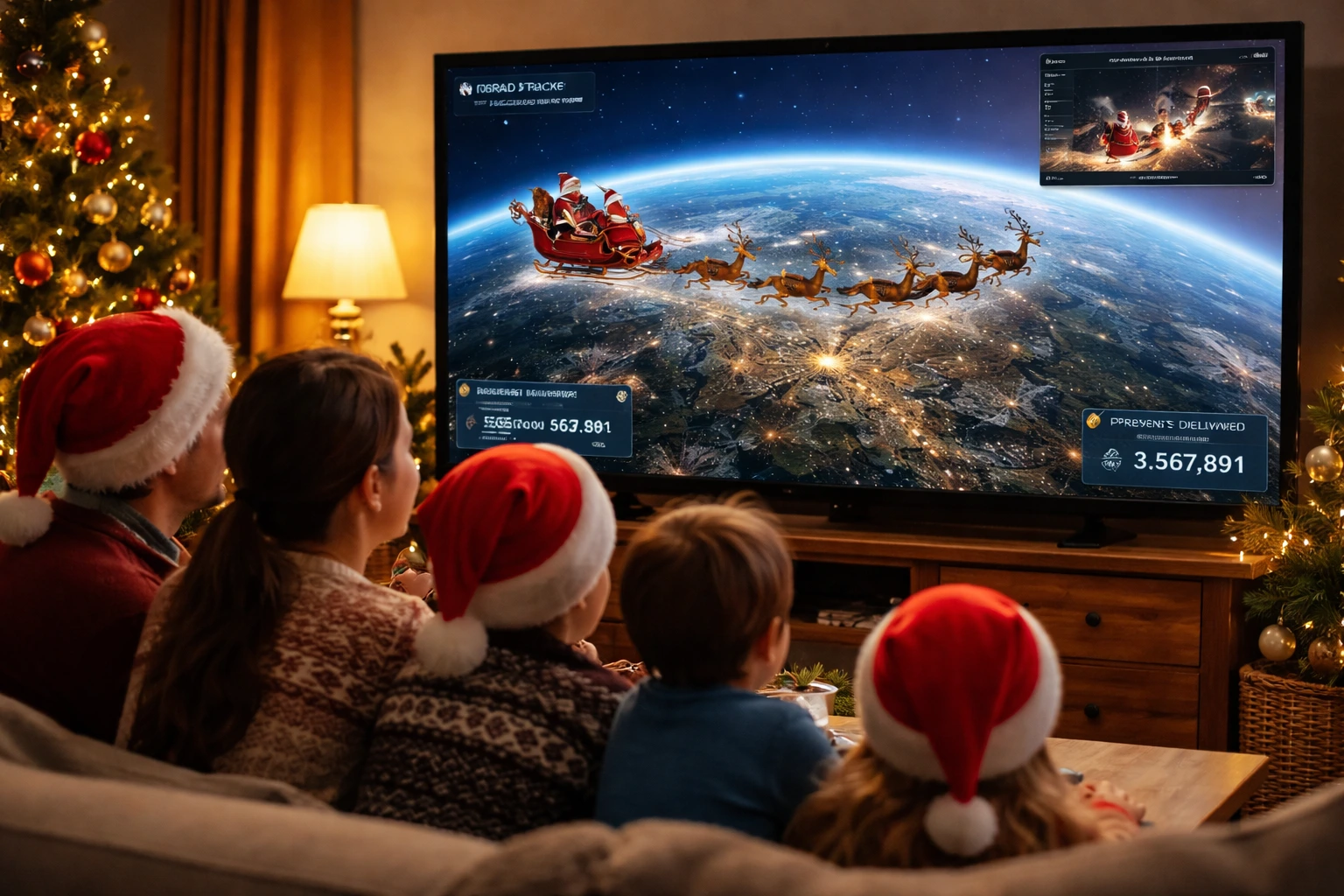
On Christmas Eve, a familiar question echoes in homes around the world Where is Santa right now? What began decades ago as a simple novelty has evolved into a global digital tradition.
Today, AI powered Santa trackers from organizations such as the North American Aerospace Defense Command and Google combine mapping technology, artificial intelligence and interactive storytelling to follow Santa Claus’ journey across the globe in real time.
For many families, especially those with young children, the trackers have become as much a part of the holiday ritual as stockings and carols.
NORAD launched the first Santa tracking program in nineteen fifty five after a misprinted newspaper advertisement prompted children to call a military command center.
Rather than turn callers away, officers answered questions about Santa’s location, creating an annual tradition that continues seventy years later.
In its early years, the tracker relied on basic radar imagery and simple animations. Over time, the program expanded alongside advances in satellite mapping, mobile apps and cloud computing.
Google introduced its own Santa Tracker in two thousand four, focusing on interactive games and educational content alongside a simulated tracking map.
This year, both platforms have leaned further into AI powered Santa trackers, reflecting broader trends in consumer technology.
NORAD officials said recent partnerships with technology companies have allowed the tracker to modernize without losing its core mission.
“Our goal has always been to create a safe, fun experience that sparks imagination,” said Maj. Gen. Laura DeHaven, NORAD’s director of public affairs.
“Artificial intelligence helps us personalize that experience while keeping the focus on storytelling.”
The NORAD tracker now includes AI driven tools such as an image generator that turns selfies into animated elves and a storytelling feature that adapts holiday tales using names and places submitted by families.
The platform is built on a three dimensional mapping system powered by open source technology and satellite imagery, offering a realistic view of Santa’s route.
Technology analysts note that these features mirror mainstream uses of generative AI in entertainment and education.
“What you’re seeing is a family friendly introduction to AI concepts,” said Marcus Feldman, a digital media researcher at the University of Colorado. “These tools are playful, but they reflect the same systems used in design, learning and visualization across industries.”
NORAD reported millions of visitors to its website and mobile apps each Christmas Eve, with traffic peaking in the hours before midnight local time. The site is available in eight languages, underscoring its international reach.
Google’s tracker offers a different approach. Along with a live map, it displays estimated arrival times, total distance traveled and the number of presents delivered.
Throughout December, Google’s Santa Village hosts coding games, quizzes and animated shorts designed to keep children engaged beyond a single night.
Both AI powered Santa trackers emphasize accessibility across devices, including web browsers, mobile apps and voice assistants.
For parents, the technology serves a practical purpose as well as an emotional one. “It buys us a little extra magic and a little extra time,” said Maria Gonzalez, a mother of two in Phoenix.
“When the kids see Santa over the Pacific, they know they still need to get to bed.” Children, meanwhile, are often less concerned with the technology behind the scenes.
“I like the Santa Cam the best,” said seven year old Liam O’Connor of Boston. “It looks like he’s really flying.”
Developers involved in the projects said future updates will likely expand personalization and educational elements while maintaining privacy safeguards.
Officials stressed that the trackers are designed for entertainment, not data collection.
Experts said the success of AI powered Santa trackers could influence how organizations present complex technology to the public.
“This is a low stakes, high trust environment,” Feldman said. “It shows how AI can be introduced in a way that feels helpful rather than intimidating.”
From Cold War era radar screens to three dimensional maps and generative storytelling, Santa tracking has evolved alongside technology itself.
The latest AI powered Santa trackers reflect a broader shift toward immersive, personalized digital experiences while preserving a sense of wonder rooted in tradition.
As families gather on Christmas Eve, the trackers continue to offer a shared moment of anticipation, blending old stories with new tools in a way that remains familiar, accessible and festive.


