
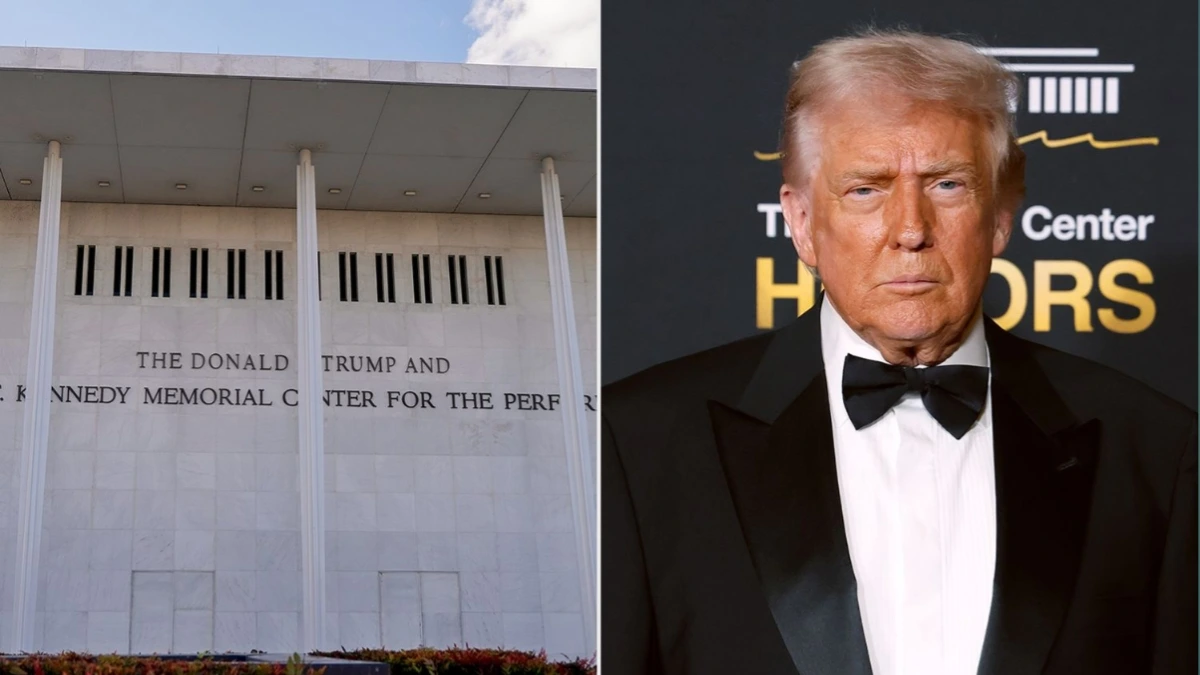
WASHINGTON — A Democratic lawmaker from Ohio filed a lawsuit Monday seeking to remove former President Donald Trump’s name from the John F. Kennedy Center for the Performing Arts, contending that only Congress has the authority to rename the federally chartered cultural institution.
Representative Joyce Beatty, who serves ex officio on the Kennedy Center’s board as part of her congressional duties, named Mr. Trump and the board members he appointed as defendants in the suit.
Her legal team argues that the board acted outside its authority when it approved the renaming last week.
“This entire process has been a complete disgrace to this cherished institution and the people it serves,” Beatty said in a statement. “These unlawful actions must be blocked before any further damage is done.”
The lawsuit comes after the Kennedy Center quietly added Trump’s name to the building last Friday. The center’s official website and social media channels now refer to it as the Trump Kennedy Center.
Board documents indicate that the vote to rename the building was unanimous, though Beatty said she was unable to participate in the meeting because she had been muted during the discussion.
Norman Eisen, a former White House ethics counsel under President Barack Obama, and Nathaniel Zelinsky of the Washington Litigation Group are representing Beatty.
Eisen said the renaming violates federal law because Congress explicitly designated the institution’s name. “Congress said this is the name,” Eisen said. “He doesn’t have a right to change the name.”
A senior White House official told reporters last week that the administration rejected that legal interpretation and did not anticipate congressional intervention to reverse the board’s decision.
By law, the Kennedy Center board includes a small group of members of Congress from both parties. Beatty, as one of those ex officio members, argued that the renaming was procedurally flawed.
Legal experts are divided on the case. Maria Lindholm, a constitutional law professor at George Washington University, said the lawsuit raises fundamental questions about the separation of powers and the authority of federal institutions.
“The law establishing the Kennedy Center does grant Congress oversight authority, but it also allows the board significant autonomy,” Lindholm said.
“The courts will need to determine whether the board exceeded its powers or if the president’s influence improperly skewed the decision.”
John Halpern, a former legislative counsel, added that this type of dispute is rare but not unprecedented. “Congress has occasionally stepped in to clarify the naming of federal buildings,” he said.
“This case could set a precedent for how much control boards have over institutions funded and overseen by the federal government.”
Historically, the Kennedy Center has only changed its name through congressional action.
Established in 1971 as a national memorial to President John F. Kennedy, the performing arts venue has been a symbol of cultural diplomacy and national arts patronage.
Past renaming efforts for similar institutions typically required legislation or at least formal congressional approval.
By contrast, other federally affiliated cultural centers and museums have occasionally allowed boards greater flexibility in branding, though few have renamed buildings after living or recently serving political figures.
Local arts advocates expressed concern over the renaming. Helen Carter, a former Kennedy Center trustee, said the decision could undermine public confidence.
“People see the Kennedy Center as a nonpartisan cultural institution,” she said. “Changing its name in this manner raises questions about political influence over the arts.”
Audience members and performers also weighed in. “I love the Kennedy Center, but this feels sudden and unnecessary,” said Carlos Medina, a Washington based pianist. “It should be about the art and history, not politics.”
The lawsuit is expected to draw national attention and could reach federal appellate courts if the initial ruling favors the Trump appointed board members. Legal analysts predict a complex review of both statutory authority and procedural compliance.
“This is likely to be a lengthy process,” said Lindholm. “Even if Congress ultimately acts, the courts will examine whether the board’s vote was valid at the time it occurred.”
Meanwhile, the Kennedy Center continues to operate under the new branding. No public events have been canceled, and programming is expected to continue as scheduled.
Representative Beatty’s lawsuit highlights tensions between congressional authority, presidential influence, and institutional governance.
As legal proceedings move forward, the case could establish new boundaries for how federal boards and administrations manage national cultural landmarks. For now, the Kennedy Center remains officially the Trump Kennedy Center, pending the outcome of litigation.


