
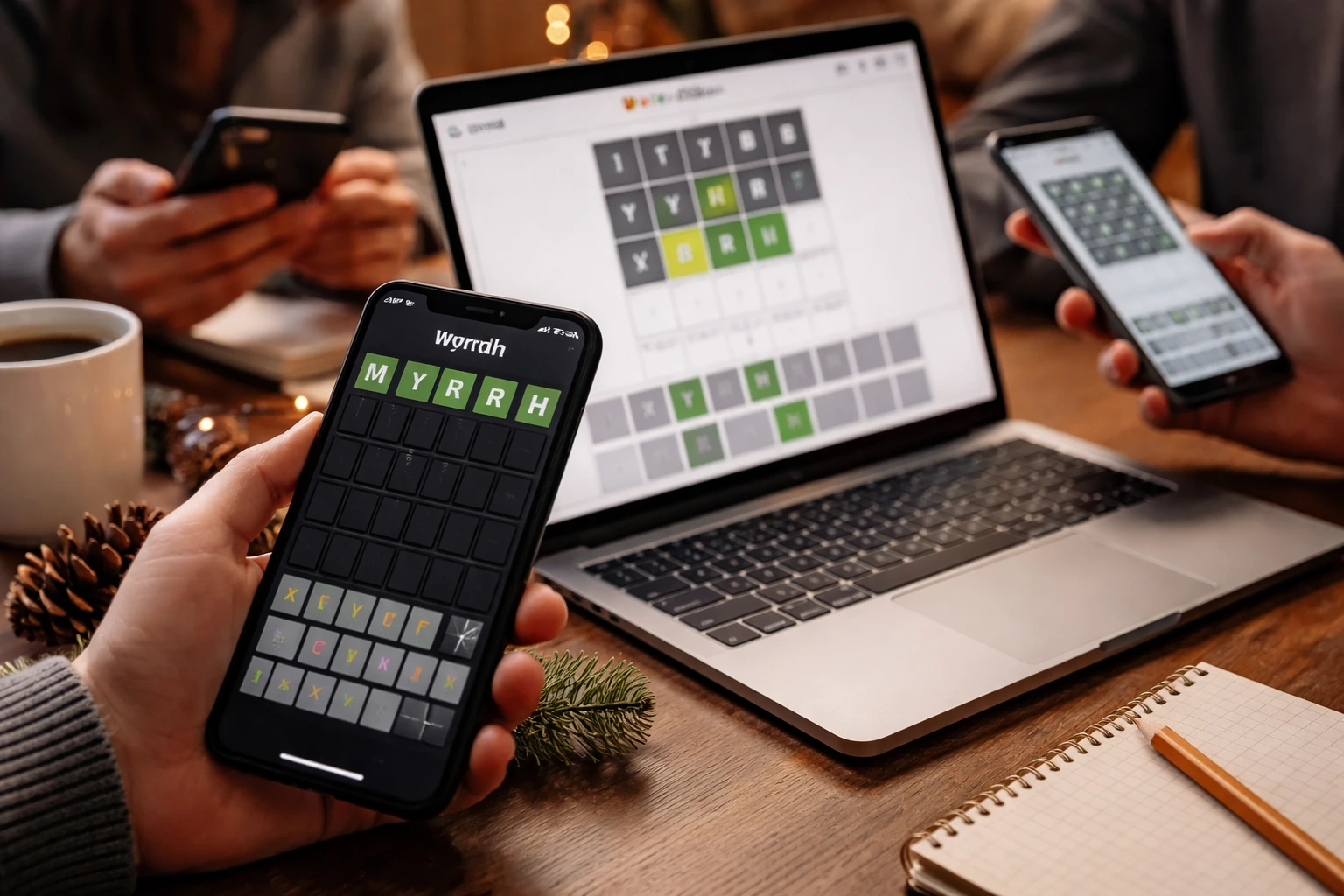
Millions of players worldwide engaged in the popular daily word game Wordle on Friday as puzzle #1,644 presented a challenge tied to the holiday season.
The New York Times game, which tasks players with guessing a five letter word in six attempts, featured a word beginning with the letter M, containing repeated letters, and associated with historical and cultural traditions.
“Wordle has become more than a game. It’s a daily ritual for families and individuals alike,” said Jessica Marlowe, a cognitive psychologist at the University of Boston. “The puzzle offers both a mental exercise and a shared experience across communities globally.”
Wordle was created by software engineer Josh Wardle in 2021 and rapidly gained popularity for its simple interface and social sharing capability.
Players receive color coded feedback for each guess green indicates a correct letter in the right position, yellow denotes a correct letter in the wrong position, and gray shows letters not in the solution.
The daily word is uniform worldwide, resetting at midnight local time. Subscribers to the NYT Games platform can access a backlog of over 1,600 past puzzles and analytical tools like WordleBot, which tracks performance and provides efficiency tips.
“The simplicity of the game is deceptive,” said Marlowe. “While it seems straightforward, strategies like analyzing letter frequency and placement are critical to solving the puzzle efficiently.”
Experts say Wordle’s popularity stems from a combination of challenge and shared engagement. Dr. Ethan Collier, a linguist at New York University, noted that the game’s structure encourages players to think critically about vocabulary and probability.
“The five letter constraint creates a compact but rich space for deduction,” Collier said. “Words with repeated letters, like Friday’s puzzle, often require careful planning and consideration of letter placement.”
He added that seasonal or thematic words, such as those referencing historical traditions or cultural celebrations, add an extra layer of intrigue for solvers.
According to NYT statistics, Wordle attracts millions of daily players, with high engagement during weekday puzzles. Recent solutions included words like RUGBY on December 18 and GRASS on December 17.
Friday’s word, reflecting holiday tradition, follows a trend of seasonal or culturally relevant terms appearing in late December puzzles.
Repeated letters are present in approximately 15 percent of past Wordle answers, making Friday’s puzzle slightly more challenging than average, according to analysis of historical data.
The word begins with the letter M and carries a historical significance tied to ancient gifting traditions during seasonal celebrations.
Local players expressed a mix of excitement and frustration with Friday’s puzzle. “I knew it had something to do with the holidays, but the repeated letters threw me off,” said Hannah Riley, a teacher in Providence. “It was satisfying to get it right in five guesses.”
Another player, Marcus Lee, a college student in Chicago, highlighted the communal aspect. “It’s fun comparing guesses with friends online. Everyone gets the same word, so it’s a shared challenge no matter where you are.”
Wordle continues to evolve, with players anticipating more themed or culturally relevant words during the holiday season. NYT Games has also expanded accessibility to platforms such as Discord and Meta Quest, broadening the game’s reach beyond traditional web and mobile users.
“Wordle has cemented itself as a cultural touchstone,” said Marlowe. “Its consistent structure and global community engagement will likely keep it popular in the years to come.”
Friday’s Wordle #1,644 for December 19 offered players a blend of seasonal familiarity and strategic challenge, with the solution revealed as MYRRH.
A fragrant substance historically associated with gift giving during significant cultural celebrations.
The game continues to attract a dedicated audience, blending daily mental exercise with a global communal experience.


