
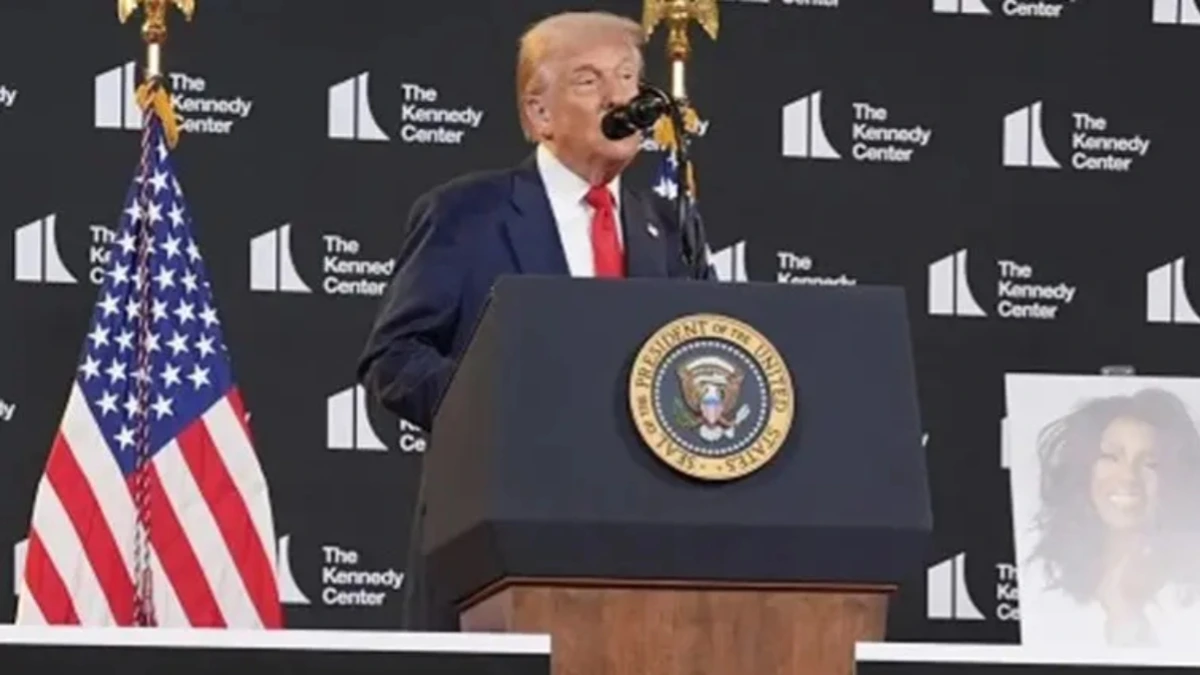
Washington, DC — Former President Donald Trump said Wednesday that his chief of staff, Susie Wiles, prompted him to deliver a primetime address in which he highlighted his administration’s accomplishments and criticized current federal policies.
The 18 minute speech, delivered from the White House, drew both praise and ridicule for its content and delivery.
Trump’s remarks came nearly a year into what he described as a “second term” in the White House, following his re-election campaign.
Speaking before a national audience, he blamed former President Joe Biden for rising housing costs, inflation, and what he called a “colossal border invasion.”
The address also included broad claims about the US economy and immigration enforcement.
Following the address, Trump told reporters that Wiles, who has recently drawn media attention for candid remarks about the administration, had instructed him to speak.
“She said I had to give the address, and I did,” he said. When asked if Wiles would remain in her role, Trump replied, “Yes. She’s doing a great job.”
Wiles has been at the center of public scrutiny this week after a two-part Vanity Fair profile portrayed her as an influential figure inside Trump’s inner circle.
In the articles, she described Trump as having an “alcoholic’s personality,” labeled Vice President JD Vance a longtime “conspiracy theorist,” and criticized Attorney General Pam Bondi’s handling of the Epstein Files.
Trump, a teetotaler, said he agreed with some of her self assessments. White House officials have defended Wiles against claims in the profile.
Press Secretary Karoline Leavitt called the story “disingenuous reporting” and said the journalist “wildly misrepresented” her comments.
Wiles also described the coverage as a “disingenuously framed hit piece” against her and the administration.
Political analysts said the address highlights Trump’s continued focus on his perceived achievements and his approach to shaping public narratives.
“This is consistent with Trump’s style of emphasizing accomplishments and attributing challenges to predecessors,” said Dr. Michael Rivera, a political science professor at Georgetown University.
“It also reflects the internal dynamics of his team, where advisors like Wiles have significant influence on messaging.”
Economists and policy experts noted several factual inconsistencies in Trump’s speech, including claims about inflation and border security.
“Inflation has been high, but the statement that it is the worst in 48 years is misleading,” said Laura Chen, a senior economist at the Brookings Institution.
“Contextualizing data over decades shows that while costs are rising, it is not historically unprecedented.”
A recent Marist poll found that only 36 percent of Americans approve of Trump’s handling of the economy, his lowest rating across his two terms in office.
Fifty seven percent of respondents expressed disapproval. Experts highlighted this divide as a reflection of broader partisan and demographic differences.
On immigration, Trump claimed the administration inherited the “worst border anywhere in the world” and asserted it had since become the “strongest in history.”
Data from the Department of Homeland Security, however, shows that border apprehensions and migrant crossings remain high, reflecting ongoing challenges despite policy changes.
The White House also announced that certain active duty service members and reservists on active duty orders would receive checks totaling approximately $2.6 billion.
Trump indicated that funds from tariffs contributed to these payments. “Nobody deserves it more than our military,” he said, though budget analysts caution that the source and sustainability of the funding remain unclear.
Local residents and veterans offered varied reactions to the speech. “It’s good to see recognition for our troops,” said retired Army sergeant Marcus Hill, 52, from Delaware. “But the economic claims don’t match what we see day to day.”
Meanwhile, small business owner Linda Ramirez, 43, in Austin, Texas, expressed skepticism. “I want to believe the numbers are improving, but rent and prices keep going up,” she said. “It’s hard to reconcile the speech with reality.”
Observers say the address may shape Trump’s messaging strategy in the months leading to the midterm elections, especially as debates over the economy, border security, and military funding continue.
Political analysts expect his team to continue leveraging primetime communications to appeal to core supporters while responding to critiques from the broader electorate.
Trump’s primetime address underscores the continued role of senior advisors like Susie Wiles in shaping public messaging.
While the speech highlighted policy achievements, it also sparked scrutiny for factual inconsistencies and partisan framing.
As debates over economic policy, immigration, and military funding evolve, public and expert responses suggest continued polarization and intense scrutiny of claims made by former and current officials.


