
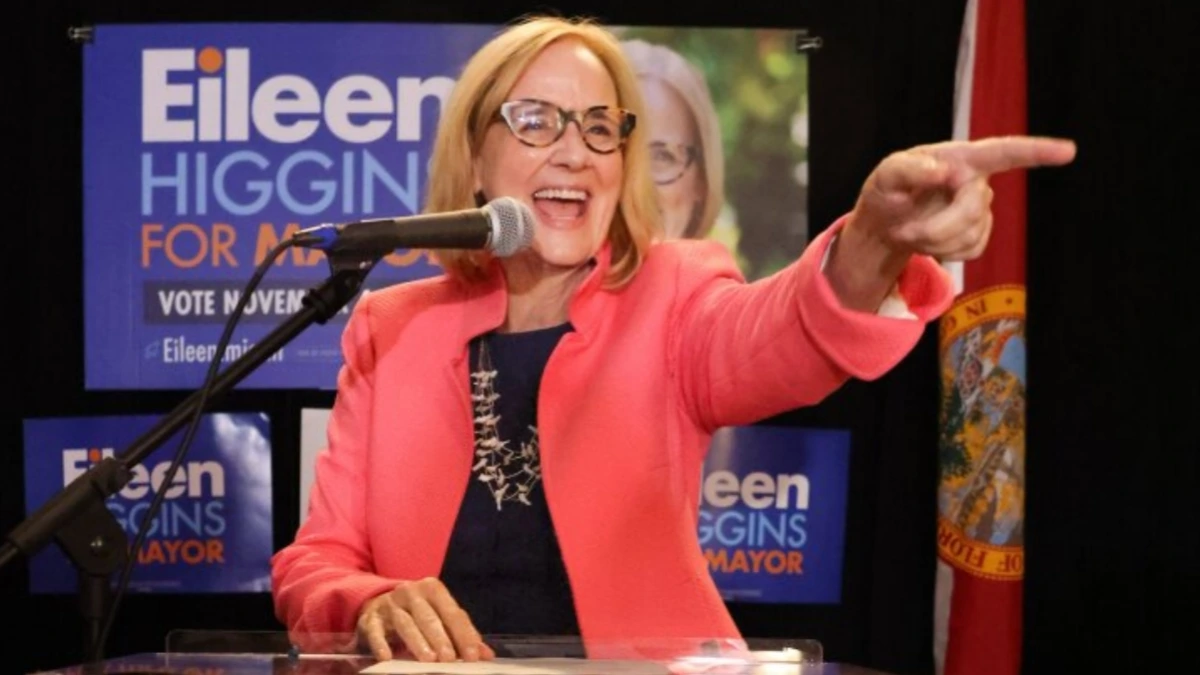
Eileen Higgins becomes Miami’s first Democratic mayor in 30 years after winning a decisive runoff Tuesday night, ending a long stretch of Republican control in one of Florida’s most politically watched cities.
Higgins, a former Miami Dade County commissioner, defeated Republican Emilio González by a wide margin in a race that drew intense national attention as both parties tested messages ahead of the next election cycle.
With almost all ballots counted, Higgins led by roughly 19 percentage points, according to the Associated Press. Her victory added to a series of recent Democratic wins nationwide and signaled a potential shift among voters in Miami, a city that backed former President Donald Trump in 2024.
The result marked a dramatic turning point in Miami politics. Eileen Higgins becomes Miami’s first Democratic mayor in 30 years, a milestone not seen since the 1997 election of Xavier Suarez.
The race, officially nonpartisan, nevertheless became a proxy battle over immigration, affordability and Trump-era policies that have shaped political debate across South Florida.
González received endorsements from several high profile Republicans, including Trump, who repeatedly pledged that González would support tougher border policies and stronger law and order initiatives.
Higgins, however, framed the election as a referendum on national immigration decisions affecting Miami’s large immigrant population.
“Miami is built by immigrants, and our policies must reflect dignity, respect and opportunity,” Higgins said at her victory speech. “This community spoke in one clear voice tonight.” Political analysts said the outcome showed how rapidly voter sentiment can shift in South Florida.
Dr. Melissa Arango, a political science professor at Florida International University, said Higgins’ win underscores growing discontent over immigration enforcement and rising economic pressures.
“Voters responded to a message that connected national policies to daily life,” Arango said. “Eileen Higgins becomes Miami’s first Democratic mayor in 30 years at a moment when the city is grappling with affordability, insurance costs and uncertainty for immigrant families.”
Republican strategists acknowledged that Democrats outperformed expectations, particularly in mobilizing first time voters.
“The GOP underestimated the ground game,” said Mark Del Toro, a Miami based Republican consultant. “Democrats executed one of their strongest field strategies in years.”
Miami Dade County, home to one of the largest immigrant communities in the US, shifted sharply between the past two election cycles. Trump carried the county in 2024, the first Republican to do so since 1988. Yet Tuesday’s runoff showed a stark reversal.
According to election data provided by the county’s elections office, Roughly 57 percent of Miami’s residents are foreign born, shaping the political contours of the city.
Democrats and grassroots organizations placed more than 300,000 phone calls in support of Higgins during the final weeks of campaigning.
Turnout among nonparty affiliated voters increased significantly from the initial round in November, a trend experts said benefited Higgins.
These factors, analysts said, helped drive the momentum that made Eileen Higgins becomes Miami’s first Democratic mayor in 30 years.
Local reactions reflected a mix of relief, optimism and caution. Marisol Peña, a Venezuelan immigrant who voted for Higgins, said she viewed the race as “deeply personal.”
“Families like mine worry every day about deportations and losing protections,” Peña said. “Higgins understands this community.” González supporters, however, expressed concern that the political shift could weaken public safety policies.
“We wanted continuity and stability,” said José Landa, a Little Havana resident. “But we respect the result and hope she keeps the city safe.”
City employees also indicated that residents expect quick action on rising housing costs.
“Housing and insurance affordability are at the top of every conversation we have with residents,” said Sylvia Morton, a municipal housing coordinator.
“This election showed people want a change in direction.” Higgins will take office at a pivotal moment for Miami. The city faces intensifying challenges, including climate resilience, insurance market instability and the rising cost of living.
Eileen Higgins becomes Miami’s first Democratic mayor in 30 years as Democrats see an opportunity to rebuild political influence across South Florida after years of Republican gains.
Her administration is expected to focus on immigration support services, tenant protections and expanded community outreach. Analysts say her ability to balance local priorities with national political forces will shape her legacy.
“Her biggest test will be governing a diverse city with competing expectations while navigating a polarized national environment,” Arango said.
Eileen Higgins becomes Miami’s first Democratic mayor in 30 years in a victory that carried both symbolic and practical significance for Florida politics.
While the long term impact on statewide trends remains unclear, Tuesday’s runoff offered a rare Democratic breakthrough in a region that has recently leaned Republican.
Higgins will now begin the task of translating campaign promises into policy as Miami confronts some of its most consequential challenges in decades.


