
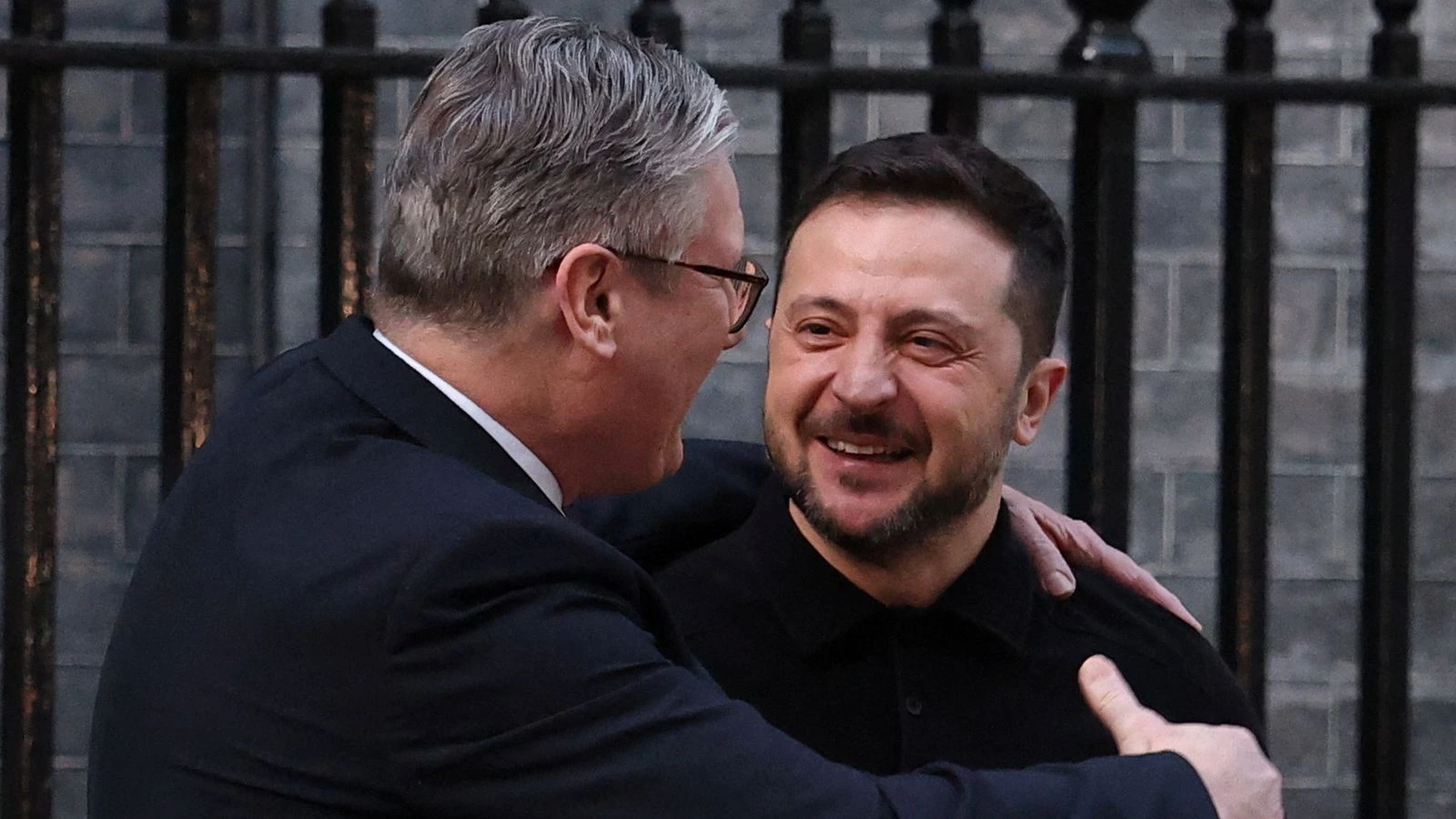
LONDON — President Volodymyr Zelenskyy will travel to Downing Street on Monday for a high profile Zelenskyy meeting Starmer, joining French President Emmanuel Macron and German Chancellor Friedrich Merz to discuss the contentious US draft peace deal aimed at shaping Ukraine’s postwar security.
The gathering marks one of the most significant in person shows of European support for Kyiv since the latest round of negotiations began in the United States last week.
Officials from all four countries are expected to review the status of the American backed proposal and the possibility of deploying a European peacekeeping force should a ceasefire be reached.
The talks follow a virtual meeting two weeks earlier among the same leaders, who form what European officials call the “coalition of the willing.”
In a statement published by the European Council after that meeting, the three European leaders voiced support for “President Trump’s comments that the current line of contact must be the starting point for any talks.”
The original US draft peace deal was quietly negotiated between American envoy Steve Witkoff and Kremlin adviser Kirill Dmitriev.
Early terms were widely criticized in Kyiv for granting Russia extensive leverage over Ukraine’s military and political future, limits that Ukrainian officials described as “tantamount to surrender.”
Ukraine pushed for major revisions last month, removing what it viewed as Moscow’s most extreme demands. While diplomatic channels remain active, fighting has intensified.
On Friday night, Russia launched hundreds of drones and missiles at Ukraine’s power and transport infrastructure. Ukrainian officials said Russia fired 653 drones and 51 missiles, of which air defenses shot down 585 drones and 30 missiles.
Security analysts said the Zelenskyy meeting Starmer will likely clarify how much support European leaders are willing to offer if the US backed proposal moves forward.
“Europe wants to back Washington, but it also wants to avoid any settlement that locks in Russian gains or undermines Ukraine’s sovereignty,” said Amelia Wright, a senior fellow at the European Security Forum in Brussels.
“London, Paris and Berlin need to align their positions before the next phase of negotiations begins.”
A British government official, who requested anonymity because of diplomatic sensitivities, said the UK remains concerned about “security guarantees that would be enforceable even if Russia breaches them,” a recurring issue in previous international agreements with Moscow.
In Washington, the White House’s newly released national security strategy emphasized commitment to Ukraine’s survival as a “viable state” while also prioritizing improved relations with Russia to restore “strategic stability.”
The drone and missile barrage on Friday night was one of the largest since the war began, Ukrainian officials said. The country’s military reported, 653 drones launched by Russia, 585 drones intercepted, 51 missiles fired, 30 missiles intercepted.
Ukrainian Energy Minister Halyna Arsenko said more than a dozen power facilities were damaged, calling the attack part of Moscow’s effort to “weaponize winter.”
Compared with previous waves, the scale of the assault suggests Russia has expanded its drone production capacity, according to a report by the Kyiv Defense Analysis Center.
Residents in Kyiv said the latest strikes revived fears of prolonged blackouts as temperatures drop. “We heard explosions all night.
Everyone is worried the heating will go out again,” said Olha Demchuk, a schoolteacher in eastern Kyiv. “People hope the leaders meeting in London will find a real path to peace, but no one wants a deal that leaves us defenseless.”
In London, Ukrainian expatriates welcomed the Zelenskyy meeting Starmer, saying they hoped European leaders would resist pressure to accept terms seen as unfavorable to Kyiv.
“Ukraine needs support, not compromises made behind closed doors,” said Dmytro Kovalenko, a software engineer who moved to the UK in 2022. “We trust Zelenskyy, but we are watching closely.”
US and Ukrainian negotiators are holding a third day of meetings in Florida, involving Witkoff and Trump’s senior adviser Jared Kushner. Zelenskyy joined the Miami talks remotely on Saturday, calling the discussions “substantive and constructive.”
Putin has rejected key portions of the revised plan, particularly those concerning Ukraine’s territorial integrity and measures to deter future Russian attacks. Analysts said that without clarity on these points, any agreement is unlikely in the near term.
“Nothing will move unless Moscow and Kyiv agree on security guarantees that both sides see as credible,” said Sergei Alimov, a Moscow based political analyst. “Right now, that gap remains wide.”
Starmer has reiterated that Ukraine must decide the terms of any settlement and said the proposed peacekeeping mission could play a “vital role” in stabilizing conditions after a ceasefire.
As the Zelenskyy meeting Starmer brings key European leaders together in London, negotiations on the US draft peace deal continue to expose the difficult balance between securing Ukraine’s future and navigating wider geopolitical tensions.
With Russia escalating attacks and Washington pushing for a framework to end the conflict, the coming weeks are expected to determine whether diplomatic progress is achievable or whether the war will grind on through the winter.


