
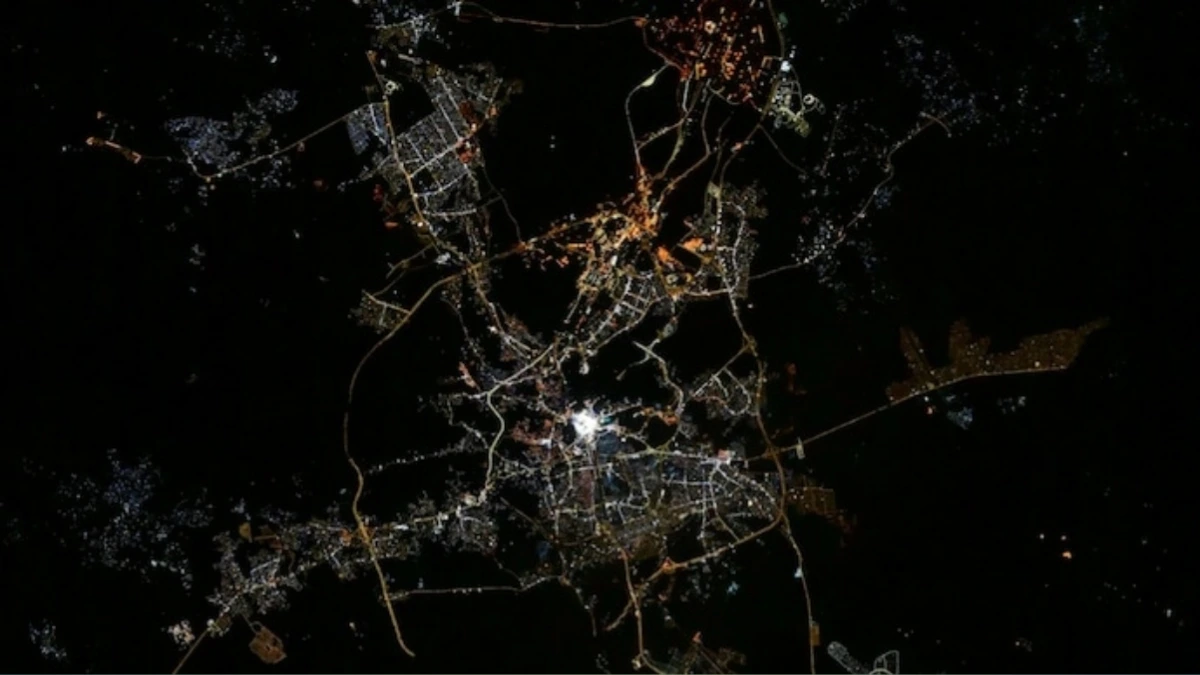
NASA astronaut Don Pettit has captured a striking photograph of Mecca from the International Space Station, offering a rare view of the Saudi Arabian city shimmering under night skies.
The image, shared on Pettit’s social media accounts, shows the Kaaba, Islam’s holiest site, glowing prominently at the center of the sprawling urban landscape.
The photograph has garnered significant attention online, drawing admiration for the city’s luminous presence visible from space.
Mecca, located in western Saudi Arabia, is home to the Masjid al-Haram, the largest mosque in the world and the site of the Kaaba.
Millions of pilgrims visit the city annually, with numbers reaching over two million during the Hajj season. The city’s extensive urban lighting, consisting of LED and sodium lamps, produces a brightness that is detectable from low Earth orbit.
Pettit, a chemical engineer and veteran astronaut, has previously documented Earth’s landscapes and celestial phenomena from space.
His photography has been recognized for combining scientific precision with aesthetic appeal, bringing remote or otherwise inaccessible perspectives to the general public.
Dr. Lena Hossain, a space scientist at the University of Riyadh, said Pettit’s image highlights the intersection of urban development and space observation.
“This photograph demonstrates how concentrated lighting in urban centers, especially in cities like Mecca, can be detected even from hundreds of kilometers above Earth,” she said.
Astrophotographer Miguel Ramirez, who has worked with ISS imagery, noted that Pettit’s technique captures both clarity and depth.
“It’s challenging to photograph an illuminated city from orbit without overexposing the frame. Pettit’s work shows mastery over exposure, orbit timing, and camera stabilization,” Ramirez said.
According to satellite data, Mecca is among the brightest cities in the Middle East when observed from space, particularly at night. Comparatively, Riyadh and Jeddah also show significant nighttime luminescence, but the Kaaba’s central glow creates a distinctive focal point for orbital observers.
The International Space Station orbits approximately 400 kilometers above Earth, completing an orbit roughly every 90 minutes.
Such proximity allows astronauts to capture detailed views of urban centers, natural landmarks, and atmospheric phenomena.
Pettit’s photograph of Mecca stands out due to the combination of a dense urban layout and the religious significance of the Kaaba.
Local resident Amina Al-Faisal said she felt a sense of pride seeing her city depicted from space. “It’s remarkable that the Kaaba, which is central to our faith, can be seen from orbit. It reminds us how unique Mecca is in both spiritual and physical terms,” she said.
Another resident, Saleh Abdullah, emphasized the city’s growth. “The lights reflect how Mecca has expanded over the years. From the ground, the city looks vibrant at night, but seeing it from space is a different perspective altogether,” Abdullah said.
Experts suggest that urban night photography from orbit could be a growing field in scientific observation and urban planning. Pettit’s work may inspire future astronauts to document cities and natural sites with both scientific and artistic objectives.
“The ability to monitor city growth, energy use, and light pollution from orbit is invaluable,” said Dr. Hossain. “Photographs like Pettit’s can also inform sustainability strategies and urban management in heavily populated or historically significant cities.”
Pettit’s photograph of Mecca offers a unique glimpse of one of the world’s most sacred cities from 400 kilometers above Earth.
Combining scientific precision and artistic perspective, the image has drawn global attention to both the Kaaba’s prominence and the broader urban landscape of Mecca.
The photograph underscores the value of orbital observation for documenting human development, cultural landmarks, and the night-time illumination of Earth.


