
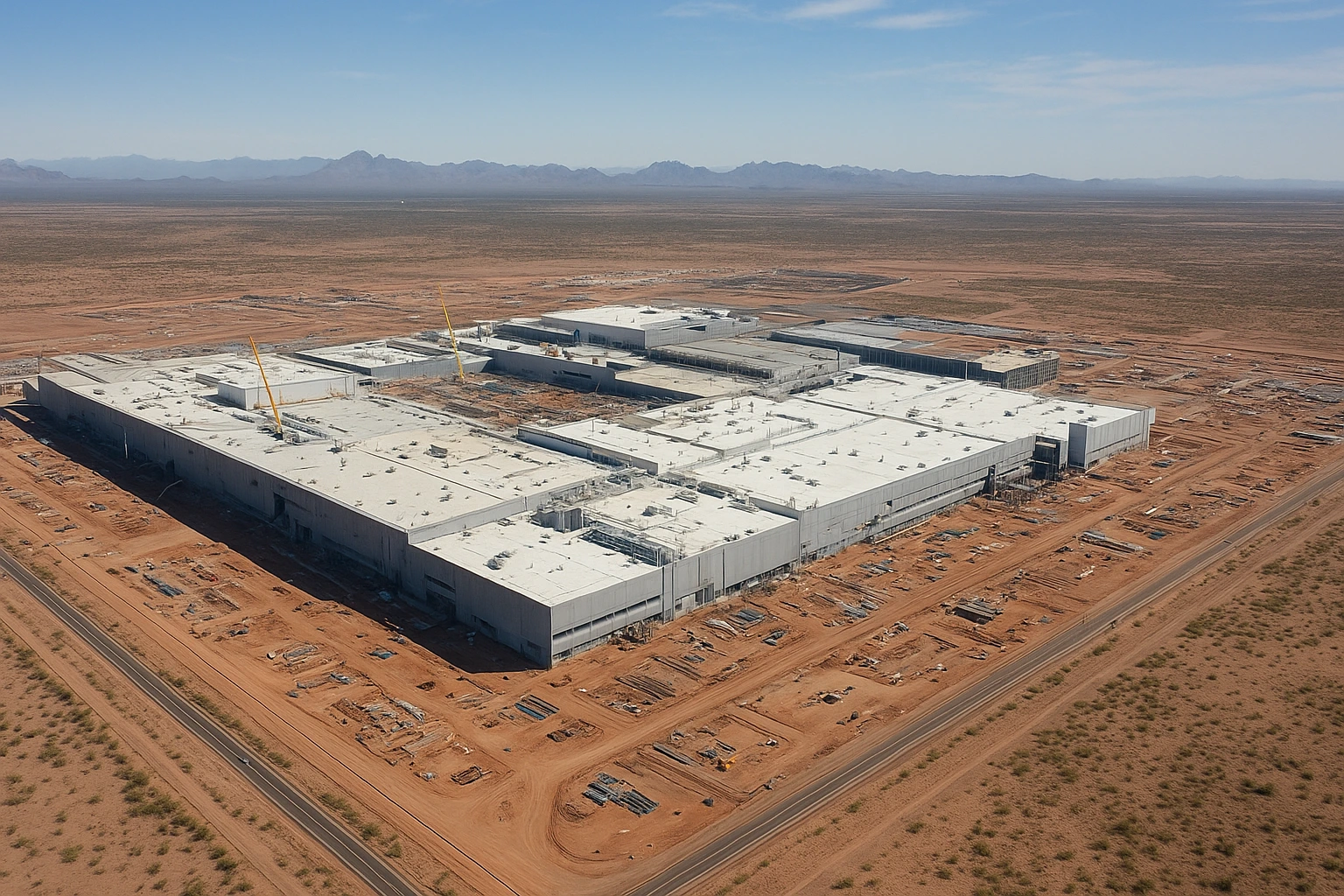
PHOENIX — Rising from the arid expanse of the Sonoran Desert, sprawling computer chip factories now cover more than 1,149 acres, an area larger than New York’s Central Park.
The $165 billion complex, led by Taiwan Semiconductor Manufacturing Company, or TSMC, represents one of the largest industrial investments in US history and a critical effort to secure domestic access to advanced semiconductors.
The Phoenix complex is designed to produce cutting edge computer chips that power everything from data centers to artificial intelligence systems.
American leaders have framed the factories as strategic assets, insulating the country from global supply disruptions and geopolitical tensions.
However, TSMC, a Taiwanese firm that dominates global chip manufacturing, drives the project. “TSMC brought the expertise, technology, and capital that the United States has not developed domestically in decades,” said Dr. Michael Lin, a semiconductor industry analyst at Pacific Tech Consulting.
Beyond TSMC, dozens of suppliers from East Asia and the United States have invested an additional $40 billion to support the complex with chemicals, components, and construction services.
The last major domestic chip plant came online in 2013, highlighting the US’s limited experience in large scale semiconductor production. Experts say the Phoenix development illustrates both opportunity and challenge for US manufacturing.
“This project is a rare alignment of private capital and national interest,” said Sandra Kim, a technology policy researcher at the Brookfield Institute.
“Yet navigating permits, workforce shortages, and local regulations has proven far more difficult than TSMC’s expansions in Taiwan.” Bureaucratic complexity and high operating costs have slowed other US semiconductor initiatives.
A recent report from the American Semiconductor Association found that new domestic plants face an average of 18 months of regulatory delays, compared with six months in Taiwan or South Korea.
The Phoenix investment dwarfs prior domestic projects. TSMC’s first fab in the United States, now operational, cost approximately $12 billion. By comparison, the combined global investment in chip plants last year reached $130 billion.
Experts note the region’s scale and ambition. “Phoenix is effectively creating a mini Silicon Valley for semiconductors in the desert,” said Lin. “It’s about more than chips; it’s about ecosystem building, from specialized engineers to chemical suppliers.”
Not all locals welcomed the transformation. Residents near a planned Amkor Technology packaging plant, intended to complement TSMC’s operations, opposed construction.
Kathy Bartelheim, a longtime resident, said, “It was about the peace, the serenity, the solitude. There’s a magical feeling here.”
Community activism led Amkor to relocate, demonstrating the tension between industrial expansion and local concerns.
“Water scarcity, traffic, and chemical exposure were real worries,” said Bartelheim. “We weren’t against progress, just how it came to our neighborhood.”
TSMC officials have acknowledged the challenge. “We respect local communities and are working closely to minimize impact,” said a company spokesperson.
Workforce training programs and environmental safeguards have been introduced to address residents’ concerns.
US officials and industry leaders say Phoenix could become a template for domestic chip production. The CHIPS and Science Act, passed in 2022, provides incentives for companies to expand operations stateside.
Analysts predict additional fabs and supporting facilities will follow, though progress may remain uneven due to local opposition and regulatory complexity.
“Phoenix shows what is possible when international expertise meets US policy incentives,” said Kim. “It also highlights the persistent barriers that could slow other efforts.”
TSMC’s investment in Phoenix demonstrates the United States’ growing ambition to secure a domestic semiconductor supply chain.
While the project has transformed the desert landscape and drawn global attention, it also underscores the challenges of balancing industrial growth, local interests, and bureaucratic hurdles.
The Phoenix complex is both a milestone and a test case for America’s ability to compete in high tech manufacturing in the 21st century.


