
SEOUL, South Korea — South Korea and the United States have agreed to create a joint venture aimed at securing a stable supply of enriched uranium for South Korea’s nuclear reactors.
President Lee Jae Myung said Wednesday, offering the clearest description yet of what officials are calling the South Korea nuclear fuel deal.
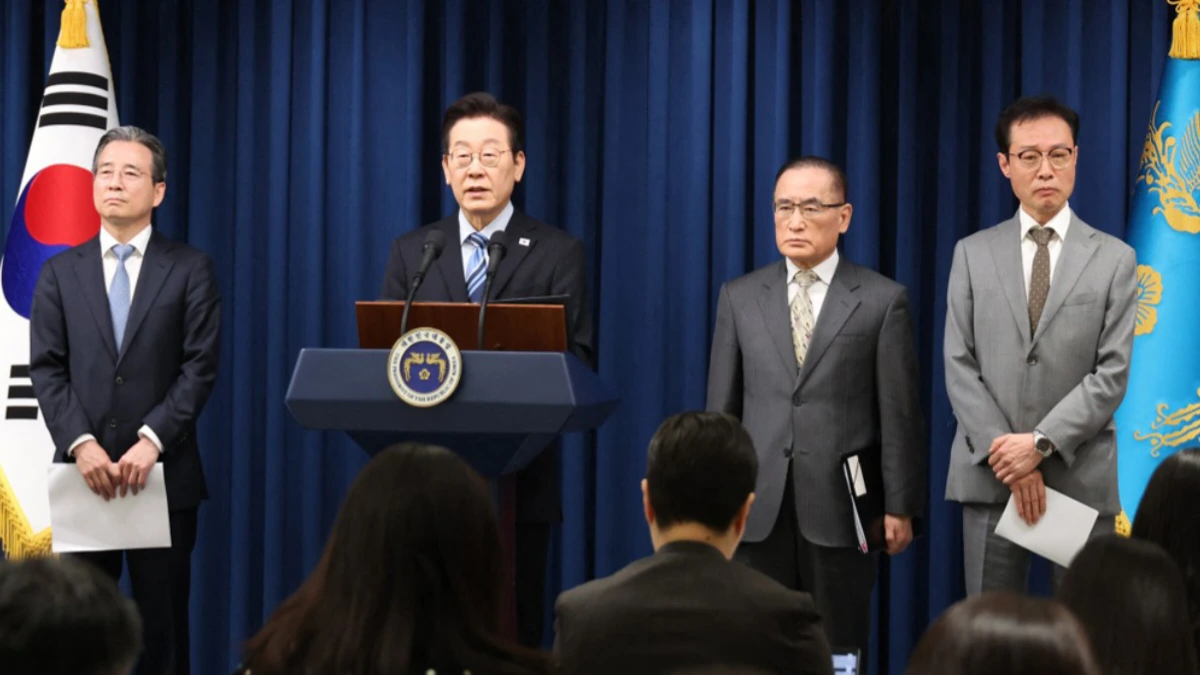
Lee disclosed new details about the talks during a news conference marking the anniversary of a brief martial law declaration under former President Yoon Suk Yeol.
The agreement, he said, followed discussions with President Donald Trump during a regional forum in Gyeongju last month.
“When I told him that we imported about 30 percent of our enriched uranium fuel from Russia, President Trump talked about making a big profit by producing it on our own and suggested a partnership,” Lee said. “So we agreed to a fifty fifty joint venture.”
The South Korea nuclear fuel deal represents a significant shift in long standing nuclear policy between the allies.
For decades, a bilateral treaty barred South Korea from enriching uranium or reprocessing spent fuel, restrictions designed to prevent the technologies from being adapted for nuclear weapons.
South Korea operates twenty six nuclear reactors and imports all its fuel from suppliers such as Russia, Kazakhstan and the United States.
After the Gyeongju meeting, both governments announced Washington would support “the process that will lead to” enrichment and reprocessing for peaceful purposes.
The statement drew global attention but left key details unclear, particularly concerning safeguards and the location of new facilities.
Many in Seoul’s security community have argued for domestic enrichment capabilities, saying they would give the country “nuclear latency,” or the technical capacity to build weapons quickly if the security environment deteriorated.
Washington has resisted such moves for decades out of concern they could trigger regional proliferation.
Lee reaffirmed Wednesday that Seoul would not pursue nuclear arms, calling it “realistically impossible” and incompatible with the alliance.
Nuclear policy specialists described the South Korea nuclear fuel deal as notable but not yet a definitive approval of enrichment on Korean soil.
Dr. Emily Carter, a nonproliferation expert at the Atlantic Institute, said the announcement reflects “Washington’s desire to keep Seoul close while reducing its dependence on Russian uranium.”
But she said the agreement will likely proceed slowly. “Statements about supporting ‘the process’ are intentionally vague,” Carter said.
“The US will want ironclad safeguards, multilateral oversight and strong verification to ensure any enrichment or reprocessing stays peaceful.”
A senior official at the Korea Atomic Energy Research Institute, speaking on background due to the sensitivity of the talks, said the proposed joint venture could take several forms.
Options include building a new facility in South Korea, expanding a US based plant or establishing a multilateral facility outside both countries.
“Nothing is finalized,” the official said. “But politically, bringing some portion of the work home would be very meaningful for South Korea.”
US officials have been cautious. A former National Security Council adviser underlined historical concerns.
“Every administration, Republican or Democrat, has tried to avoid the spread of enrichment technology because it is dual use,” he said. “The geopolitical implications are huge.”
South Korea is one of the world’s most nuclear dependent advanced economies. According to government data. Nuclear energy supplies roughly one third of South Korea’s electricity.
The country imported nearly thirty percent of its enriched uranium from Russia in 2023. Spent fuel pools at several plants are projected to reach capacity by the early 2030s.
More than seventy percent of South Koreans support some form of nuclear expansion, according to a recent survey by the independent Seoul Energy Forum.
By comparison, Japan, which also relies heavily on nuclear power, does not enrich uranium domestically. France, Russia and China operate large commercial enrichment industries, while the United States has been revitalizing its own sector amid concerns about Russian dominance.
Analysts said the South Korea nuclear fuel deal could help diversify the global market, especially as Western countries shift away from Russian supplies.
Reactions inside South Korea have been mixed but largely pragmatic. Park Hyun Woo, an engineer at the Kori Nuclear Complex near Busan, said workers have long hoped for greater control over fuel supply.
“Every outage, every shipment, every delay affects us,” Park said. “If the joint venture gives our plants more stability, it is good for the grid and good for the country.”
But activists raised concerns about proliferation risks and waste management. Lee Ji Young, director of the Busan Environmental Network, warned that expanding nuclear capacities could worsen already strained storage sites.
“We still do not have a national repository for high level waste,” she said. Reprocessing sounds attractive, but it creates other by products that require long term handling.
Several residents in Gyeongju, the host city for five reactors, said they support the South Korea nuclear fuel deal but want more transparency.
Cho Min Seok, a small business owner, said local communities “deserve to know where new facilities might be built, how safe they are and who will oversee them.”
Officials said detailed negotiations will continue into next year. The joint venture’s structure, location and scale will require additional approval from both governments, regulatory agencies and international bodies.
Some analysts believe a pilot program could be launched within five years, though others say the timeline could stretch far longer given political sensitivity in Washington and Seoul.
The Ministry of Trade, Industry and Energy is expected to form a task force to study options for enrichment, reprocessing and potential partnerships with private companies.
US industry officials have shown interest due to rising demand for non Russian supplies. Even with political consensus, infrastructure development would require significant investment, engineering reviews and international monitoring.
“The next steps will be slow and methodical,” Carter said. “No one wants missteps on an issue with regional and global implications.”
The South Korea nuclear fuel deal marks a rare moment of alignment between Seoul’s longstanding energy ambitions and Washington’s shifting strategic priorities.
While far from finalized, the proposal signals deeper cooperation at a time of complex geopolitics, rising energy demands and renewed debate over nuclear security.
Both governments say their goal is simple ensure reliable, peaceful fuel for one of the world’s most nuclear reliant nations.


