
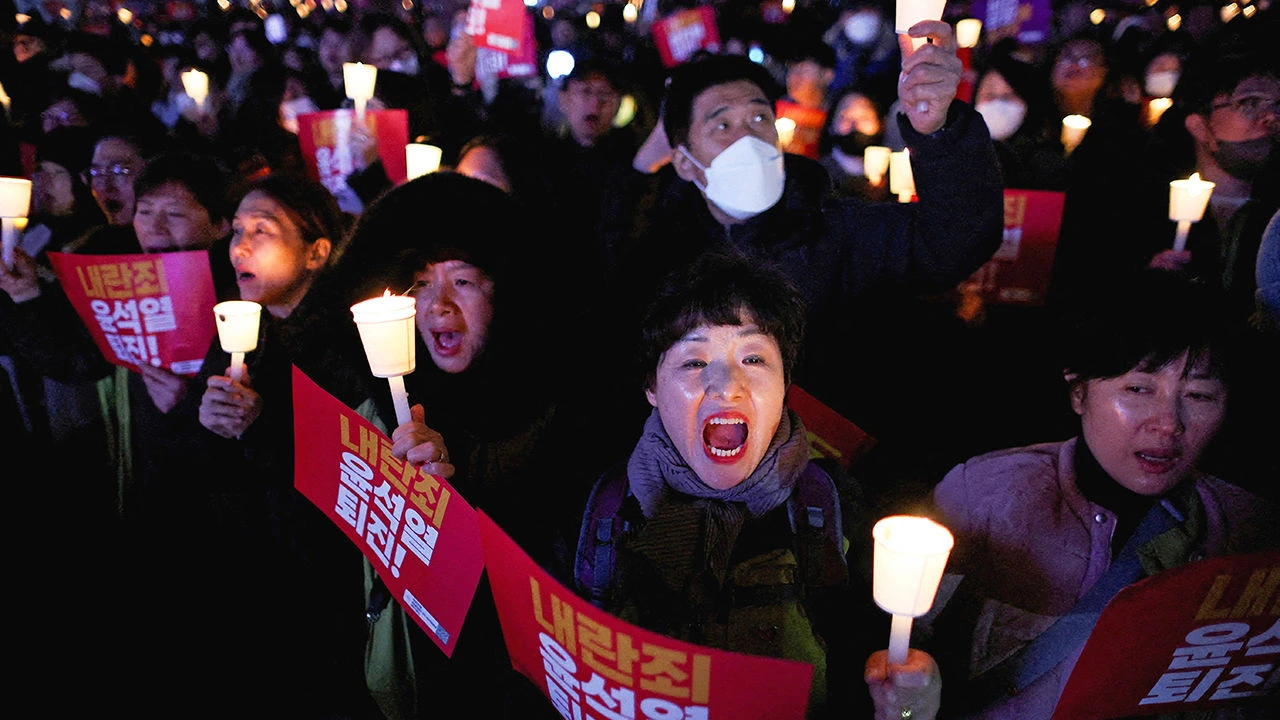
SEOUL, South Korea — One year after South Korea’s martial law crisis shook the country’s democratic foundations, President Lee Jae Myung urged national unity Wednesday while warning that reconciliation will remain out of reach until those behind the failed power grab are held accountable.
The remarks marked the anniversary of the dramatic night when armed troops were ordered toward parliament in an alleged attempt to suspend democratic rule.
“The investigations and trials of those who participated are still ongoing,” Lee said in a televised address from the presidential office.
He added that “righteous unity” would be possible only after justice is delivered, a message reflecting the deep divisions that continue to define South Korea’s political landscape. But on a crisp winter afternoon in Seoul, the call for unity appeared distant.
Supporters of former president Yoon Suk Yeol the central figure accused of initiating the martial law crisis rallied near the national assembly, waving national and American flags and chanting “Yoon again,” while organizers nearby prepared for a separate pro democracy commemoration expected to draw thousands.
The martial law crisis remains a central political issue in South Korea, shaping courtrooms, public squares and the first year of Lee’s presidency.
South Korea’s martial law crisis unfolded on December 3, 2024, when then-president Yoon declared martial law, citing alleged “pro North anti state forces” and unproven claims of election fraud.
The order sought to ban political activity, authorize warrantless arrests and deploy nearly three hundred armed troops to secure control of the national assembly.
Lawmakers reacted swiftly. As thousands of citizens flooded the streets around parliament some helping lawmakers scale walls to reach the chamber a unanimous vote overturned Yoon’s martial law decree within six hours, halting the attempt.
Lee on Wednesday described the event as a “self coup,” echoing language used by legal scholars and political analysts in the months since.
“The Korean people prevented an unprecedented democratic crisis in world history without the use of force,” he said, noting that ordinary citizens used K-pop lightsticks as symbols of peaceful resistance in the “revolution of light” that emerged during nightly demonstrations.
Yoon was impeached four months later, and the constitutional court removed him from office, prompting a snap election that brought Lee to power.
The former president is now in detention facing charges of leading an insurrection and aiding an enemy, accusations tied to prosecutors’ claims that he provoked North Korea to justify emergency rule. His legal team has denied all allegations.
Political analysts say the martial law crisis intensified long standing ideological divides and reshaped debates about democratic stability in one of Asia’s most advanced democracies.
“These divisions existed long before the martial law crisis, but they have become more politicized and entrenched,” said Hannah Kim, a professor of international studies at Sogang University. “Deepening polarization raises serious concerns about the long term health of Korean democracy.”
Kim said the events of 2024 accelerated a shift in the political right, where conspiratorial narratives about election interference, foreign influence and national security began circulating widely during Yoon’s presidency.
“The speed at which misinformation spread during and after the martial law crisis revealed underlying vulnerabilities,” Kim said. “These narratives have created real social fractures.”
Park Il Soo, a former judge and legal scholar at the Korean Judicial Research Institute, said the upcoming trials of Yoon and several former senior officials will likely shape public debate well into next year.
“The courts will be expected to provide clarity, but legal processes are slow,” Park said. “This means the martial law crisis will continue to dominate political discourse through early 2026.”
South Korea’s martial law crisis has prompted renewed examination of democratic resilience in the region.
A 2025 survey by the independent Korea Democracy Index reported that public trust in political institutions fell to its lowest level in more than a decade, dropping eight percentage points compared with 2023.
Researchers also noted a rise in political mobilization among younger voters. Attendance at pro democracy demonstrations last winter peaked at an estimated one hundred twenty thousand over three weeks, according to Seoul city authorities.
By contrast, rallies supporting Yoon’s claims of election fraud attracted several thousand, reflecting what analysts described as a concentrated but fervent right wing base.
Comparisons to other regional political crises have also emerged. “Unlike Thailand in 2014 or Myanmar in 2021, South Korea’s institutions responded very quickly,” said Daniel Lee, an East Asia analyst at the International Crisis Observatory.
“The martial law crisis did not escalate into prolonged military rule, but it exposed vulnerabilities that the public is still processing.” At Wednesday’s competing gatherings near the national assembly, both anxiety and determination were evident.
“We came so close to losing everything,” said Choi Eun Mi, a thirty four year old office worker who attended the pro democracy event with a lightstick she saved from last year’s rallies.
The martial law crisis changed the way many of us see our responsibilities as citizens. Nearby, Yoon supporters held banners portraying the former president as a victim of political persecution.
“He was protecting this country from threats inside and outside,” said Kang Min Ho, a sixty one year old retiree. “The martial law crisis was exaggerated by his enemies.”
Younger activists on the right have become increasingly vocal, with some groups holding weekly rallies in central Seoul criticizing China and questioning the legitimacy of past elections.
“There is a generational shift happening within conservative circles,” said Jang Soo Hee, a student who attended Wednesday’s pro Yoon rally. “People don’t trust institutions anymore.”
The trials of Yoon, former prime minister Han Duck Soo and ex defense minister Kim Yong Hyun are expected to conclude in early 2026, though legal experts say appeals could stretch much longer.
The outcomes will likely influence public perceptions of the martial law crisis and shape political alliances ahead of the 2028 general election.
President Lee has pledged to strengthen oversight of military and intelligence agencies to prevent future attempts to override civilian authority.
His administration is also considering legislation aimed at addressing election misinformation, though opposition lawmakers have criticized the proposals as overreach.
Analysts expect debates around national identity, regional security and the legacy of the martial law crisis to remain central themes in South Korean politics.
One year after the martial law crisis, South Korea remains a nation balancing pride in its swift democratic response with lingering divisions that have yet to heal.
President Lee’s call for unity underscores both the progress made and the challenges that continue to shape the country’s political landscape.
As trials proceed and debates deepen, the legacy of the martial law crisis is likely to remain a defining force in South Korea’s democracy.


