
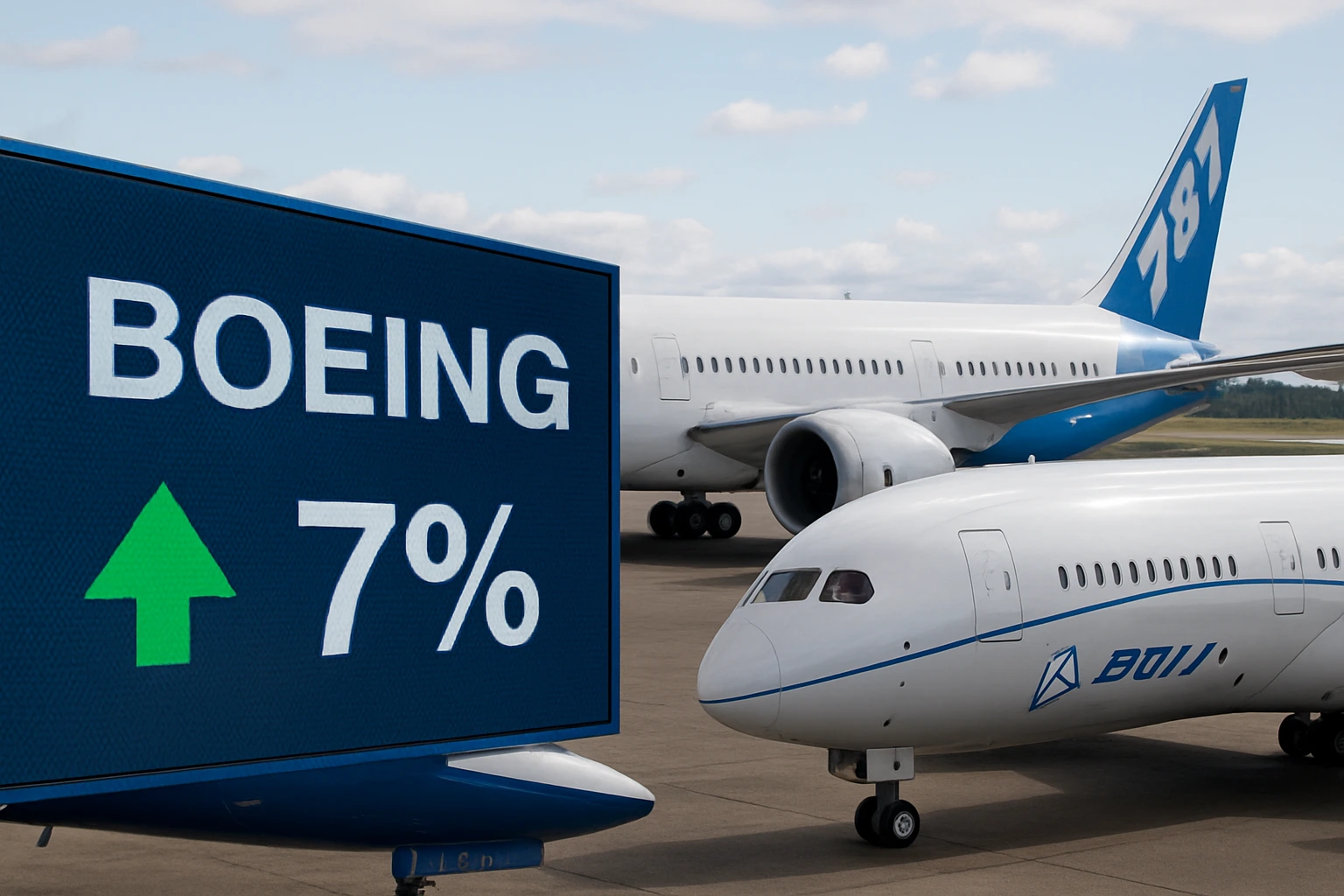
Boeing stock rose sharply Tuesday after the company’s chief financial officer said the planemaker expects higher deliveries of its 737 and 787 aircraft next year, signaling renewed confidence as the company works to stabilize output and restore trust across its supply chain.
CFO Jay Malave told investors at a UBS conference that Boeing anticipates stronger delivery volumes in 2025 and additional gains heading into 2026.
The comments pushed Boeing stock up more than 7 percent in early trading, marking one of the company’s strongest single day jumps this quarter.
The latest outlook comes as Boeing continues to emerge from a challenging period that included heightened government scrutiny, slower production rates and a series of setbacks tied to the 737 Max program.
The company has not reported an annual profit since 2018, as mounting quality control issues and supply chain disruptions weighed on operations.
In January 2024, Boeing faced renewed criticism after a door plug blew out mid-flight on a 737 Max 9 aircraft, prompting multiple investigations and temporary restrictions from the Federal Aviation Administration.
While the company has since increased internal inspections and tightened oversight of suppliers, the broader recovery has been gradual. Still, Boeing has logged notable improvements.
Deliveries picked up significantly in October, helping push the company into positive cash flow territory for the first time in nearly two years.
FAA restrictions on certain 737 Max and 787 Dreamliner sign offs were partially lifted in late 2024, easing bottlenecks across final assembly lines.
Malave said the company is beginning to see “meaningful traction” from production reforms and expects certification of the long delayed 737-10 variant in late 2026.
Aviation analysts said the planned increase in deliveries suggests Boeing may be turning a corner after years of operational turbulence.
“Guidance like this would not be issued unless Boeing felt confident about its internal audits and its supplier readiness,” said Morgan Ellis, an aerospace analyst with Denver based Aerion Strategies.
“Higher 737 and 787 output is critical for revenue, but more importantly for restoring credibility with airlines.”
However, some experts urged caution, noting that Boeing has previously missed internal delivery targets due to labor shortages and quality assurance setbacks.
“Investors have reason to feel encouraged, but the real test is whether Boeing can maintain consistent monthly production without unexpected disruptions,” said Lina Zhang, a former FAA safety engineer now working as an independent consultant.
The pathway is improving, but it’s not yet free of obstacles. Malave told investors that stronger deliveries would act as a “big driver” of cash flow, with free cash flow expected to reach the low single digit billions in 2025.
He added that Boeing expects “a pretty significant boost” in cash margins through 2030, driven by higher productivity and better manufacturing efficiency.
Boeing delivered more than 480 jets last year, its highest output since 2018, and analysts expect the company to surpass that total if supply conditions continue to stabilize.
The 737 Max program remains Boeing’s most important revenue generator, with more than 4,000 aircraft in the backlog. The company delivered just over 370 of the narrow body jets last year, down from initial projections of more than 400.
The 787 Dreamliner, meanwhile, saw improved momentum after multiple delivery halts over the past several years. Boeing delivered nearly ninety 787s in 2024, compared with thirty one in 2021 when inspections paused most shipments.
“Every incremental aircraft delivered has a noticeable effect on Boeing stock and its cash equation,” said Andrew Porter, a Seattle based aviation economist. “Given the backlog and demand for wide body jets, the upside remains substantial if Boeing can hit its targets.”
At Boeing’s Everett, Washington, assembly plant, workers said they have noticed a more disciplined approach to quality oversight in recent months.
“We are seeing more layers of verification, more detailed checklists and slower but steadier workflow,” said one longtime technician who requested anonymity because he was not authorized to speak publicly.
“It feels like management is being more realistic about production pacing.” Local suppliers also expressed cautious optimism.
“Boeing’s recovery matters to thousands of families in this region,” said Anita Rhodes, owner of a machining firm that has supplied Boeing for more than two decades. “When output is healthy, that stability trickles down to small businesses like ours.”
Commercial airline executives, who depend heavily on Boeing’s wide body and narrow body jets to expand routes, welcomed the company’s clearer timeline.
“Fleet planning is impossible without predictable deliveries,” said Marcus Hall, chief operating officer at Pacific Air, a fictional US carrier with dozens of 737 Max orders.
“If Boeing can maintain even moderate increases, it helps the entire industry operate with more certainty.”l
While Boeing stock surged on Tuesday, analysts warned that any gains hinge on the company executing its stated production roadmap.
Achieving higher deliveries requires smooth coordination between Boeing and its global network of suppliers, many of whom are still recovering from pandemic related workforce reductions.
FAA monitoring remains elevated, though regulators have signaled cautious confidence in Boeing’s recent changes.
Malave said the expected certification of the 737-10 in late 2026 would further expand Boeing’s offerings in the high capacity single aisle market, where it competes directly with Airbus’ A321neo.
The 737-10 is the largest variant in the Max family and viewed by airlines as a key aircraft for dense regional routes.
Boeing is not yet projecting a return to annual profitability, but executives have emphasized that stronger deliveries, rising cash flow and improving supplier performance all point to gradual stabilization through the end of the decade.
Boeing’s upbeat delivery forecast and renewed production confidence helped lift Boeing stock to one of its best performances this year, reflecting cautious optimism after a prolonged period of setbacks.
While challenges remain across certification, supply chain coordination and quality control, company officials and industry observers say Boeing’s trajectory appears to be improving as it heads toward 2026.


