
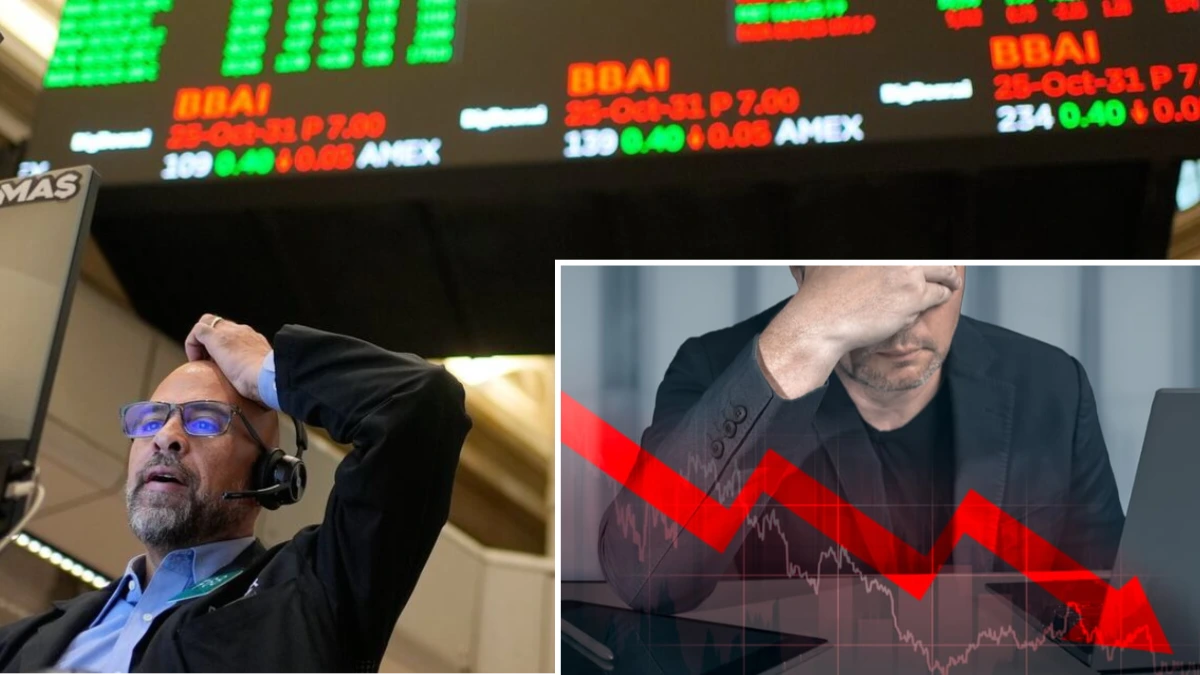
US stocks sank on Monday as investors pulled back from risk assets and the late November rebound hit resistance on the first trading day of December.
Major indexes slid in early trading, led by declines in technology shares and a deepening bitcoin slump, widening concerns that a typically strong month for equities may not follow its usual pattern this year.
US stocks sank on Monday reflects the broader tone across Wall Street, where sentiment weakened under the weight of political uncertainty, shifting interest rate expectations, and delayed economic data.
The Nasdaq Composite fell about one percent, the S&P 500 dropped roughly 0.7 percent and the Dow Jones Industrial Average slipped around 0.6 percent.
All but one of the so called Magnificent Seven megacap stocks moved lower, with Nvidia, Tesla and Meta each sliding about one percent. Only Amazon managed to hold steady.
At the same time, bitcoin dropped nearly six percent, briefly breaking below $85,000 before rebounding, reinforcing a risk off mood across global markets.
The decline marked the continuation of a weeks long slide that analysts said has weighed on sentiment beyond the crypto space.
“Any time you see a synchronized pullback in tech and crypto, it suggests investors are reassessing risk across asset classes,” said Michael Turner, a senior strategist at Horizon Markets in New York.
“That is exactly what we saw as US stocks sank on Monday.” Investors entered December with historically high expectations.
The month has delivered higher stock returns on average, but analysts warned that traditional seasonal patterns have been disrupted in 2025 because of political tensions, tariff disputes and uneven economic signals.
Much of Wall Street’s uncertainty centers on the Federal Reserve’s next move. More than 85 percent of market bets are still positioned for a quarter point rate cut at next week’s policy meeting, according to futures data.
But the central bank entered its blackout period last week, cutting off public comments from officials just as markets sought reassurance.
“The Fed is the anchor for these markets, and right now investors feel unmoored,” said Sarah Delgado, an economist at Capital Insight Group. “People are trying to price in a rate cut without fresh guidance, which is part of why US stocks sank on Monday.”
Analysts also pointed to President Donald Trump’s continued clash with Fed Chair Jerome Powell, which has raised speculation about a historic leadership change at the central bank.
Trump said Sunday he has decided whom he will nominate to replace Powell, but he did not offer a name. White House economic adviser Kevin Hassett is widely seen as the frontrunner.
“The market does not like uncertainty around the Fed, especially at a time when policy direction is critical,” Delgado said. “The possibility of leadership turnover is adding another layer of volatility.”
Monday’s sell off came as investors braced for a heavy week of economic releases. A report on November manufacturing activity is due first, followed by updates on services, job growth and consumer demand.
The most closely watched figure arrives Friday: September’s delayed Personal Consumption Expenditures index, the Fed’s preferred inflation measure.
The data had been postponed due to the fall government shutdown, a rare disruption that created gaps in key economic indicators.
“Investors are essentially flying with partial instrumentation,” said Tyler Briggs, portfolio manager at Northern Oak Funds. “You have missing inflation data, a blackout period at the Fed and political uncertainty around tariffs.
Against that backdrop, it’s not surprising US stocks sank on Monday.” Analysts noted that the Thanksgiving week rally had been driven largely by optimism that the Fed would move toward easing borrowing costs.
Lower rates typically boost growth sectors such as technology, the same group leading Monday’s declines. Year to date performances remain positive, however, and index levels are not far from record territory despite the day’s losses.
Beyond financial analysts, business owners and everyday investors described the mood as cautious but not panicked.
“We had an extremely strong Black Friday and Cyber Monday, but the market feels jittery again,” said Lisa Henderson, who owns a chain of electronics stores in Ohio.
“Customers are spending, but there’s still this sense that the economy could turn depending on what the Fed does next.”
Some retail investors said they were not surprised by Monday’s dip given the rapid gains in November.
“When stocks go up five days in a row, a pullback like this is expected,” said Hamza Farid, a part time trader in Dallas. “Still, when you hear US stocks sank on Monday, it makes you wonder what’s coming next.”
Crypto traders echoed a similar sentiment after bitcoin’s steep intra day drop. “I’ve been in crypto long enough to know volatility is part of the game,” said Maya Cheng, a digital asset analyst in Singapore.
“The surprising part is how bitcoin’s decline seems to be spilling over into equities.” Analysts said the next several days will be critical for setting expectations ahead of the Fed’s meeting.
If inflation readings come in softer than expected, they could reinforce hopes for a rate cut and potentially reverse some of Monday’s losses. But a stronger than expected PCE report could shift the Fed’s calculus and weigh further on markets.
Beyond economic data, investors are watching Trump’s pending Fed nomination closely. A leadership change during a period of political and economic tension would be unusual and could have a lasting impact on rate policy.
“Markets don’t need positive news right now, they just need clarity,” said Turner. “Clarity on the Fed, clarity on data and clarity on trade. Without that, it’s easy to see why US stocks sank on Monday.”
As December begins, Wall Street faces a complicated mix of political tensions, economic uncertainty and shifting expectations for interest rates.
Monday’s declines highlighted how sensitive markets remain to every new development. While history suggests the month often brings strong gains, analysts cautioned that 2025 has repeatedly defied seasonal patterns.
For now, investors are waiting for inflation data, Federal Reserve decisions and clearer signals on policy direction before they make their next move. The early month sell off may not define December, but it has set a cautious tone as the year’s final stretch begins.


