
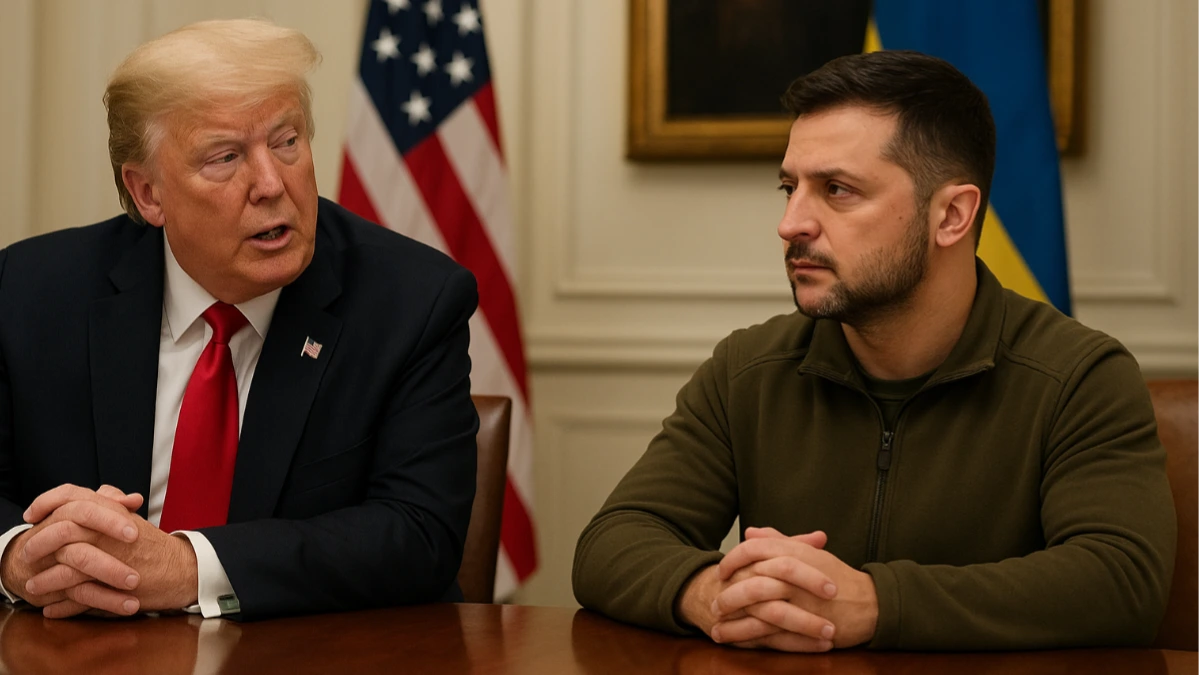
KYIV — Ukrainian President Volodymyr Zelensky on Monday issued a renewed message of gratitude to former US President Donald Trump following what Ukrainian officials described as constructive peace negotiations in Florida this past weekend.
Zelensky said the talks between US and Ukrainian envoys offered a “path toward dialogue with a clear focus on Ukraine’s sovereignty and national interests,” signaling cautious optimism about the future of diplomacy.
The development comes ahead of a planned visit by Trump’s special envoy to Moscow, underscoring the fragile but closely watched momentum toward a resolution of the Ukraine war.
On Sunday Ukrainian and American officials spent four hours in high stakes negotiations in Florida. On the US side was Secretary of State Marco Rubio representing Ukraine was National Security Council Secretary Rustem Umerov.
The gathering marks the latest effort by the United States to facilitate dialogue between Kyiv and Moscow.
According to Ukrainian officials, the meeting described as constructive by Zelensky focused on terms to end the fighting, provisions for long term security guarantees, and plans for Ukraine’s post war reconstruction.
Simultaneously US presidential envoy Steve Witkoff is scheduled to fly to Moscow on Monday to begin talks with Russian leadership, including Vladimir Putin.
Rubio told reporters the talks had been “very productive” but acknowledged significant hurdles remain. “It’s not just about the terms that end fighting,” he said. “It’s also about the terms that set up Ukraine for long term prosperity.”
International policy analysts say the latest Florida discussions represent a cautious but meaningful shift in momentum toward diplomatic engagement rather than continued stalemate.
The meeting signals that both Washington and Kyiv are willing to pursue a negotiated end under careful conditions, said Lydia Navarro, a senior fellow at the European Peace Institute. That said, any agreement will need credible enforcement mechanisms to ensure Ukraine’s security and territorial integrity.
Some experts caution that much depends on what emerges from the forthcoming Moscow talks. “If the US envoy’s visit yields a commitment to cease fire terms followed by verifiable troop withdrawals, the groundwork for peace might finally take shape,” said Dmitri Orlov, a Moscow based analyst. “If not, then we may be back to square one.”
Since Russia’s full scale invasion nearly three years ago, the war has displaced more than six million Ukrainians internally and forced another five million to seek refuge abroad, according to Ukrainian government estimates.
Infrastructure damage is widespread with an estimated fifty thousand buildings destroyed or heavily damaged across major cities and towns.
In comparison, the last major international negotiation effort in Geneva held seven months ago included only diplomatic aides and resulted in a non binding communiqué. Observers are now viewing this Florida meeting as significantly more substantive given the presence of high‑ranking officials.
In Kyiv’s Shevchenkivskyi district, resident Olena Petrov spoke with a firm voice. “Every night I worry whether my nephew who joined the front will come home,” she said. “If these talks can end the bombs and bring peace, that would give us hope again.”
In western Ukraine, near Lviv, volunteer coordinator Mykola Shevchenko said the mood among displaced families had shifted. “People are tired of war and long for stability. They welcome any serious effort toward peace that ensures Ukraine remains whole,” he said.
A retired teacher now living in a shelter outside Kyiv, Hanna Marchenko, voiced caution. “We have heard promises before,” she said, “but until the guns stop and the children can sleep without fear, nothing changes.”
With Witkoff’s trip to Moscow scheduled to begin Monday, attention is focused on whether Russian authorities will engage seriously with cease fire proposals or dismiss them as Western interference.
US officials have signaled they expect “hard bargaining” and a demand for substantial concessions if Russia wants sanctions relief.
If Russia agrees to even a preliminary cease fire, Ukraine and its Western backers will likely press for a comprehensive agreement that includes territorial guarantees, rebuilding aid and broad international oversight.
Failure to reach consensus, however, could trigger renewed rounds of hostilities. On the Ukrainian side, government spokespeople say they will only agree to terms that preserve sovereignty and territorial integrity. Zelensky’s fresh message to Trump underscores that Kyiv is watching closely.
With the release of the statement from Kyiv and the scheduled flight of the US envoy to Moscow, the diplomatic push toward ending the Ukraine war has entered a critical phase.
Zelensky sends fresh message to Trump with hope but also with wary realism, reflecting Ukraine’s determination to achieve a lasting peace on terms that protect its future.
The coming days may decide whether this renewed dialogue becomes a turning point or another chapter in a long unresolved conflict.


