
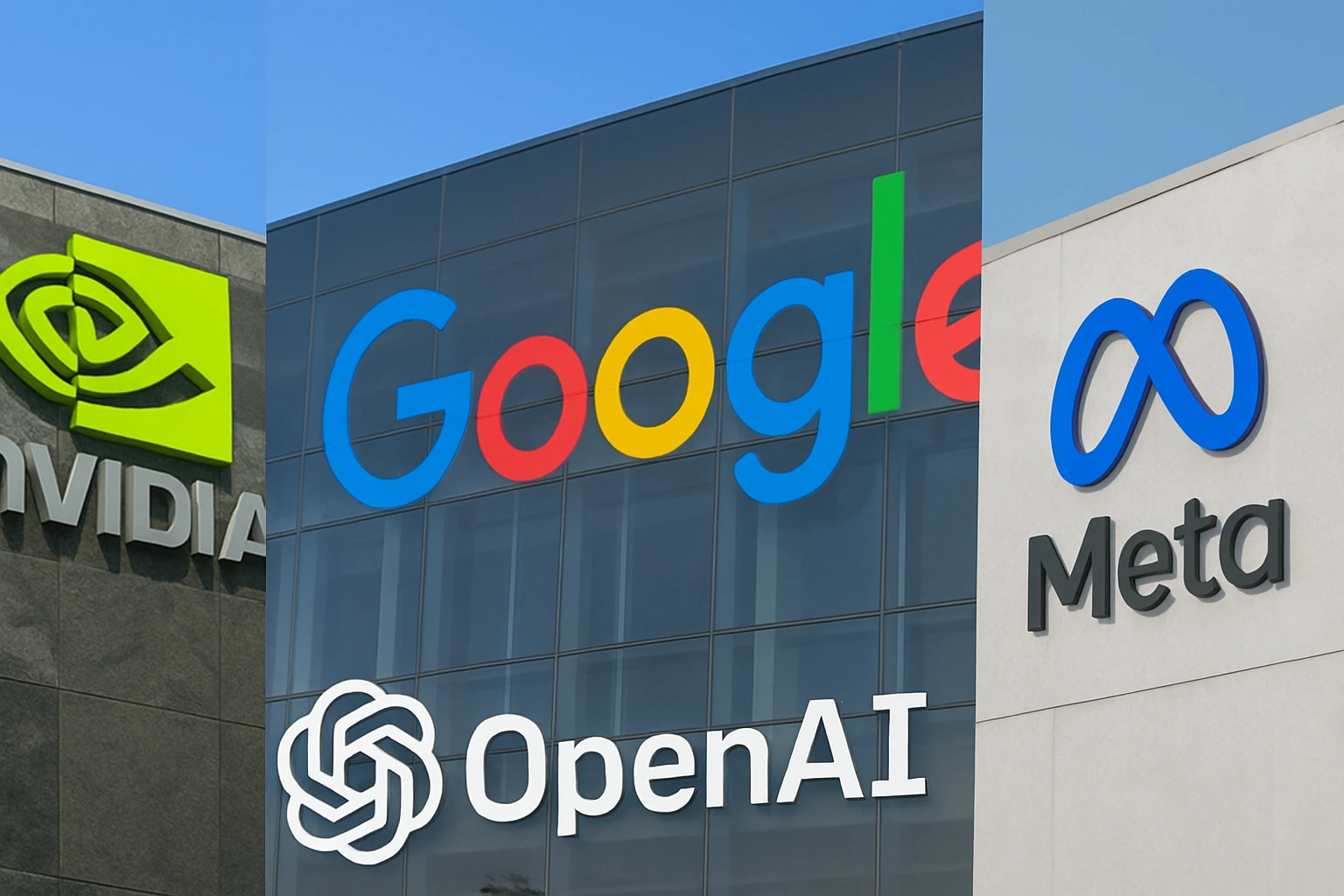
Google’s rapid progress with its latest artificial intelligence system, Gemini 3, has triggered rare public reactions from Nvidia and OpenAI, underscoring the shifting dynamics of the global AI competition.
The focus keyword Gemini 3 surfaced prominently in industry discussions after the model climbed to the top of several benchmark leaderboards, prompting rivals to weigh in on the company’s newfound momentum.
The renewed attention began after Google unveiled Gemini 3 on November 18. Within twenty four hours, more than one million users had tested the model through Google’s development tools and coding platforms.
The release followed weeks of speculation that Google had dramatically upgraded its AI capabilities.
Nvidia posted on X on November 25 that it was “delighted by Google’s success,” while affirming that its own GPUs still offer “greater performance, versatility and fungibility than ASICs,” referring to the custom chips Google uses to train and run its systems.
OpenAI CEO Sam Altman also congratulated Google, writing that Gemini 3 “looks like a great model.” Google’s growing visibility has come after a period in which the company appeared to lag behind OpenAI and other competitors.
Google management reportedly declared a “code red” in late 2022 after the explosive debut of ChatGPT. Today, ChatGPT holds at least eight hundred million weekly active users, while Google’s Gemini app has roughly six hundred fifty million monthly users.
Industry analysts said the public acknowledgments from Nvidia and OpenAI illustrate how seriously the tech sector is taking Google’s advancement.
“They’re in the lead for now until somebody else comes up with the next model,” Angelo Zino, senior vice president and technology lead at CFRA, said.
Experts described Gemini 3 as a pivotal moment in the AI race, especially because Google’s custom Tensor chips are increasingly being considered by other firms.
A report by The Information said Meta is in talks with Google about acquiring its Tensor processors, and Anthropic announced in October that it planned to expand its use of Google’s infrastructure.
Ben Barringer, global head of technology research at Quilter Cheviot, said the competition is not simply about which model performs best in benchmarks.
Different models excel in different tasks. It doesn’t mean Alphabet becomes the end all in AI. It means the ecosystem is evolving.
AI policy researcher Dana Hooper, who advises several US think tanks, said Gemini 3 highlights a broader shift in strategy among tech giants.
“We’re seeing companies diversify their chip dependencies. Nvidia still dominates, but Google’s vertical approach building both the chips and the model gives it leverage that others are now watching closely.”
Benchmark results released after the launch show Gemini 3 outperforming ChatGPT, Claude and xAI’s Grok in areas such as text generation, image editing and image to text analysis. In search specific benchmarks, however, Perplexity and xAI models ranked higher.
Nvidia remains the dominant supplier of AI hardware, reporting sixty two percent year over year revenue growth in its October quarter and a sixty five percent increase in profit. Its GPUs are widely used across data centers, startups and cloud providers.
Google’s Tensor chips are ASICs, custom built for specific workloads, in contrast to the general purpose GPUs that Nvidia and AMD manufacture.
Industry data shows that while ASICs offer efficiency advantages, they cannot fully replace GPUs for broad scale AI training.
Shares of Google rose nearly eight percent last week, while Nvidia dipped a little more than two percent as investors reacted to reports of growing competition in the AI infrastructure market.
Reactions among developers and enterprise users have been mixed but largely enthusiastic.
“I tried Gemini 3 the day it came out, and the speed difference alone is noticeable,” said Daniel Hayes, a software engineer in Chicago who works with generative AI tools.
“But I still rely on older models for specific tasks. It’s not a full replacement yet.” Tech entrepreneur Laila Khan in San Francisco said businesses are watching chip developments closely.
“If Meta and Anthropic are exploring Google’s hardware, that signals real competition in the supply chain. Companies don’t want to depend on one vendor anymore.”
A university researcher in Boston, Emily Ward, said benchmark performance may matter less than reliability. “Benchmarks show potential, but real world testing is what determines value. We still need long-term studies before declaring a winner.”
Analysts expect the AI competition to intensify as companies push toward multimodal and agent based models.
If demand rises for custom chips alongside general purpose GPUs, the industry could see a split market where multiple hardware strategies coexist.
Zino said the leadership position could shift again within months. “This is a cycle measured in weeks, not years. The winner today may be the runner up next quarter.”
Regulators are also watching the landscape as AI infrastructure becomes more concentrated among a handful of corporations.
Policy experts expect new scrutiny around chip access, cloud dependency and competitive fairness. The role of Gemini 3 is likely to remain prominent as Google continues integrating the model across its products, from Search to Workspace.
Analysts said the company’s ability to convert technical momentum into commercial adoption will determine whether its current lead endures.
The debut of Gemini 3 has reshaped the tone of the AI race, prompting Nvidia, OpenAI and other industry players to formally acknowledge Google’s progress.
While the competition remains fluid and highly technical, the responses reflect growing recognition that Google has reasserted itself as a central force in the development of next generation AI systems.
How far that influence extends will depend on future models, market adoption and the evolving hardware strategies guiding the sector.


