
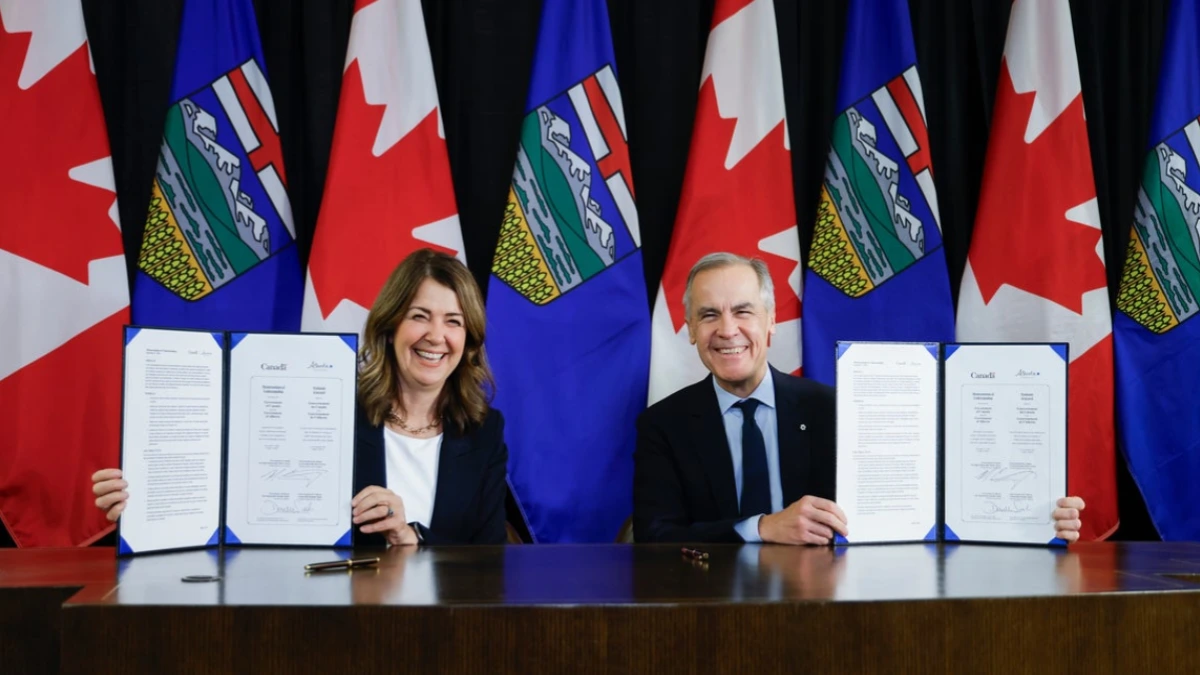
Carney’s Alberta oil pipeline deal is already encountering strong political resistance less than a day after it was announced, underscoring the challenge Prime Minister Mark Carney faces in advancing one of Canada’s most contentious energy projects.
The agreement with Alberta Premier Danielle Smith opens the door for a new oil pipeline to the Pacific Coast, a longstanding ambition for Canada’s energy heartland, but one fraught with policy, environmental and jurisdictional hurdles.
The deal, signed Thursday in Ottawa, exempts Alberta’s proposed pipeline from some federal climate rules and suspends Ottawa’s oil and gas emissions cap, marking a major shift from the policies of Carney’s predecessor, former Prime Minister Justin Trudeau.
In return, Alberta committed to raising its carbon price and creating what it described as the world’s largest carbon capture program.
For Alberta, the political breakthrough is a long-awaited turning point. “This marks the end of dark times for our province,” Smith said, arguing Alberta had been restricted from developing its resources.
Carney said the project was essential for national economic security, noting the agreement aims to reduce reliance on the United States, which buys over 90 percent of Canadian crude.
He said new access to Asian markets could help diversify exports and reduce vulnerability to what he called “shifting geopolitical pressures.”
But the celebrations were short-lived. Hours after the signing, federal culture minister Steven Guilbeault resigned from cabinet in protest, warning the pipeline could cause major environmental harm.
Energy analysts say Carney’s Alberta oil pipeline deal represents both opportunity and risk for a federal government balancing climate commitments with economic pressures.
Dr. Helena Marchand, an energy policy researcher at the University of Calgary, said the agreement might “ease longstanding tensions” between Alberta and Ottawa but complicated relations with British Columbia.
“Carney is walking a very narrow line,” Marchand said. “Alberta sees this as long overdue, but British Columbia will want firm guarantees on environmental safety and indigenous consent.”
British Columbia Premier David Eby said his government was not consulted before the agreement was finalized. He called the project a “distraction” from his province’s liquefied natural gas agenda and noted that no private backer or First Nations partners have endorsed it.
Environmental experts also reacted sharply. Lena Caldwell, a Vancouver based climate analyst, said exempting the pipeline from federal restrictions “sets a concerning precedent” that could weaken national climate policy.
Suspending the emissions cap sends a message that economic pressures can override environmental safeguards, she said.
Canada exported more than three million barrels per day of crude oil to the United States in 2023, according to the Canada Energy Regulator. By contrast, exports to Asia remain limited, hindered primarily by infrastructure bottlenecks on the West Coast.
Carney’s Alberta oil pipeline deal aims to change that by enabling a potential new route to northern British Columbia’s coastline, though no exact path has been proposed.
Alberta has pledged C$14 million to begin early planning, with the expectation a private company will eventually take over the project.
A coalition representing Coastal First Nations declared this week that an oil pipeline to the northern coast “will never happen,” highlighting one of the most significant barriers ahead. Under the agreement, the project cannot proceed without indigenous co-ownership.
In oil markets, analysts say a new Pacific outlet could boost Canada’s global competitiveness, especially at a time when demand in Asia remains strong. But they caution that similar projects have stalled in the past due to political, regulatory and legal barriers.
On the streets of Edmonton, reactions were mixed. Ben Whitfield, a longtime oil worker, said the project offered “hope after years of uncertainty.”
He said many in the industry believe new export routes are vital for long term stability. “We’ve been through boom and bust cycles,” he said. “We need new markets if we want to keep people working.”
In Vancouver, residents expressed concern about tanker traffic and environmental risks. “I understand the economic arguments, but we’re talking about sensitive coastal ecosystems,” said Sarah Liu, a local teacher. “One spill could undo decades of progress.”
Some First Nations leaders echoed those concerns. Nathan Wyatt, an adviser to a northern BC band not yet approached by Alberta or Ottawa, said indigenous participation must be meaningful.
“Co-ownership on paper is not enough,” Wyatt said. “Communities need guarantees on safety, revenue sharing and legal authority.”
The tensions illustrate the political landscape Carney now faces as he attempts to move forward with what he called a “national project.”
Carney’s Alberta oil pipeline deal outlines a commitment to bring British Columbia “immediately” into discussions, but the timeline for negotiations remains unclear. Experts predict a lengthy regulatory process, with environmental assessments likely to take years.
Conservative leader Pierre Poilievre dismissed the agreement as merely the start of another slow federal review. “This is from a prime minister who promised to move with unimaginable speed,” he said during a press conference Thursday.
Economists say the broader objective of doubling Canada’s non US exports within the next decade will depend heavily on whether this project advances.
But with political opposition in British Columbia, a lack of private financing and indigenous concerns still unresolved, the pipeline faces an uncertain future.
Carney’s Alberta oil pipeline deal has reshaped the federal provincial landscape but exposed sharp divisions across the country.
As Ottawa, Alberta and British Columbia prepare for negotiations, the project’s prospects remain clouded by political resistance, environmental objections and questions about indigenous consent.
For now, the agreement marks the beginning of what is likely to be a long and fractious national debate.


