
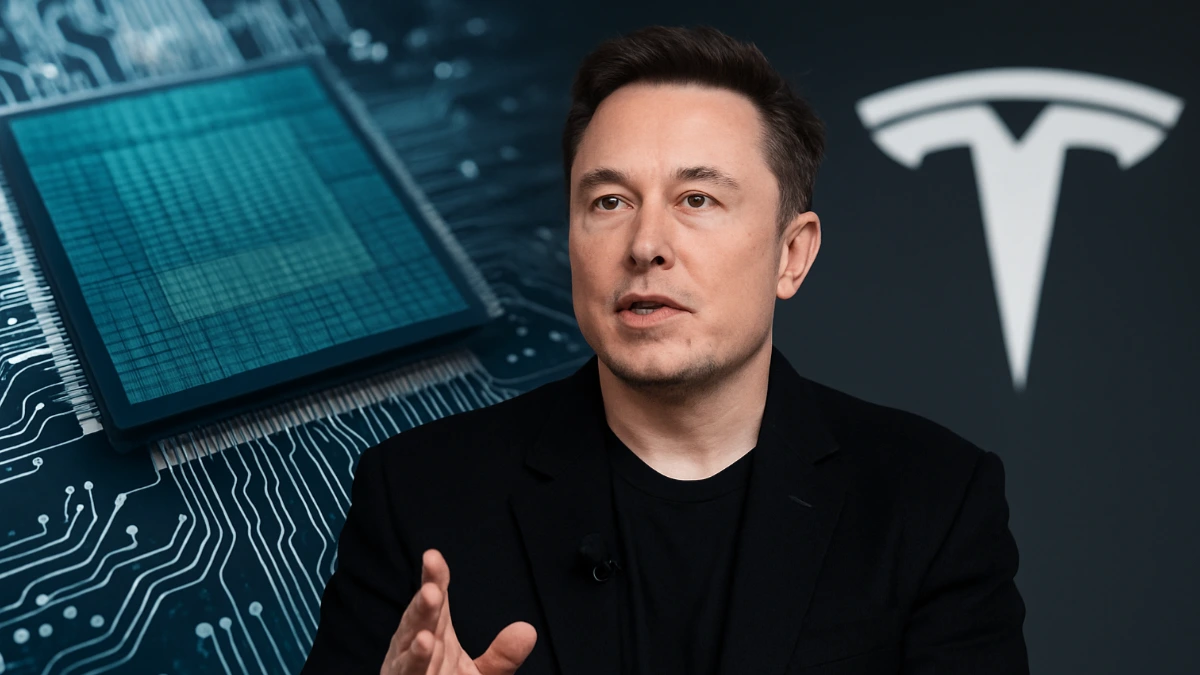
AUSTIN, Texas — Tesla CEO Elon Musk said Thursday that the electric vehicle maker will likely build a “gigantic” semiconductor factory to produce custom chips for its self driving cars and humanoid robots, marking one of the company’s most ambitious hardware ventures yet.
Speaking at Tesla’s annual shareholder meeting, Musk said the company’s long term vision for autonomous driving and robotics will require chip production at a scale that existing suppliers cannot meet.
“I can’t see any other way to get to the volume of chips that we’re looking for,” Musk said. “I think we’re probably going to have to build a gigantic chip fab.”
Tesla has long relied on suppliers like Nvidia, Samsung and Taiwan Semiconductor Manufacturing Company (TSMC) for its advanced computing chips.
The automaker already designs many of its own processors in house but depends on these manufacturers for fabrication a process dominated by only a few global players.
By moving into chip manufacturing, Tesla would be venturing into one of the most capital intensive and technically challenging industries in the world. Building a chip fabrication plant, or “fab,” typically requires billions of dollars and years of construction.
Musk did not specify where or when Tesla might begin building the facility but suggested it would be “like giga but way bigger,” referencing the company’s existing Gigafactories that produce vehicles and batteries.
Industry analysts say Tesla’s potential move reflects both its ambition and its growing frustration with the global semiconductor supply chain.
“Tesla wants control over its most critical technologies,” said Dr. Karen Liu, a semiconductor analyst at TechFront Research in San Francisco.
By developing its own chips and now possibly its own fab, it’s signaling that vertical integration is key to its future in autonomy and AI.
Liu added that Tesla’s initiative could mirror the approach of companies like Apple, which designs its own chips but outsources production to partners such as TSMC.
“Building a fab from scratch is a different level of risk,” she said. “It would make Tesla one of the few companies in the world to design and manufacture its own advanced processors.”
Another industry expert, Michael Cho of the Global Semiconductor Alliance, noted that Musk’s comments come at a time when U.S. policymakers are pushing to strengthen domestic chip production.
“If Tesla were to build this in the US it would align closely with the government’s goals under the CHIPS and Science Act,” Cho said.
The global semiconductor market is projected to surpass $1 trillion by 2030, according to McKinsey & Company, with demand fueled by AI, electric vehicles and automation.
TSMC currently holds more than 50 percent of the global foundry market, while Samsung and Intel follow as the next largest players. These companies spend tens of billions annually on research and plant expansion.
Tesla’s potential entry into chip fabrication could disrupt traditional supply dynamics. The company already designs AI chips for its vehicles and data centers, and Musk said Thursday that Tesla’s next generation processor will use about one third the power of Nvidia’s Blackwell chip while offering similar performance at less than 10 percent of the cost.
“Nvidia makes incredible chips,” Musk said, “but they have to serve many different use cases. We can optimize ours specifically for Tesla.”
In Austin, home to Tesla’s Gigafactory Texas, local business leaders said the region could benefit if Tesla decides to locate its chip facility nearby.
“If Tesla builds a fab here, it would cement Austin’s role as a global tech hub,” said Melissa Hart, president of the Austin Chamber of Commerce. “It would create thousands of high skill jobs and attract suppliers from across the semiconductor ecosystem.”
Others expressed caution about the environmental and resource challenges associated with chip manufacturing. “A chip fab uses an enormous amount of water and energy,” said Jason Morales, an environmental engineer and local resident.
“Tesla will need to show it can balance innovation with sustainability.” Employees within Tesla’s engineering teams reportedly welcome the idea.
“We’ve been developing in house chips for years,” said a Tesla chip designer who requested anonymity because they were not authorized to speak publicly. “Having our own fab would let us iterate faster and scale our AI systems much more efficiently.”
Musk said Tesla’s in house chips will power future products including the Cybercab, a fully autonomous vehicle without a steering wheel or pedals, and Optimus, the company’s humanoid robot.
He claimed Optimus could eventually “be better than the best human surgeon” and even “eliminate poverty” by expanding global productivity. Tesla, he said, aims to produce Optimus units for around $20,000 each.
The Cybercab is expected to enter production in April, marking another milestone in Tesla’s drive toward autonomous mobility.
Musk added that Tesla’s current vehicles could soon allow drivers to text and engage in limited activities while the car drives itself though the company has not specified when such capabilities would receive regulatory approval.
While Musk’s forecasts are often bold, analysts note that Tesla’s track record of delivering complex engineering projects gives the plan credibility. Still, the leap from vehicle manufacturing to chip fabrication could test even Musk’s resources and timelines.
Tesla’s proposed “gigantic” chip factory underscores the company’s growing ambition to control every layer of its technology stack from AI software and robotics to the silicon that powers them.
If realized, the plan could reshape not only Tesla’s supply chain but also the broader landscape of advanced chip production, challenging the dominance of firms like TSMC and Samsung.
Whether Tesla can translate Musk’s vision into silicon reality remains to be seen, but the company’s pursuit of autonomy both in its vehicles and its operations continues to drive it into uncharted territory.


