
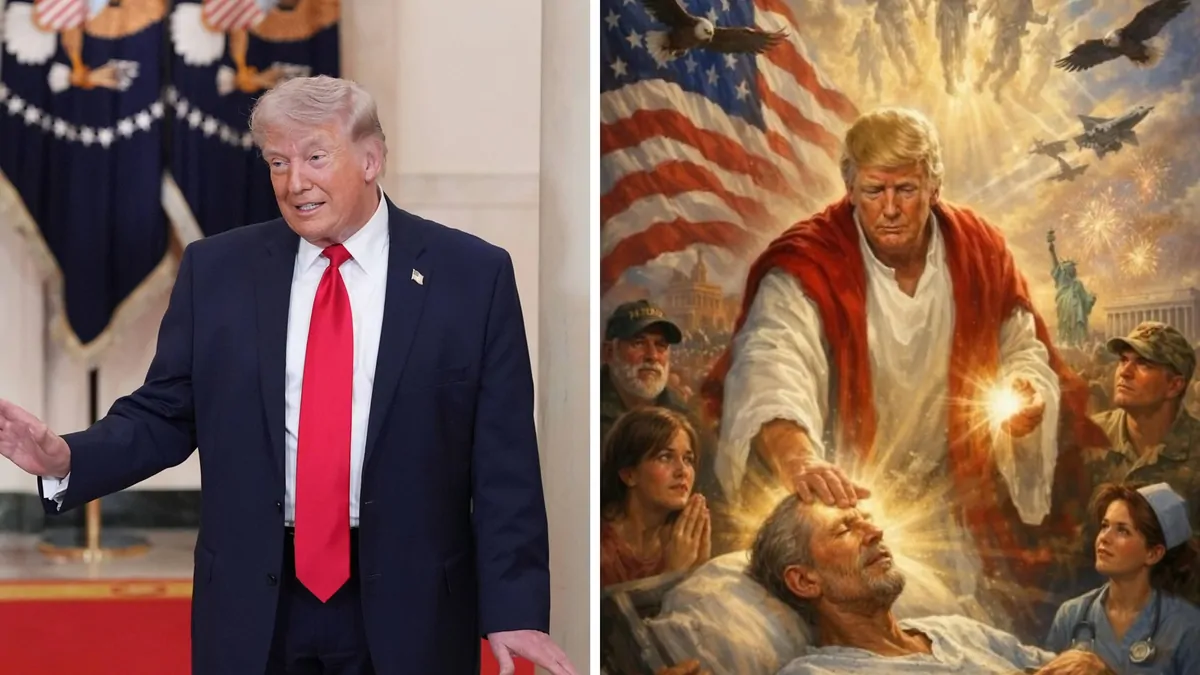
The Trump AI image controversy intensified Sunday as Donald Trump shared an AI-generated depiction of himself as Jesus Christ while criticizing Pope Leo on social media.
SUMMARY
- Trump’s AI post triggered backlash from religious groups and political observers globally.
- Vatican officials rejected claims tied to nuclear policy and crime rhetoric.
- Digital misinformation risks rise as political leaders amplify AI-generated imagery.
The incident underscores rising concerns in March 2026 over AI-driven political messaging.
As global elections and conflicts intensify, leaders’ use of synthetic media is drawing scrutiny from regulators, religious institutions and technology firms.
Tensions escalated after Pope Leo criticized the Iran conflict in March, urging de-escalation and warning against leaders whose “hands are full of blood.”
Trump responded through repeated posts on Truth Social, culminating in the AI image controversy.
Trump has previously shared AI-generated content, including a parody inspired by Apocalypse Now in 2025. However, religious imagery marks a sharper escalation, particularly involving the Vatican.
“This reflects a broader normalization of AI in political communication,” said Dr. Rumman Chowdhury, CEO of Humane Intelligence and former AI ethics lead at Twitter.
She noted that religious symbolism amplifies emotional impact and misinformation risks. Massimo Faggioli, professor of theology at Villanova University, said the clash signals a “deepening ideological divide between nationalist politics and global religious leadership.”
He added that papal criticism of war aligns with long standing Vatican doctrine, not partisan positioning. The Trump AI image controversy also intersects with platform accountability.
According to Nick Clegg, president of global affairs at Meta, labeling AI-generated political content remains inconsistent across platforms, increasing public confusion.
“We are seeing confusion among parish communities,” said Father Antonio Spadaro, Vatican communications adviser. “The misuse of sacred imagery creates tension beyond politics.”
In Chicago, community organizer Maria Lopez said, “People are debating whether this is satire or belief. That uncertainty is the real issue.”
Over the next six to twelve months, regulatory pressure on AI-generated political content is expected to increase, particularly in the US and EU.
Legislative proposals may require labeling mandates and platform accountability standards.
Religious institutions are also likely to expand digital communication strategies to counter misinformation.
The Trump AI image controversy highlights a convergence of politics, religion and artificial intelligence, signaling long term challenges for governance, public trust and global information integrity.
NOTE! This article was generated with the support of AI and compiled by professionals from multiple reliable sources, including official statements, press releases, and verified media coverage. For more information, please see our T&C.


