
KEY POINTS
- The Taiwan US trade deal aligns Taipei with tariff terms granted to Japan, South Korea and the European Union.
- US officials say it will support semiconductor reshoring through new industrial parks.
- China condemned the accord, citing sovereignty concerns over Taiwan.
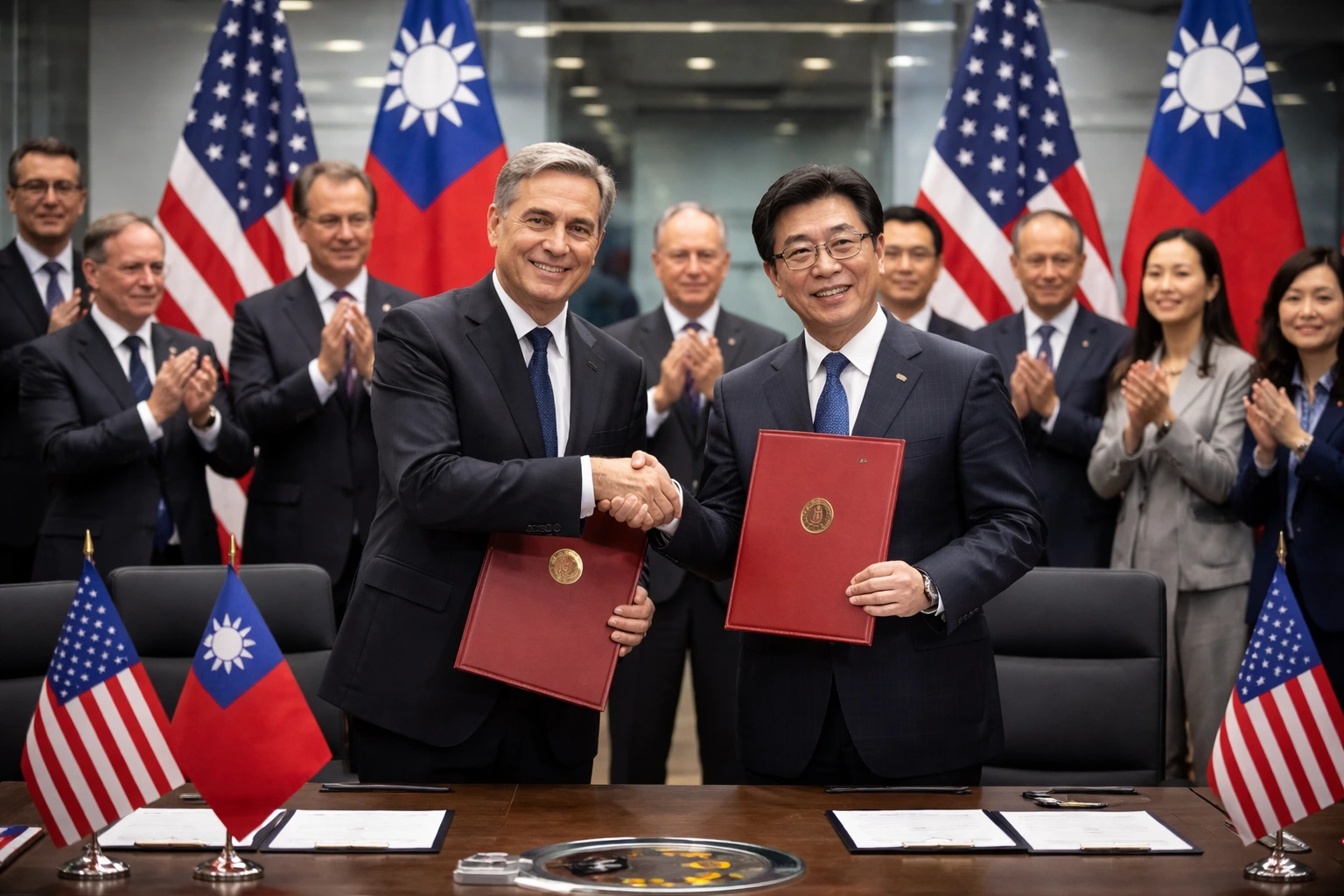
TAIPEI, Taiwan — Taiwan’s premier on Friday praised a new Taiwan US trade deal that cuts American tariffs on Taiwanese goods to 15% in exchange for $250 billion in planned investments in the United States tech sector.
A move Washington said would accelerate domestic manufacturing while drawing criticism from Beijing.
The Taiwan US trade deal arrives as global supply chains remain unsettled by geopolitical risk and the race to expand artificial intelligence capacity.
Taipei says the agreement secures parity with other surplus economies and deepens strategic ties with Washington.
US officials frame it as a cornerstone of a broader industrial policy aimed at reducing reliance on overseas chip fabrication.
President Donald Trump initially proposed a thirty 2% tariff on Taiwanese goods before revising it to 20% and then 15% after negotiations, according to Taiwanese officials.
Similar arrangements with the European Union and Japan set the benchmark. China, which claims Taiwan as its territory, has long opposed formal agreements between Taipei and foreign governments.
The accord now requires ratification by Taiwan’s parliament, where opposition lawmakers have raised concerns about domestic semiconductor competitiveness.
Trade specialists say the Taiwan US trade deal blends tariff relief with industrial commitments, a structure increasingly used by Washington to link market access with onshore investment.
The Commerce Department said the partnership would create several US based industrial parks and encourage advanced packaging and fabrication.
Ryan Majerus, a former US trade official now at King & Spalding, noted that timing matters because the Supreme Court is reviewing the legality of the administration’s broad tariff authority.
Key terms under the Taiwan US trade deal compared with recent benchmarks
| Partner | Baseline U.S. Tariff | Final Tariff | Investment Commitments | Sector Focus |
|---|---|---|---|---|
| Taiwan | 32% | 15% | $250B | Semiconductors, AI hardware |
| Japan | 20% | 15% | Public-private | Autos, electronics |
| EU | Variable | 15% | Targeted | Clean tech, chips |
Taiwan Premier Cho Jung tai said the Taiwan US trade deal shows Washington views Taiwan as a strategic partner and confirmed no added fees for automotive and wood furniture exports and zero tariffs for some aerospace components.
A Chinese Foreign Ministry spokesperson, Guo Jiakun, said Beijing opposes any agreement with “sovereign connotations” involving Taiwan.
The US Commerce Department said companies investing in American fabs could receive favorable tariff treatment, including exemptions.
Implementation hinges on legislative approval in Taipei and corporate follow through.
Taiwan based TSMC has announced plans to raise capital spending by nearly forty percent this year and accelerate construction in Arizona, part of a $165 billion US investment pledge.
Analysts say the Taiwan US trade deal could anchor longer term procurement contracts for US defense and cloud providers, tightening cross Pacific supply links.
The Taiwan US trade deal formalizes a trade investment exchange that links tariff relief with domestic manufacturing goals.
While Beijing’s objections underscore enduring political tensions, the accord’s immediate effect is commercial lowering barriers, redirecting capital and redefining how semiconductor capacity is distributed across allied economies.
In my analysis, this Taiwan US trade deal reflects Washington’s shift toward geo economic alignment, using tariff leverage to hardwire semiconductor supply chains into allied ecosystems.
I predict formal chip origin rules will emerge, tying tariff benefits to domestic fabrication. For consumers, this means steadier tech prices. Track US fab localization metrics.
NOTE! This report was compiled from multiple reliable sources, including official statements, press releases, and verified media coverage.
Adnan Rasheed, Lead Research Analyst


