
SUMMARY
- Sen. Tim Sheehy assisted Capitol Police during the protester removal.
- Three officers were treated for injuries, according to Capitol Police.
- The protester faces assault and resisting arrest charges linked to the Senate Armed Services hearing disruption.
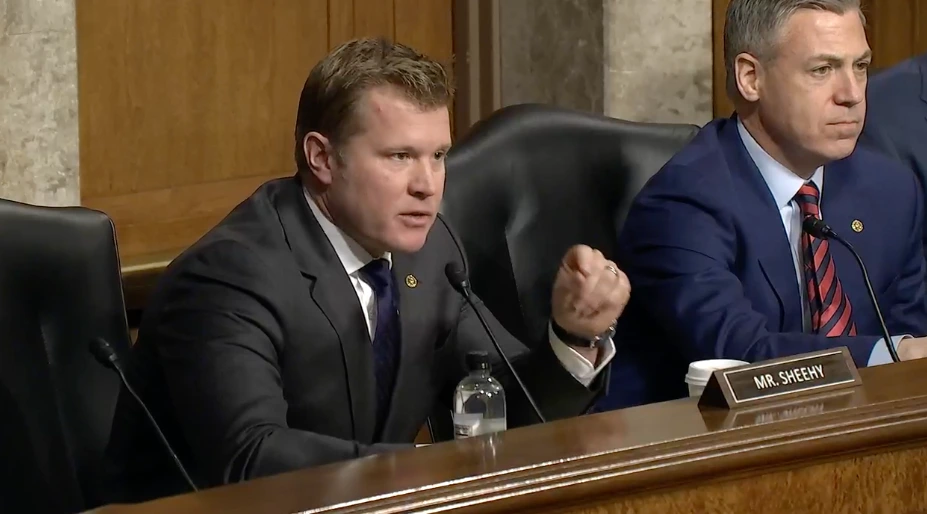
WASHINGTON — Sen. Tim Sheehy was involved in a brief physical struggle Wednesday as US Capitol Police removed a protester from a Senate Armed Services subcommittee hearing inside the Hart Senate Office Building, authorities and video footage show.
The incident occurred shortly before 3 p.m. during a Senate Armed Services Subcommittee session when a man identified as Brian C. McGinnis, 44, disrupted proceedings and resisted officers attempting to escort him from the room.
Video circulating online shows McGinnis, dressed in a Marine Corps uniform, placing his hand between a door hinge and frame as officers tried to clear the hearing room. Police said he injured himself while resisting removal.
Sheehy, a Montana Republican and member of the Senate Armed Services Committee, said on X that he intervened to help deescalate the confrontation.
“Capitol Police were attempting to remove an unhinged protestor from the Armed Services hearing. He was fighting back. I decided to help out and deescalate the situation,” Sheehy wrote.
According to US Capitol Police, three officers were treated by DC Fire and EMS for injuries sustained during the encounter.
The agency said protests are not permitted inside congressional buildings, though demonstrations are allowed elsewhere on Capitol grounds.
McGinnis faces three counts of assault on a police officer, three counts of resisting arrest and one count of crowding, obstructing and incommoding, police said.
Alan He, a CBS News correspondent, reported that McGinnis is a Green Party candidate running for Senate in North Carolina.
Sarah Binder, a senior fellow at the Brookings Institution and professor of political science at George Washington University, said disruptions at high profile congressional hearings often reflect heightened political tensions.
“Security enforcement inside hearing rooms has tightened over the years as protests have become more direct and theatrical,” Binder said.
Capitol Police Chief J. Thomas Manger has previously emphasized that maintaining order inside committee rooms is critical to congressional operations, noting that security protocols are designed to protect lawmakers, staff and the public.
The Senate Armed Services Committee oversees military policy and defense spending, areas that frequently draw anti war activism and organized demonstrations.
The case now moves to the District of Columbia court system. Capitol Police said the investigation remains ongoing and additional information will be released as it becomes available.
NOTE! This article was generated with the support of AI and compiled by professionals from multiple reliable sources, including official statements, press releases, and verified media coverage. For more information, please see our T&C.


