
SUMMARY
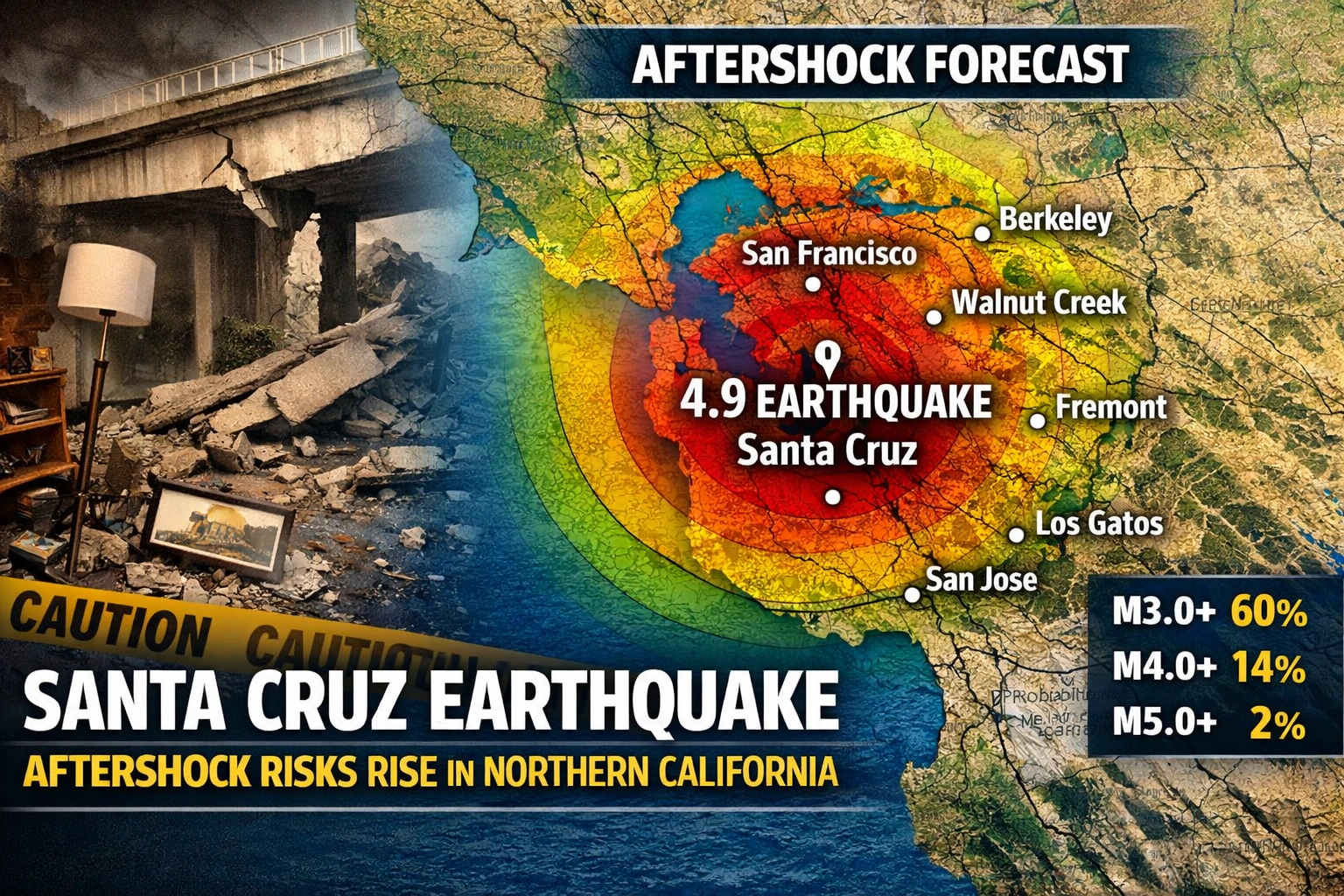
- Aftershocks likely within seven days, including up to nine magnitude three or higher events.
- Urban centers reported light shaking, highlighting regional seismic vulnerability across dense economic corridors.
- Preparedness gaps persist despite statewide drills, underscoring need for household and infrastructure resilience planning.
A Santa Cruz earthquake measuring 4.9 struck near Boulder Creek early Thursday, shaking Bay Area communities and prompting warnings from the United States Geological Survey about elevated aftershock probabilities.
Thursday’s Santa Cruz earthquake arrives amid heightened global attention on urban seismic risk as population density and aging infrastructure converge in major economic hubs.
California’s Bay Area, home to critical technology and logistics networks, faces renewed scrutiny over resilience standards and emergency response coordination following the early morning tremor.
The region sits along the San Andreas Fault system, where incremental stress accumulation has produced frequent moderate quakes since 2023.
Data from the USGS indicates a measurable uptick in magnitude three activity across central California during the past eighteen months.
David Applegate, director of the USGS, said the Santa Cruz earthquake reflects “typical but consequential” stress release patterns.
Jeanne Hardebeck, a research geophysicist at the USGS Earthquake Science Center, noted aftershock clustering can strain emergency services.
Economically, brief disruptions to Silicon Valley commuter routes and data infrastructure highlight systemic exposure to even midscale seismic events.
Santa Cruz County Sheriff Jim Hart said dispatch centers received no immediate major damage reports but field assessments continue.
Resident Maria Lopez described “sharp jolts lasting several seconds,” while Fremont coordinator Alex Chen reported increased hotline calls.
USGS projections suggest aftershock frequency decline, while economic impacts may persist into 2026.
NOTE! This article was generated with the support of AI and compiled by professionals from multiple reliable sources, including official statements, press releases, and verified media coverage. For more information, please see our T&C.


