
SUMMARY
- Andreeva struggled to manage the psychological pressure of defending her Indian Wells title.
- Siniaková capitalized on strategic play and composure to upset a high ranked favorite.
- The match highlighted the challenges young players face with expectations and in match volatility.
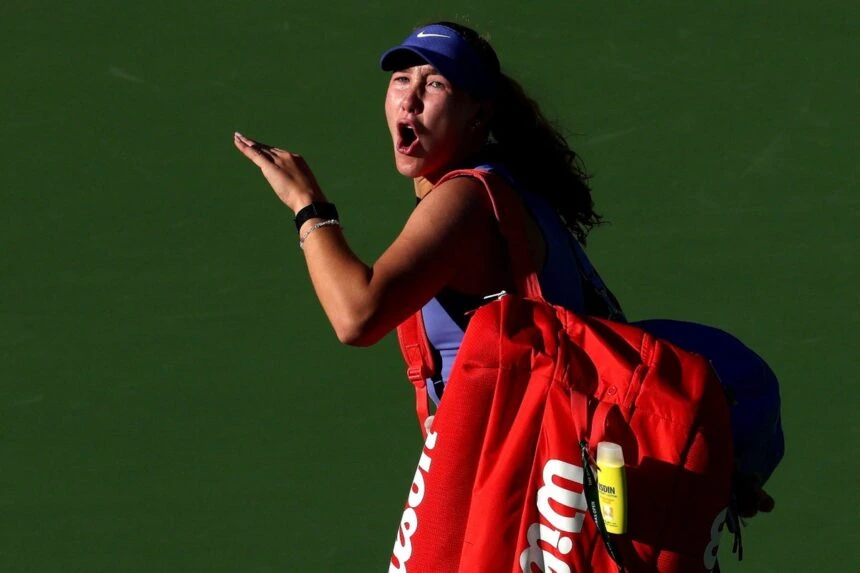
INDIAN WELLS, Calif. — Rising tennis star Mirra Andreeva, 18, was eliminated from the 2026 BNP Paribas Open in a dramatic third round match against Kateřina Siniaková, leaving the Coachella Valley stadium amid boos and visible frustration.
The defending champion lost 4-6, 7-6(5), 6-3 in a match marked by momentum swings, intense pressure, and emotional outbursts.
Andreeva, who won the BNP Paribas Open last year, showed flashes of the aggressive, high intensity tennis that propelled her to the winner’s podium.
However, the match against Siniaková demonstrated the difficulty of balancing skill with mental resilience under the weight of expectation.
Her exit marks a second consecutive early round loss in major WTA 1000 events this season following Dubai.
Andreeva, ranked inside the top 20, has quickly ascended the professional circuit, claiming two WTA 1000 titles in 2025 and reaching multiple quarterfinals and semifinals since.
Known for her powerful topspin forehand and full Western grip, she has faced increasing scrutiny and pressure to maintain consistent performance.
Siniaková, a doubles world No. 1 and singles competitor outside the top 40, brought strategic depth and composure, seizing critical points to turn the match in her favor.
Sports psychologist Dr. Maria Rodriguez, of the International Tennis Performance Institute, said, “Andreeva’s emotional responses highlight the impact of performance anxiety in young athletes.
Her swings between aggression and hesitation are typical in high-pressure matches.”
Former WTA champion Conchita Martínez, Andreeva’s coach, acknowledged post match, “Mirra is talented, but learning to handle expectations is part of developing into a top-tier professional. Matches like this are growth opportunities.”
Tennis analyst Ben Rothenberg, writing for The New York Times, noted, “The shift from leading underdogs to defending champion brings an invisible load.
Andreeva’s match against Siniaková is a textbook case of mental pressure affecting shot selection and in game decisions.”
Siniaková said, “I knew the pressure was on her. I tried to enjoy my game with nothing to lose. It was about staying composed.”
Andreeva reflected, “I’m not really proud of how I handled it. These are things I need to work on. I’ll have the chance to improve.”
Tournament director Tommy Haas commented, “Young players like Andreeva face intense scrutiny. Matches like this reveal both talent and the learning curve required at the highest level.”
Andreeva has time to refine her match management and emotional resilience. Experts suggest focused mental coaching and simulated pressure scenarios as potential pathways for improvement.
Siniaková, meanwhile, advances to face higher ranked competitors, demonstrating how tactical patience and psychological stability can offset raw talent in high-stakes matches.
The Indian Wells exit underlines the dual challenge of youth and expectation in professional tennis.
Andreeva’s talent remains undisputed, but mastering the mental game will be essential to sustain long term success on the WTA Tour.
NOTE! This article was generated with the support of AI and compiled by professionals from multiple reliable sources, including official statements, press releases, and verified media coverage. For more information, please see our T&C.


