
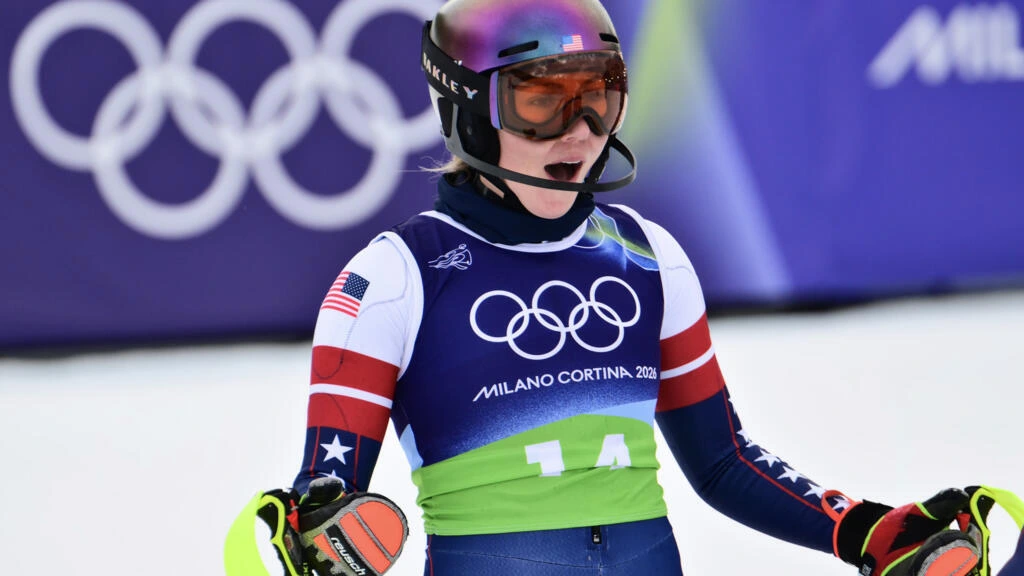
SUMMARY
- Mikaela Shiffrin wins Olympic gold in slalom, her first medal since 2018
- Victory restores momentum after a difficult 2022 Olympic campaign
- US women match their second best Alpine skiing medal haul at a single Games
CORTINA D’AMPEZZO, Italy — Mikaela Shiffrin captured Olympic gold in women’s slalom on Wednesday, Feb. 18, ending an eight race medal drought at the Winter Games and reaffirming her dominance in alpine skiing at the 2026 Winter Olympics.
Shiffrin posted a combined time of 1 minute, 39.10 seconds to secure her second Olympic slalom title and third career gold medal.
Camille Rast of Switzerland took silver, 1.5 seconds back, and Anna Swenn Larsson of Sweden claimed bronze, 1.71 seconds behind.
The win marked Shiffrin’s first Olympic medal since earning silver in the combined at the 2018 Pyeongchang Games.
It followed a stretch that included three did not finish results at the 2022 Beijing Olympics and raised questions about her Olympic form despite sustained World Cup success.
Her performance in Cortina delivered a decisive answer. Shiffrin built a commanding 0.82-second lead in the first run over Germany’s Lena Duerr and maintained control in the second, skiing with measured aggression on a course that challenged several contenders.
Shiffrin entered Milano Cortina as the most decorated World Cup skier in history, with 108 victories and 166 podium finishes across six disciplines downhill, super-G, giant slalom, slalom, combined and parallel.
She secured her ninth career season slalom title before the Olympics, winning seven of eight World Cup slalom races this season.
Her Olympic résumé, however, had remained unchanged since 2018. In Beijing, she failed to finish multiple technical events, a sharp contrast to her consistency on the World Cup circuit.
With Wednesday’s victory, Shiffrin tied snowboarder Shaun White and bobsledder Kaillie Humphries for the second-most Winter Olympic gold medals by a US athlete.
Speedskaters Bonnie Blair and Eric Heiden each hold five gold medals. She also earned her fourth Olympic medal, equaling Julia Mancuso for the most by a US woman in Alpine skiing.
The US women finished the 2026 Games with three Alpine medals, matching their second highest total at a single Winter Olympics.
US Ski & Snowboard President Sophie Goldschmidt said in a statement that Shiffrin’s victory “reflects long term technical discipline and psychological resilience at the highest level of competition.”
Dr. Mark Aoyagi, a sport psychology consultant who has worked with Olympic athletes, said slalom demands “rapid cognitive recalibration after each gate,” adding that returning from prior Olympic disappointment requires “structured confidence rebuilding rather than emotional momentum.”
The slalom discipline is considered one of the most technically demanding events in Alpine skiing, requiring precision timing and split second balance adjustments. Shiffrin recorded the fastest sectional times in three of four course segments during her opening run.
International Ski and Snowboard Federation race director Markus Waldner said course conditions were “firm and consistent,” allowing athletes to attack without excessive surface variability.
Swiss team coach Hans Flatscher said Rast’s silver medal represented “a benchmark result against the strongest technical skier of this era.”
American teammate Breezy Johnson, who won downhill gold earlier in the Games, said Shiffrin’s preparation sessions after the team combined event were “methodical and focused.”
Shiffrin’s Olympic gold in slalom reinforces her position heading into the final stretch of the World Cup season.
With her ninth slalom crystal globe already secured, attention shifts to overall standings and long term career milestones.
Her performance in Cortina may also influence athlete development strategies within US Ski & Snowboard, particularly in balancing multi discipline competition with Olympic specific preparation cycles.
Mikaela Shiffrin wins Olympic gold in slalom at Milano Cortina 2026, closing a chapter marked by Olympic setbacks and reaffirming her standing in the sport’s record books.
The result strengthens the US Alpine program’s medal legacy and adds measurable weight to a career already defined by sustained excellence across disciplines.
NOTE! This article was generated with the support of AI and compiled by professionals from multiple reliable sources, including official statements, press releases, and verified media coverage. For more information, please see our T&C.


