
SUMMARY
- Indiana House committee advances Chicago Bears stadium bill for Hammond site
- Team signals commitment to due diligence near Wolf Lake
- Illinois officials pause parallel Arlington Heights negotiations
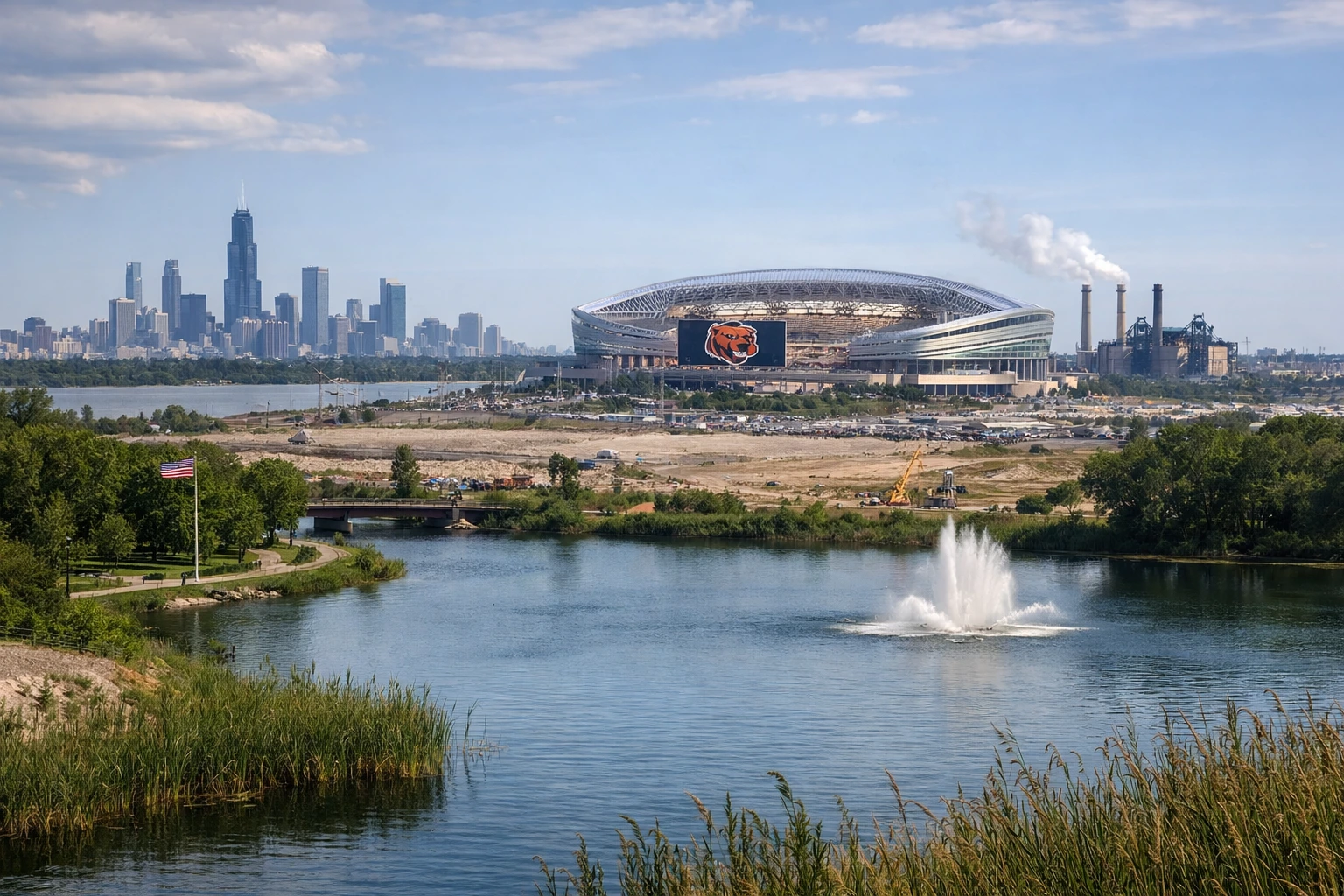
HAMMOND, Indiana, — The Chicago Bears stadium proposal in northwest Indiana moved closer to reality Thursday after a key Indiana House committee unanimously advanced amended legislation outlining financing and governance for a potential new venue near Wolf Lake in Hammond.
The Chicago Bears said in a statement that passage of the bill would mark “the most meaningful step forward in our stadium planning efforts to date,” as lawmakers in Indiana and Illinois weigh competing proposals to host the NFL franchise’s future home.
The committee vote represents a significant development in a multistate contest to secure one of the National Football League’s most storied franchises.
The Chicago Bears stadium debate carries economic and political implications for both Indiana and Illinois, where the team currently plays at Soldier Field.
Indiana’s proposal, structured around Senate Bill 27, would authorize bond financing, establish a governing board and set parameters for a long term lease agreement with the team, according to legislative documents.
The Indiana Senate earlier approved legislation designed to frame a potential agreement with the Bears.
Lawmakers had previously indicated they would not proceed without clearer signals from the team about its intentions in northwest Indiana.
In their statement, the Bears said they are committed to completing “site specific necessary due diligence” to support a vision for a “world class stadium” near Wolf Lake in Hammond.
The team thanked Gov. Mike Braun, House Speaker Todd Huston and Sen. Ryan Mishler for establishing what it called a critical framework.
Braun said Indiana had identified “a promising site near Wolf Lake” and described the measure as contingent upon due diligence. Huston said there was a shared commitment to advance the proposal.
The Hammond location sits roughly twenty miles from downtown Chicago and about twenty minutes from Soldier Field, a point emphasized by Rep. Ryan Mishler during committee debate.
John Rennie Short, a professor of public policy at the University of Maryland Baltimore County who studies stadium economics, said multistate competition can strengthen a team’s negotiating leverage.
“When jurisdictions compete, franchises often gain more favorable financing terms and infrastructure commitments,” Short said.
Dennis Coates, an economist at the University of Maryland, Baltimore County, said academic research has repeatedly found limited direct economic returns from publicly financed stadiums.
“The broader fiscal impact depends heavily on debt structure, ancillary development and opportunity costs,” Coates said, noting that bond backed projects require careful long term revenue forecasting.
Illinois officials have continued parallel negotiations over a potential stadium in suburban Arlington Heights.
A legislative hearing in the Illinois Revenue and Finance Committee was canceled after the Bears requested a pause to revise bill language, according to Matt Hill, a spokesperson for Illinois Gov. J.B. Pritzker.
Hammond Mayor Tom McDermott said the project would be “transformative” for northwest Indiana and pledged local cooperation if the Chicago Bears stadium plan advances.
Rolling Meadows Mayor Lara Sanoica, whose city is near the Arlington Heights site, said prolonged negotiations in Illinois have complicated regional planning. “Our region has been asleep at the wheel for the past three years,” Sanoica said.
Braun described the proposal as a “once in a generation opportunity” for Indiana, citing the state’s pro-growth environment.
The full Indiana House must vote before the session ends Feb. 27 for the Chicago Bears stadium framework to advance. Illinois lawmakers have until late May to finalize any competing proposal.
Both states face complex fiscal and political calculations, including bond repayment structures, property tax considerations and infrastructure costs tied to transportation and public services.
The Chicago Bears stadium decision now hinges on parallel legislative timelines and detailed negotiations over financing and site feasibility.
With Indiana moving swiftly and Illinois continuing talks, the franchise’s next home remains uncertain but increasingly central to regional economic strategy in the Midwest.
NOTE! This article was generated with the support of AI and compiled by professionals from multiple reliable sources, including official statements, press releases, and verified media coverage. For more information, please see our T&C.


