
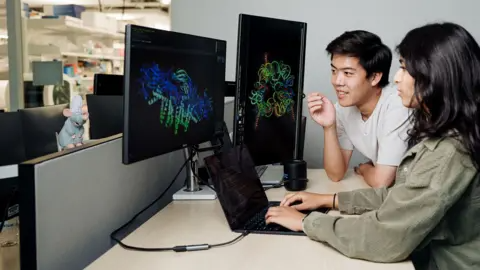
Researchers from Stanford University and the Arc Institute have used artificial intelligence to generate viral genomes that differ from known natural viruses, according to a study published Aug. 6 in the journal Science.
The research focused on bacteriophages, viruses that infect bacteria but do not infect humans.
Scientists used the Evo family of genome language models to generate new genetic sequences within a framework designed around ΦX174, a small and well studied bacteriophage that infects Escherichia coli.
The models learned patterns from large collections of genetic sequences, allowing them to generate DNA sequences one nucleotide at a time.
The researchers then produced thousands of candidate genomes and used computational methods to identify those most likely to function.

Nearly 300 candidates were synthesized and tested in the laboratory. Sixteen produced viable bacteriophages capable of infecting and lysing E. coli.
The researchers found that the resulting phages had low sequence similarity to known natural sequences.
At least one also contained a functional genetic feature that had not previously succeeded when introduced into ΦX174 through conventional genetic engineering.
The findings could have implications for the development of bacteriophage therapies, an area of research that has received renewed attention because of antibiotic resistance.
Phages can specifically target bacteria and have been studied as potential alternatives or complements to antibiotics.
One challenge is finding a phage that can effectively attack the particular bacterial strain causing an infection.

In the study, a mixture of the AI-designed phages was able to overcome resistance in some E. coli strains. A comparable mixture of naturally sourced phages did not achieve the same result.
The authors said the finding lays out a potential path toward generating adaptive phage therapies against rapidly evolving bacterial pathogens.
The research is experimental, however, and no bacteriophage therapy has received full U.S. Food and Drug Administration approval, according to the supplied material.
The approach differs from conventional genetic engineering, which generally starts with existing biological sequences and modifies or combines them.
The researchers instead used genome language models to generate complete phage genomes from scratch.
The relevant training approach deliberately excluded sequences resembling viruses known to infect humans, animals, plants or fungi.
The experiment also involved a relatively simple viral genome. Tom Ellis, a professor of synthetic genome engineering at Imperial College London, noted that ΦX174 is among the smallest and easiest genomes to work with.
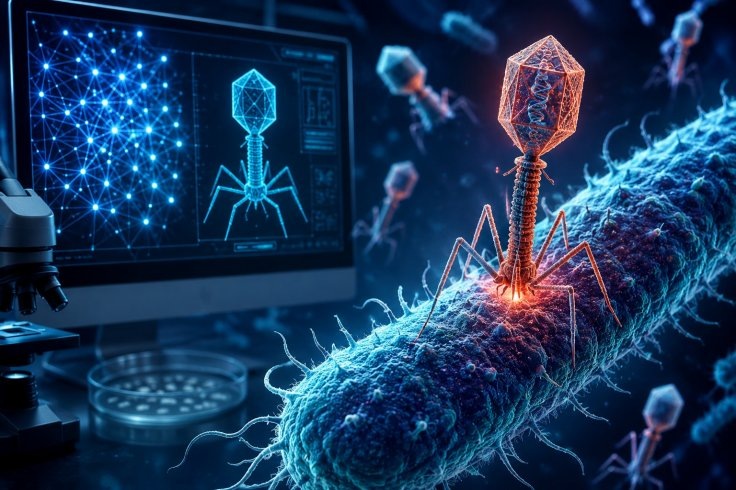
Only a small proportion of synthesized candidates were viable, showing that generating a sequence computationally does not automatically produce a functioning virus. The advance has also prompted warnings from biosecurity experts.
Researchers from the Johns Hopkins Center for Health Security wrote in a companion article in Science that the ability to compose viral genomes using generative AI now exists, while governance for safely managing the capability has not developed at the same pace.
They specifically warned against applying the approach to eukaryote-infecting pathogens, which can infect humans, animals or plants. Another concern is DNA synthesis screening.
Existing systems can compare sequences against databases of known pathogens and toxins, but AI-generated genomes may be novel and therefore difficult to identify using conventional sequence matching approaches.
The Johns Hopkins researchers called for stronger safeguards, including improved screening of synthetic DNA orders and methods capable of detecting potentially dangerous AI-generated sequences.
Jordi García Ojalvo, a professor of systems biology at Pompeu Fabra University of Barcelona, called the breakthrough significant while noting that the need to test generated genomes individually limits the immediate risk.
Patrick Cai, a synthetic biology researcher at the University of Manchester, said the findings suggest genome language models are beginning to learn biological design principles encoded by evolution.
The study establishes a new capability in AI-assisted genome design but does not demonstrate that the technology can generate viruses capable of infecting humans.
For now, the successful designs target E. coli. The researchers and biosecurity experts say the development of appropriate safeguards will become increasingly important as biological AI systems continue to advance.
Can AI now design viruses from scratch?
The study shows that AI can generate functional bacteriophage genomes from scratch. The viruses tested infect E. coli and were not shown to infect humans.
Could these viruses help treat antibiotic-resistant infections?
The results suggest potential for phage therapy. A mixture of the AI-designed phages overcame resistance in some E. coli strains during laboratory testing, but the approach remains experimental.
Does the study prove AI can create human infecting viruses?
No. The researchers focused on bacteriophages and excluded sequences associated with viruses known to infect humans, animals, plants and fungi from the relevant training data.


