
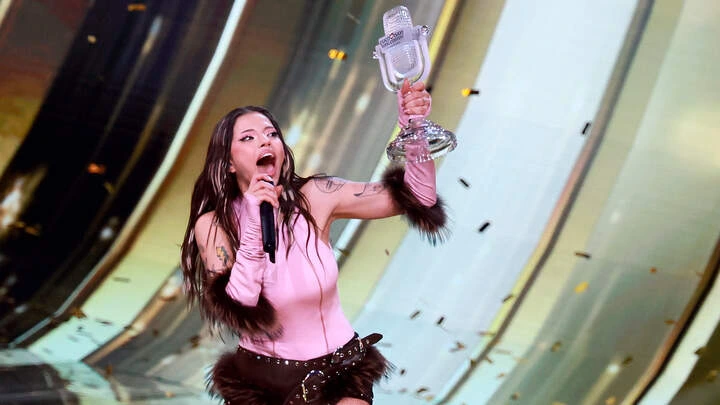
Bulgaria Eurovision victory dominated global entertainment headlines Saturday after Bulgarian singer Dara won the 2026 Eurovision Song Contest in Vienna, while Israel finished second amid widespread political protests over the Gaza war.
SUMMARY
- Bulgaria secured its first Eurovision title after seven decades of participation.
- Five countries boycotted Eurovision over Israel’s participation linked to the Gaza conflict.
- European broadcasters face mounting pressure over future contest governance and political neutrality.
The 2026 contest transformed Eurovision from a music spectacle into a test of European cultural diplomacy.
Hosted in Vienna’s Wiener Stadthalle, the event drew roughly 10,000 spectators while exposing widening divisions among public broadcasters over Israel’s role in international entertainment platforms.
The Bulgaria Eurovision victory came through Darina Yotova, professionally known as Dara, whose dance anthem “Bangaranga” topped jury and audience voting.
Bulgarian Deputy Prime Minister Atanas Pekanov called the result “a magnificent story of immense talent and tireless effort.”
Eurovision’s political tensions intensified after Spain, Ireland, Iceland, Slovenia and the Netherlands withdrew from participation.
The boycott followed mounting civilian casualties in Gaza since October 2023. According to Gaza health authorities, more than 72,740 Palestinians have been killed.
Media analyst Dr. Sofia Kalogeropoulos of the European Media Institute said Eurovision now faces “its deepest institutional legitimacy challenge since the Cold War era.”
Meanwhile, Vienna based political sociologist Markus Heller noted public broadcasters increasingly face domestic political pressure tied to foreign policy disputes.
Outside the arena, Austrian police monitored hundreds of demonstrators opposing Israel’s inclusion.
Protest organizer Lena Hartwig said cultural institutions “can no longer separate entertainment from geopolitical accountability.”
The Bulgaria Eurovision victory is expected to boost Bulgaria’s tourism and music exports through 2027.
European Broadcasting Union officials meanwhile face growing calls for formal membership voting reforms before Eurovision 2027.
NOTE! This article was generated with the support of AI and compiled by professionals from multiple reliable sources, including official statements, press releases, and verified media coverage. For more information, please see our T&C.


