
SUMMARY
A total lunar eclipse, or blood moon, will be visible across large parts of North America and the Asia Pacific region.
The celestial event will not be widely seen again until late 2028, with the next North America visible total lunar eclipse in June 2029.
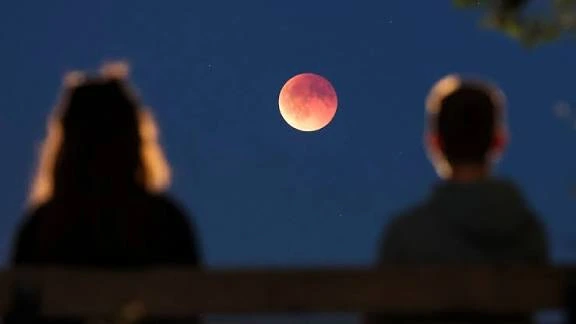
A rare total lunar eclipse, widely known as a “blood moon,” will be visible across North America, Australia and New Zealand on Tuesday, marking the last opportunity for nearly three years to witness the moon turn a deep coppery red as it passes fully into Earth’s shadow.
Astronomers say the blood moon highlights Earth’s atmosphere and orbital dynamics, offering both scientific and public engagement value.
Skywatchers across multiple continents are preparing for a total lunar eclipse that will transform Tuesday’s full moon into a dramatic red sphere.
The phenomenon occurs when Earth aligns directly between the sun and the moon, blocking direct sunlight and casting a shadow across the lunar surface.
The eclipse is expected to draw broad public interest due to favorable viewing times in major cities and its extended absence from the Americas after this event.
During a total lunar eclipse, sunlight filtering through Earth’s atmosphere bends and reaches the moon indirectly. Shorter blue wavelengths scatter, while longer red wavelengths pass through, bathing the moon in a reddish glow.
Dr. Rebecca Allen, an astrophysicist at Swinburne University, said the light that passes through Earth’s atmosphere transforms the lunar surface into “a deep, coppery red.”
Dr. Brad Tucker, an astrophysicist at Australian National University, said the effect is similar to sunrise or sunset colors, when refracted light skims the atmosphere.
Total lunar eclipses typically occur every 18 months to three years.
The next total lunar eclipse will occur on New Year’s Eve 2028 but will not be visible in the Americas. North America’s next full view is scheduled for June 2029.
Viewing Times in Selected Cities
| City | Eclipse Start | Eclipse End |
|---|---|---|
| New York, Washington | 3:44 a.m. | About 6:30 a.m. |
| Detroit | 3:44 a.m. | 7:06 a.m. |
| New Orleans, Chicago | 2:44 a.m. | About 6:24 a.m. |
| San Francisco, Los Angeles | 12:44 a.m. | About 6:23 a.m. |
| Tokyo | 5:44 p.m. | 11:23 p.m. |
| Beijing | 6 p.m. | 10:23 p.m. |
NASA noted observers near the edge of the visibility region may see only part of the eclipse if the moon sets before totality ends.
Richard Easther, a physics professor at the University of Auckland, said the eclipse will be visible nationwide in New Zealand when it reaches its deepest point shortly after midnight.
“As an astronomer, I am excited by anything that encourages people to look up and experience the night sky,” Easther said.
Astronomers note that public interest in a blood moon often spikes during periods of heightened social media activity, though the phenomenon itself is predictable and well understood within orbital mechanics.
NASA officials recommend viewing from dark locations away from city lights and allowing 10 to 15 minutes for eyes to adjust. Jupiter will also be visible high in the sky, offering what Allen described as “a great pairing.”
The March full moon, often called the “worm moon” in North American tradition, coincides with seasonal soil warming in the Northern Hemisphere.
A partial lunar eclipse is scheduled for Aug. 28, 2026, with optimal visibility in the Americas and Africa.
While lunar eclipses are routine astronomical events, scientists say each blood moon provides a visible demonstration of Earth’s atmospheric composition and planetary motion.
Tuesday’s blood moon total lunar eclipse offers millions a rare opportunity to witness the alignment of sun, Earth and moon in vivid color.
For many regions, it will be the final full spectacle until the end of the decade, underscoring both its rarity and enduring appeal.
NOTE! This article was generated with the support of AI and compiled by professionals from multiple reliable sources, including official statements, press releases, and verified media coverage. For more information, please see our T&C.


