
SUMMARY
- Trump’s speech is expected to emphasize domestic economic achievements and job creation while minimizing foreign policy tensions.
- Approval ratings show 39% support for Trump’s economic leadership and 38% for his immigration policies.
- The address may set the stage for Republican messaging ahead of midterm elections, with Democrats likely to protest or boycott portions of the speech.
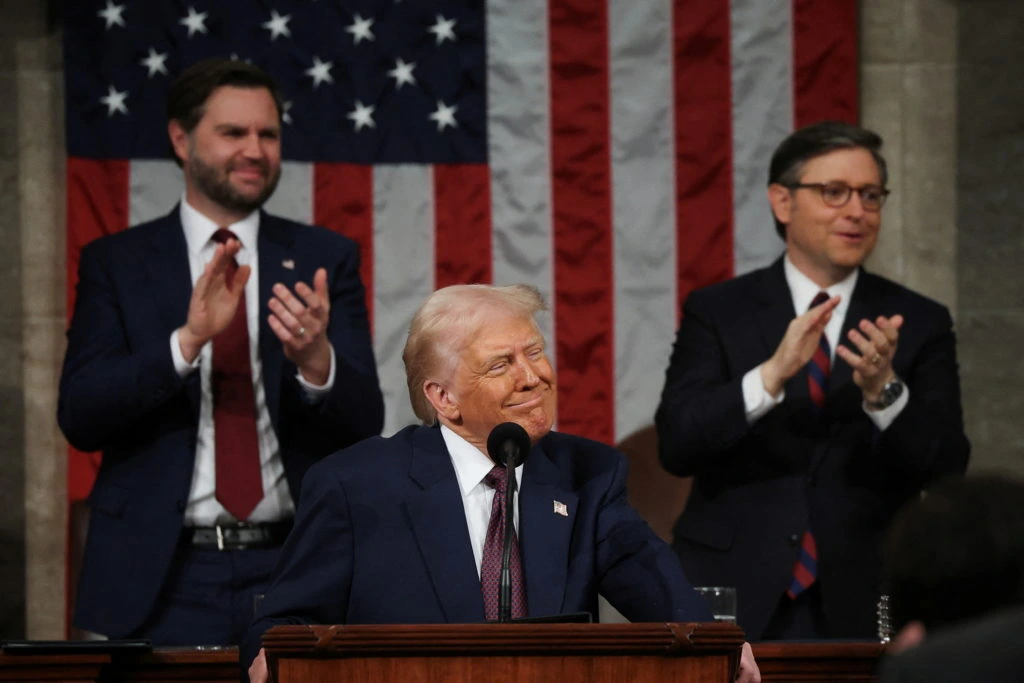
WASHINGTON — President Donald Trump is set to deliver his 2026 State of the Union address on Tuesday, a high stakes moment aimed at energizing Republican voters ahead of November’s midterm elections for control of Congress.
The address comes amid declining approval ratings and recent Supreme Court rulings that have constrained his economic and trade policies.
The State of the Union has become a pivotal platform for Trump to appeal directly to voters, framing the narrative for his party heading into a potentially contentious midterm cycle.
With polls reflecting voter skepticism over the first year of his second term, the president is expected to focus on economic themes, infrastructure, and energy costs while framing Democrats as responsible for ongoing challenges.
Trump returned to the White House in 2025 on promises of economic revival and tighter immigration controls.
While early measures included sweeping tax cuts and attempts to impose tariffs on foreign goods, public approval has waned.
The Supreme Court’s February ruling limiting his tariff authority has added pressure on the administration to articulate a credible economic plan.
Additionally, recent clashes between federal agents and protesters, resulting in two US citizen deaths, have drawn public scrutiny of his domestic enforcement strategies.
“Given the Supreme Court decision and slower economic growth, the president needs to bolster his economic message,” said Alex Conant, a Republican strategist.
Conant expects Trump to highlight job creation, manufacturing reshoring, and lower energy costs while attributing economic struggles to Democratic policies under former President Joe Biden.
Vice President JD Vance echoed this approach, stating in a Fox News interview that Trump would focus on reshoring manufacturing and energy affordability.
Political analyst Kathleen Hall Jamieson of the University of Pennsylvania said the address will likely resemble a campaign speech “Expect Democrats cast as villains, Republicans as heroes, and the president positioned as both national and global savior.”
Trump’s foreign policy record including military strikes in Yemen, Nigeria, Iran, and a high profile operation targeting Venezuela’s former leader Nicolás Maduro has yet to translate into domestic political support.
Observers note that voters may respond more strongly to domestic economic issues than global interventions.
“People want to know how these policies affect their everyday lives,” said Maya Hernandez, a small business owner in Houston.
“Tariffs and tax cuts sound good, but our costs haven’t gone down much.” Congressional staffers expect heightened partisan tension.
“Some Democrats may boycott or protest, similar to prior years,” said Jonathan Blum, a congressional analyst with the Brookings Institution.
A Republican strategist, Alex Conant, added, “Any House Republicans who fail to support the president’s tariffs could be spotlighted, reinforcing party messaging.”
Trump’s address could shape Republican strategies for the midterms by reinforcing economic messaging and framing Democrats as obstacles to recovery.
While foreign policy has dominated headlines, analysts predict the speech will prioritize domestic concerns to resonate with undecided voters.
Lawmakers’ reactions applause, protest, or absence may influence media coverage and public perception in the coming months.
The 2026 State of the Union represents a critical political moment for Trump, offering a platform to rally supporters, define policy priorities, and influence midterm voter sentiment.
The balance between domestic economic focus and restrained foreign policy messaging will be closely watched by both parties, setting the tone for an election year marked by public skepticism and partisan tension.
NOTE! This article was generated with the support of AI and compiled by professionals from multiple reliable sources, including official statements, press releases, and verified media coverage. For more information, please see our T&C.


