
SUMMARY
- The Lovers’ Arch collapse occurred after severe storms struck southern Italy on Valentine’s Day
- Officials link coastal erosion and extreme weather to the arch’s deterioration
- The site was a major tourism symbol for Salento and Puglia
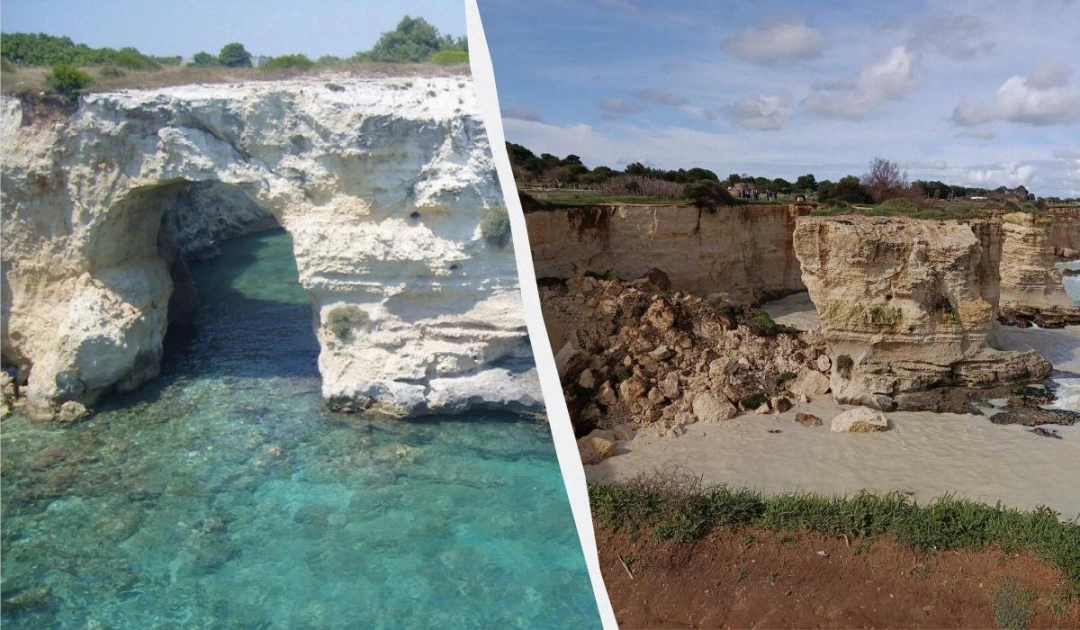
SALENTO, Italy — A powerful winter storm swept away Italy’s famed Lovers’ Arch collapse site along the Adriatic coast on Valentine’s Day, toppling the centuries old rock formation known as Faraglioni di Sant’Andrea and alarming officials in the southern Puglia region.
The natural stone arch, long associated with romance and marriage proposals, crumbled after days of heavy seas and high winds battered the calcarenite cliffs near the town of Melendugno. Local authorities said the structure had shown signs of fragility for years.
The collapse of the landmark often called “Lovers’ Arch” for the tradition that couples who kissed beneath it would share eternal love has prompted renewed scrutiny of coastal erosion and climate related risks across southern Europe.
Maurizio Cisternino, mayor of Melendugno, said the loss represents “a blow to the heart” for the community and for Salento’s tourism image.
He said the municipality had previously sought national funding for preservation but did not secure the grant.
The arch formed over centuries as wind and waves carved through soft calcarenite rock along Puglia’s Adriatic shoreline. In the late eighteenth century, the promontory shifted from a pirate lookout point to a romantic destination.
Social media exposure in recent years increased visitor numbers, though access remained free and unregulated.
Pierpaolo Campostrini, director of CORILA, a Venice based consortium studying lagoon and coastal systems, said rising sea temperatures in the Mediterranean intensify storm systems and accelerate erosion.
“Warmer waters add energy to weather events, which increases mechanical stress on fragile coastal formations,” he said.
According to Italy’s Higher Institute for Environmental Protection and Research, nearly 23 percent of the nation’s coastline is subject to significant erosion, with southern regions particularly vulnerable.
| Indicator | Current Estimate | Historical Context |
|---|---|---|
| Italian coastline at erosion risk | 23% | Increasing over past 20 years |
| Preservation grant sought | $4.5 million | Not approved in 2024 |
| Mediterranean surface temperature rise | +1.4°C since preindustrial era | Above global average |
Lorenzo Barlato, a local resident who proposed to his wife overlooking the arch more than 40 years ago, said he was “deeply saddened” by the loss, calling it part of the area’s identity.
Francesco Stella, Puglia’s tourism councillor, said the region will assess safety conditions along nearby cliffs but acknowledged that “nature has reclaimed what it created.”
Municipal officials said remaining debris will be left to erode naturally. Regional authorities are reviewing broader coastal management strategies as extreme weather events become more frequent across Italy’s south.
NOTE! This article was generated with the support of AI and compiled by professionals from multiple reliable sources, including official statements, press releases, and verified media coverage. For more information, please see our T&C.


