
SUMMARY
- Investigators confirmed Nancy Guthrie case DNA evidence was recovered from her property and nearby items
- Authorities have processed more than 32,000 leads with assistance from federal and local agencies
- Officials said DNA collected does not match family members or known close contacts
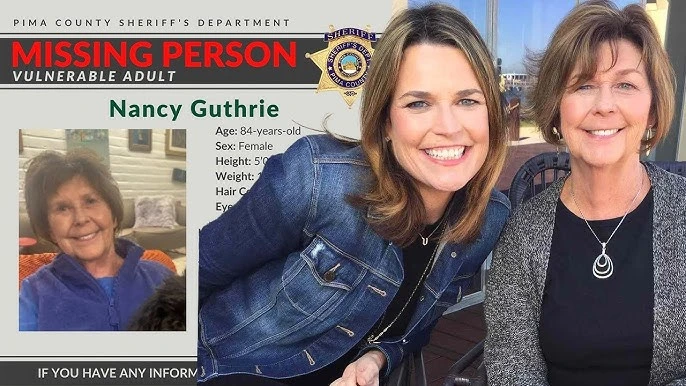
TUCSON, Arizona — Authorities investigating the disappearance of 84 year old Nancy Guthrie say newly obtained DNA evidence has intensified efforts to identify a masked suspect believed responsible for her abduction earlier this month, even as thousands of tips have yet to produce a confirmed breakthrough.
The discovery of forensic material has shifted focus toward laboratory analysis and suspect identification, according to officials overseeing the search near Tucson.
The development represents one of the most concrete investigative steps since Guthrie vanished from her home Feb. 1, prompting national attention due to her connection to broadcast journalist Savannah Guthrie.
Chris Nanos, sheriff of Pima County Sheriff’s Department, said forensic teams recovered DNA samples from Guthrie’s residence and from gloves found roughly two miles away.
Doorbell camera footage recorded the night of her disappearance shows a masked individual wearing gloves, a backpack and what appeared to be a holstered handgun.
Authorities said the Nancy Guthrie case DNA evidence did not belong to relatives, household staff or other individuals known to have regular access to the home.
Investigators also collected elimination samples from family members and workers to narrow the pool of potential matches.
The Federal Bureau of Investigation joined the investigation and increased its reward to $100,000 for information leading to
Guthrie’s recovery or a suspect’s arrest. Officials described the suspect as a man approximately five feet nine inches to five feet 10 inches tall with an average build.
Michael Alcazar, adjunct professor at John Jay College of Criminal Justice and a retired New York police detective, said forensic evidence can provide critical direction even when immediate matches are unavailable.
“DNA can transform an investigation by identifying unknown individuals or linking evidence across locations,” Alcazar said.
“But timelines depend on database availability, lab processing and whether the suspect has prior records.”
Erik Smith, professor of forensic science at Arizona State University, said DNA findings often narrow investigative scope rather than instantly solving cases.
“Recovery of unknown DNA suggests an external actor was present,” Smith said. “It provides investigative leverage, but matching and confirmation require precise lab comparisons and corroborating evidence.”
Sheriff Nanos acknowledged the emotional and investigative volatility tied to the Nancy Guthrie case DNA evidence and extensive public leads.
“It’s exhausting, these ups and downs,” Nanos said. “But we will keep moving forward.”
Savannah Guthrie, co-host of the Today, urged the public to remain vigilant and report suspicious observations to authorities.
We are at an hour of desperation, and we need your help,” she said in a public message.
Fred Talbott, a retired Virginia resident who contacted federal authorities after viewing suspect images, said public participation remains vital. “I saw something that might help, and I wanted investigators to know,” Talbott said.
Authorities said laboratory analysis of the Nancy Guthrie case DNA evidence remains ongoing.
Investigators continue comparing samples against national forensic databases and reviewing digital surveillance footage, delivery records and regional activity patterns.
Officials emphasized that forensic timelines vary widely depending on laboratory processing speeds and the availability of comparable DNA profiles.
The emergence of Nancy Guthrie case DNA evidence marks a critical stage in an investigation defined by scale and urgency.
While the forensic material has not yet identified a suspect, officials said it strengthens investigative direction and reinforces their commitment to resolving the disappearance through evidence driven methods and sustained public cooperation.
NOTE! This article was generated with the support of AI and compiled by professionals from multiple reliable sources, including official statements, press releases, and verified media coverage. For more information, please see our T&C.


