
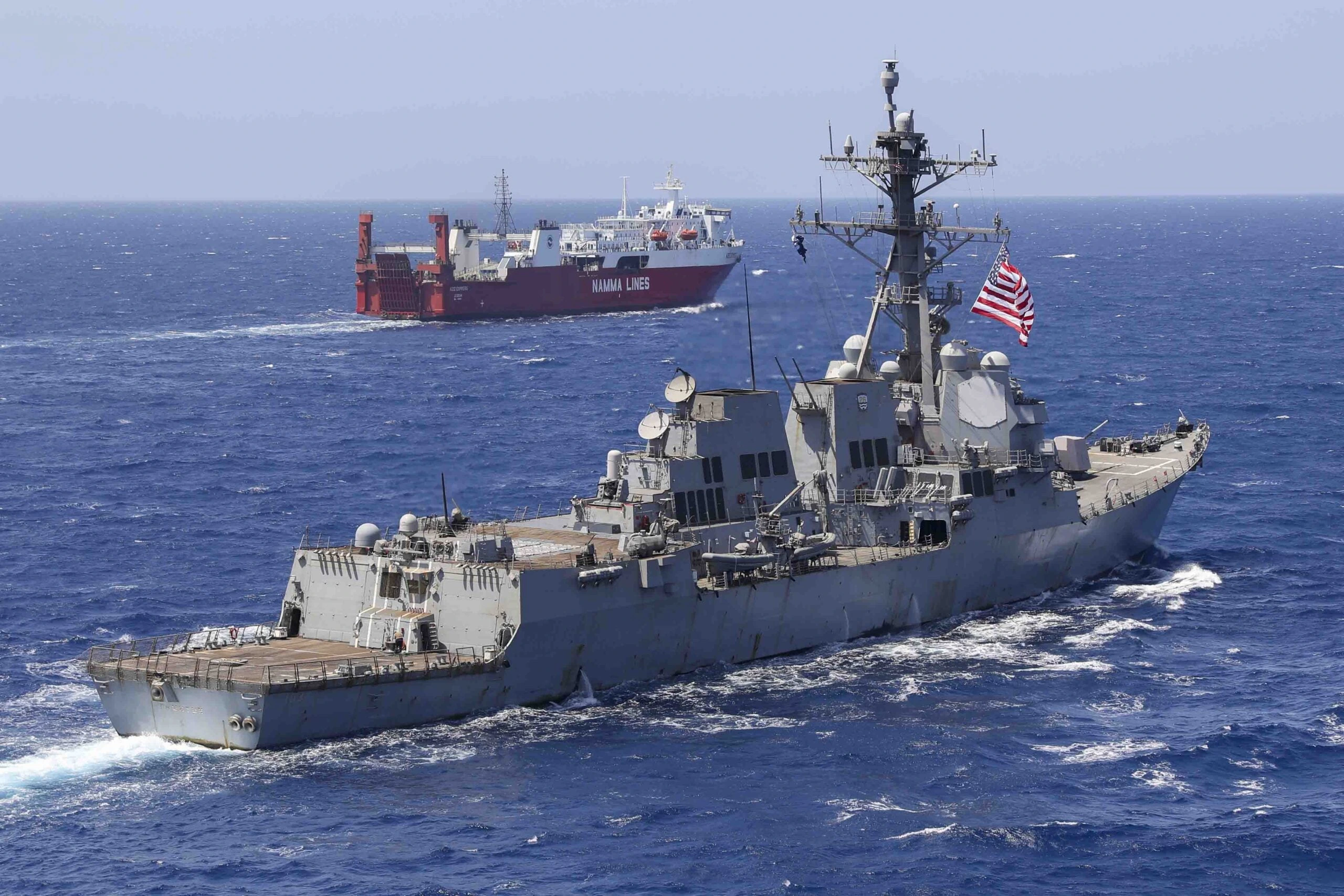
SUMMARY
- USS Truxtun and USNS Supply collided in the Caribbean Sea during a routine resupply operation, resulting in two minor injuries.
- Both vessels are now sailing safely; injured personnel are in stable condition, according to US Southern Command.
- The collision underscores operational risks amid the largest US naval deployment in the Caribbean in decades.
Two US Navy ships collided Wednesday in the Caribbean Sea, injuring two sailors during a routine at sea resupply operation, US Southern Command said Thursday.
The destroyer USS Truxtun and the supply ship USNS Supply were performing a parallel transfer of fuel and provisions when the collision occurred.
The incident highlights operational challenges faced by the US Navy amid its historically large presence in the Caribbean.
Southern Command confirmed both vessels are now operating safely, and the sailors sustained minor injuries.
The USS Truxtun, a recently commissioned Arleigh Burke class destroyer, left Norfolk, Virginia, on Feb. 3.
After an emergent equipment repair, it returned to sea on Feb. 6. The Caribbean deployment forms part of a 12-ship US naval presence, including the aircraft carrier USS Gerald R.
Ford and several amphibious assault ships. The Trump administration initiated the buildup, citing drug interdiction and regional security missions.
“Collisions at sea are rare but carry serious operational implications,” said Rear Adm. Daniel B. Fuller, maritime operations analyst at the Center for Naval Analysis.
“Even minor incidents can delay critical missions and require immediate investigations.”
Dr. Laura Simmons, senior fellow for maritime security at the Atlantic Council, noted, “The Caribbean remains a complex operational theater.
Resupply maneuvers require precise navigation under challenging conditions, making safety protocols essential.”
Lt. Cmdr. Sarah Delgado, US Southern Command spokesperson, said, “Both ships have resumed operations, and the safety of personnel is our top priority.”
Petty Officer James Herrera, aboard the USS Truxtun, described the collision as “a sudden jolt during routine resupply” but praised the crew’s swift response.
The Navy has launched an internal investigation to assess equipment, procedural, and human factors. Operational safety reviews and training are expected to continue as the deployment progresses.
While no long term damage was reported, the collision underscores the challenges of sustaining large scale naval operations in sensitive regions, highlighting the need for vigilance during high risk maneuvers.
NOTE! This article was generated with the support of AI and compiled by professionals from multiple reliable sources, including official statements, press releases, and verified media coverage. For more information, please see our T&C.


