
KEY POINTS
- Washington Post layoffs will eliminate entire sections including sports and books
- National politics, business and health coverage will become core priorities
- The cuts highlight ongoing financial pressure across the global news industry
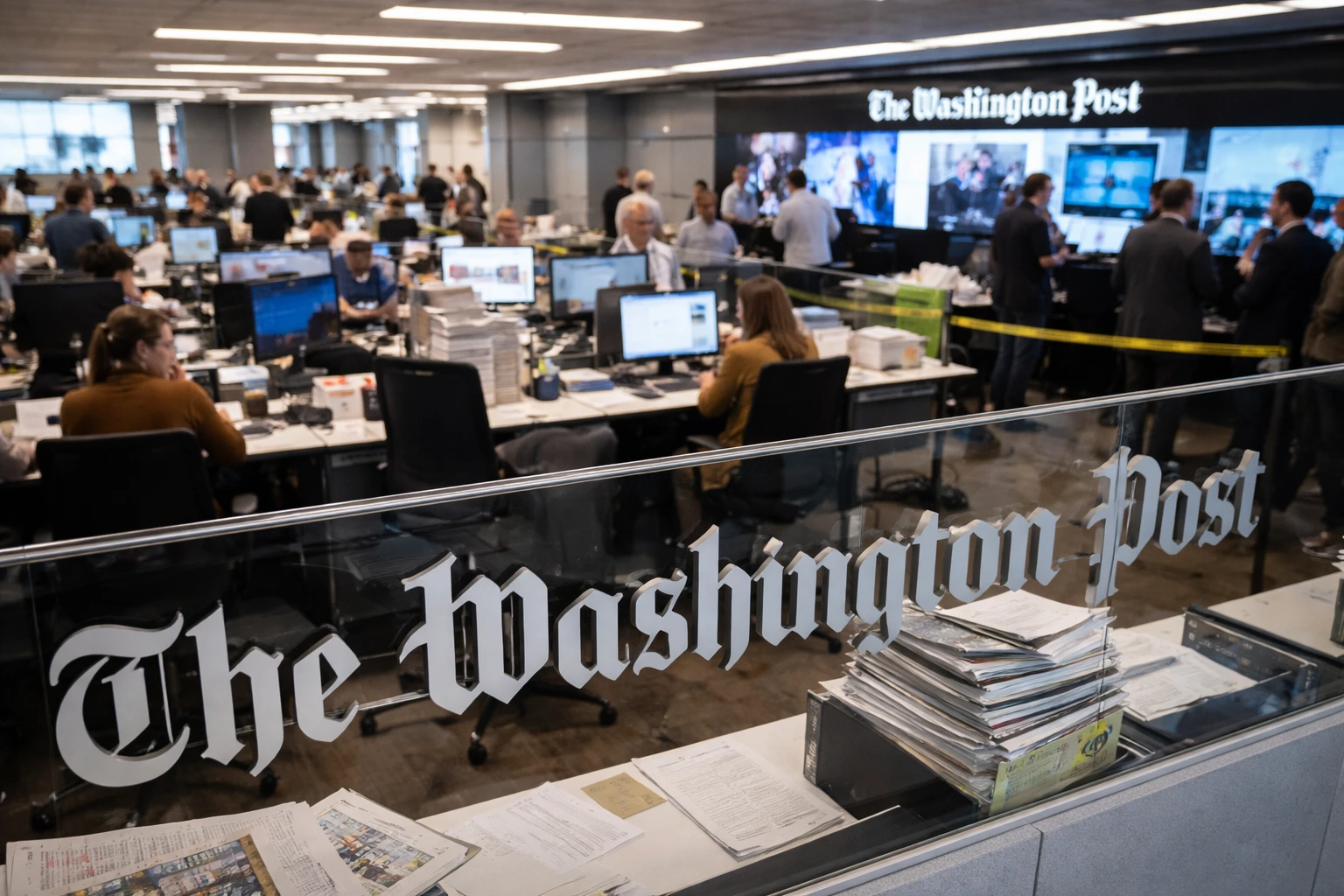
The Washington Post on Wednesday began a widespread round of layoffs that will sharply reduce its sports, local and international coverage, part of a broader restructuring aimed at curbing financial losses and refocusing the newspaper on national news, politics, business and health, according to newsroom leadership.
The decision marks one of the most significant structural shifts at The Washington Post in recent years and underscores the difficulty even globally recognized news organizations face in building sustainable digital business models.
Executives say the changes are intended to better align coverage with reader demand and long term financial stability.
Executive Editor Matt Murray told newsroom employees during a staff call that all departments would be affected.
He confirmed the sports section will close, though some journalists will move into the features department to cover sports culture.
The metro desk will shrink, the books section will shut down and the “Post Reports” daily podcast will end. International reporting will be reduced but maintained in nearly a dozen global bureaus.
Murray said the organization has lost substantial amounts of money for years and has struggled to meet audience needs.
He described the moves as a “broad strategic reset with a significant staff reduction,” adding that business side operations are also facing cuts.
The Post has been owned by Amazon founder Jeff Bezos since 2013. After years of expansion and newsroom investment, the paper has faced declining digital traffic and subscriptions, mirroring trends across the media industry.
Bezos appointed Will Lewis as publisher in late 2023 to chart a path toward profitability. Lewis has overseen experiments involving artificial intelligence tools for comments moderation, podcasts and news aggregation.
“These cuts reflect a strategic narrowing rather than a collapse,” said Rasmus Kleis Nielsen, director of the Reuters Institute for the Study of Journalism at the University of Oxford.
“Many legacy newsrooms are concentrating resources where they believe audiences and revenue potential are strongest, particularly national politics.”
Margaret Sullivan, a journalism professor at Columbia University and former media columnist, said the loss of sports and local coverage could weaken community ties.
“Metro and sports reporting are often where readers form daily habits. Shrinking those areas risks accelerating audience erosion,” she said.
In a 2024 staff meeting, Lewis warned employees that the company was in serious financial trouble.
“We are losing large amounts of money,” he said, adding that readership had declined sharply.
At a New York Times conference later that year, Bezos acknowledged the challenge, saying, “We saved The Washington Post once, and we’re going to save it a second time.”
Media economist Robert Picard of the University of Oxford said the layoffs are symptomatic of wider disruption.
“Generative artificial intelligence, platform dependence and subscription fatigue have fundamentally altered the economics of news,” he said. “Cost reductions are often the fastest lever executives can pull.”
The Washington Post is expected to invest more heavily in flagship national reporting and digital products while continuing to test technology driven efficiencies.
Executives have not provided a timeline for completing the layoffs or detailed figures on job losses.
The restructuring places renewed emphasis on proving that a globally influential newsroom can adapt to shifting reader behavior without abandoning journalistic standards.
The Washington Post layoffs signal a pivotal moment for one of the world’s most prominent newspapers and reflect broader pressures reshaping journalism worldwide.
As publishers confront declining audiences and revenues, the Post’s strategic reset will be closely watched as a test of whether focus and scale can restore financial stability in the digital age.
NOTE! This article was generated with the support of AI and compiled by professionals from multiple reliable sources, including official statements, press releases, and verified media coverage. For more information, please see our T&C.


