
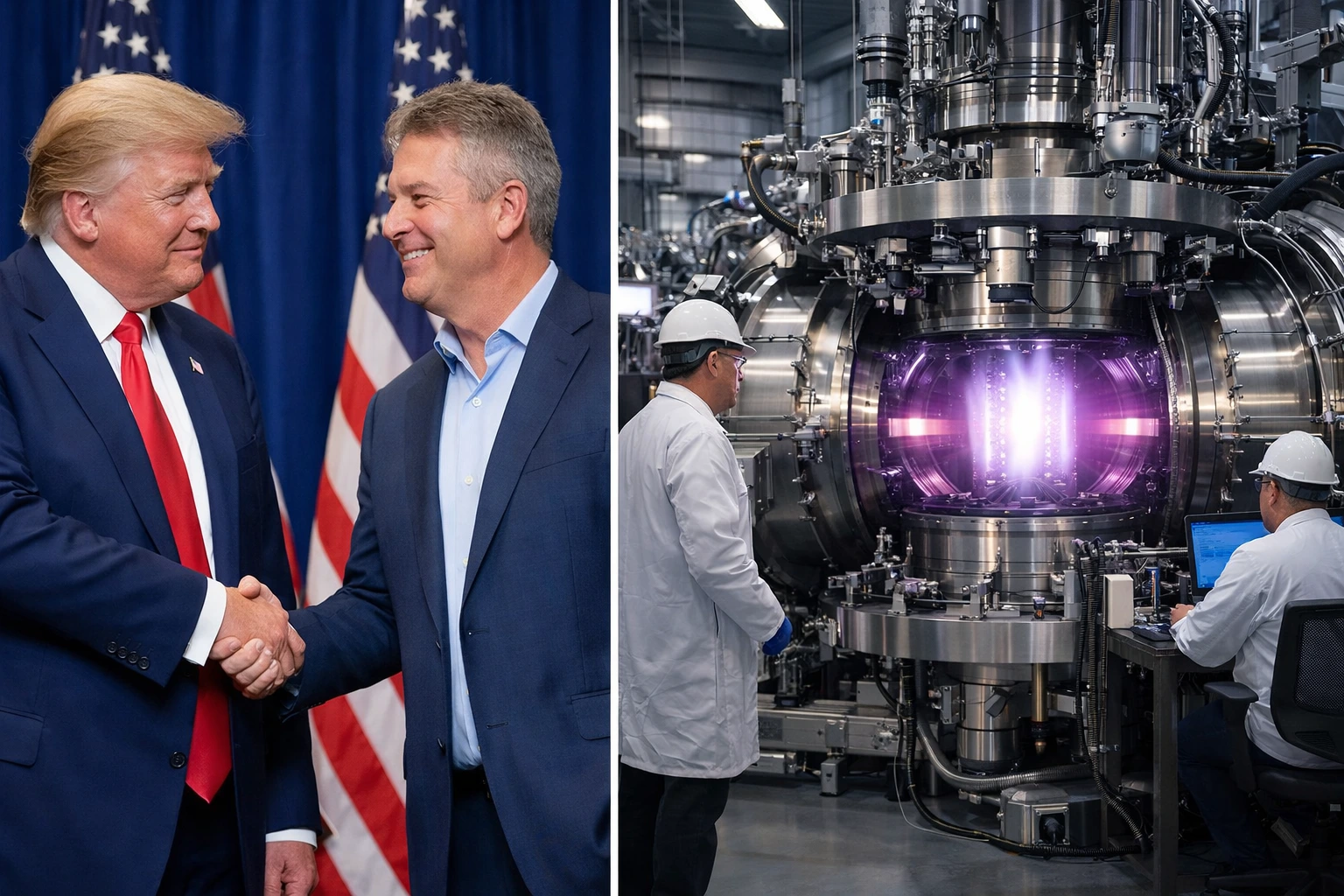
Trump Media and Technology Group said Thursday it had agreed to merge with TAE Technologies, a privately held fusion energy company, in an all stock transaction valued at more than six billion dollars, a move that sent Trump Media shares soaring in premarket trading.
The announcement pushed DJT stock up about twenty five percent before the opening bell, reversing some of the steep losses the stock has suffered this year.
The transaction, known as the Trump Media TAE merger, is expected to close in mid 2026, subject to regulatory approvals and shareholder consent.
Trump Media, best known as the parent company of the social media platform Truth Social, has steadily broadened its ambitions since going public.
Earlier this year, the company expanded into financial services with the launch of Truth.Fi, signaling a strategy that extends well beyond digital media.
TAE Technologies, based in California, focuses on advanced fusion research, a field that has long promised clean and nearly limitless energy but has yet to produce electricity at a commercial scale.
No fusion power plant currently supplies power to the grid, according to the US Energy Information Administration.
Under the terms of the Trump Media TAE merger, shareholders of each company would own roughly half of the combined entity.
Trump Media would become the holding company for Truth Social, Truth+, Truth.Fi and several TAE subsidiaries, including TAE Power Solutions and TAE Life Sciences, the companies said.
Former President Donald Trump indirectly owns more than one hundred fourteen million shares of Trump Media. Before taking office in January, he transferred his majority stake into a revocable trust overseen by his eldest son, Donald Trump Jr.
Energy analysts cautioned that while fusion remains one of the most promising frontiers in power generation, commercial viability is still uncertain.
“Fusion has made impressive scientific progress over the past decade, but scaling it into a utility grade power plant remains an enormous engineering and financial challenge,” said Dr. Karen Whitfield, an energy policy researcher at Stanford University.
“Public market funding could accelerate development, but it also introduces pressure to deliver results on a fixed timeline.”
Media industry observers noted that the Trump Media TAE merger represents an unconventional pairing of a politically oriented media company and a deep-tech energy firm.
“This is not a typical diversification play,” said Michael Grant, a technology mergers analyst based in New York. “It signals a desire to position the company around national-scale infrastructure and energy narratives rather than consumer media alone.”
Trump Media shares have fallen more than seventy five percent since reaching their peak in January, reflecting volatile trading and questions about long term revenue growth.
By contrast, fusion startups attracted billions of dollars in private investment globally over the past five years, according to data from the Fusion Industry Association.
Several competitors, including Commonwealth Fusion Systems and Helion Energy, remain privately funded.
If completed, the Trump Media TAE merger would make the combined company one of the first fusion focused firms traded on public markets.
In Rancho Cucamonga, California, where TAE operates research facilities, some local residents greeted the announcement with cautious optimism.
“We’ve seen these scientists working here for years, and it’s exciting to think their work could eventually power cities,” said Luis Mendoza, a nearby business owner. “At the same time, people want to know what this means for jobs and long term stability.”
A Trump Media shareholder from Florida, who declined to give his name, said the stock jump was encouraging but not decisive. “The market likes big ideas,” he said. “Whether this actually works is a different question.”
Following the merger, the companies said they aim to develop what they described as the world’s first utility scale fusion power plant, pending regulatory clearance.
Fusion energy, they said, could eventually provide abundant electricity to support artificial intelligence infrastructure and broader economic growth.
Federal approval processes, capital requirements and technical milestones remain significant hurdles. Industry experts said timelines for operational fusion plants often extend well beyond initial projections.
The Trump Media TAE merger marks a bold and unconventional step for a company that began as a social media platform and is now positioning itself at the intersection of media, finance and advanced energy research.
While the market reacted swiftly, the long term impact will depend on whether fusion technology can move from experimental promise to commercial reality within the coming decade.


