
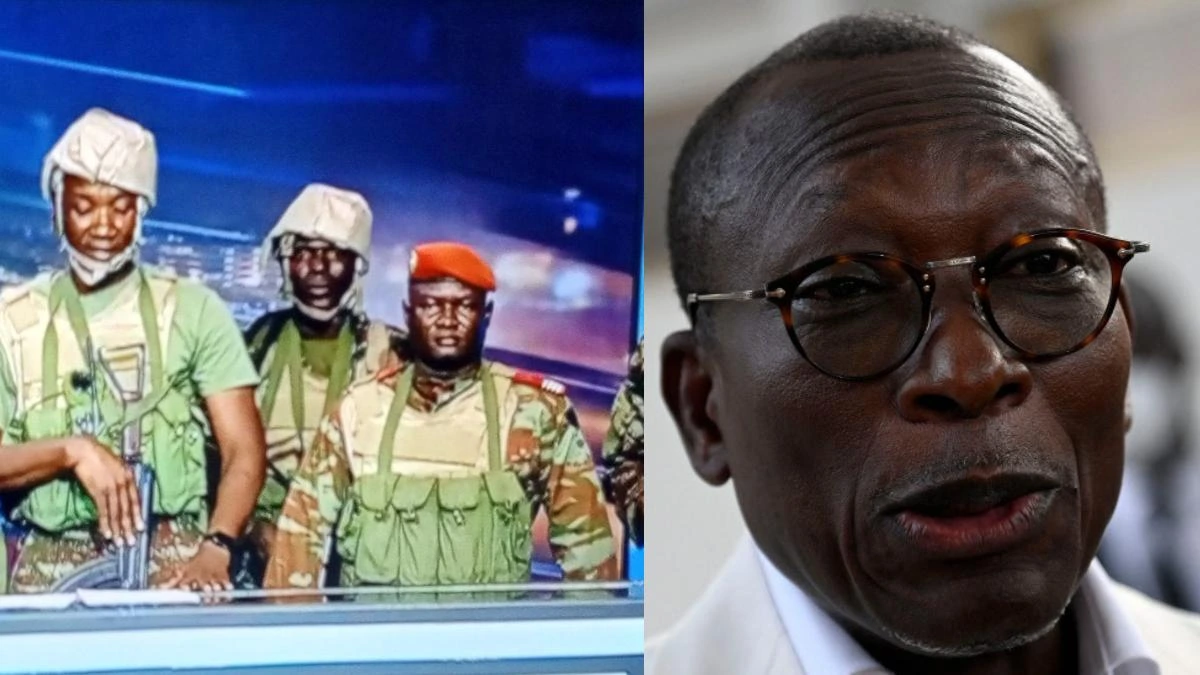
DAKAR, Senegal — Benin’s government said Sunday that it had thwarted an attempted military coup after a small group of soldiers briefly seized state television and announced they had removed the president and dissolved national institutions.
Officials said security forces regained control within hours, preventing what they called a coordinated effort to destabilize the country. The Benin coup attempt came amid heightened political tensions ahead of next year’s presidential election.
Early Sunday, eight soldiers identifying themselves as the Military Committee for Refoundation appeared on state television declaring that President Patrice Talon had been removed and that the country’s borders were closed.
The broadcast cut abruptly after just minutes, and local media reported that national guard units quickly moved to secure the area around the presidential residence.
Interior Minister Alassane Seidou said the soldiers had “engaged in a mutiny aimed at destabilizing the state and its institutions,” adding that loyal forces responded swiftly.
“Their retaliation allowed us to keep control of the situation and to fail the maneuver,” Seidou said in a video posted on social media.
The Benin coup attempt followed a successful overthrow last month in Guinea Bissau and comes as West Africa has faced a growing wave of military takeovers in Mali, Burkina Faso, Niger and Guinea.
Benin, a coastal nation of about fifteen million people, had long been seen as one of the region’s most stable democracies.
Analysts warned that the Benin coup attempt underscores the country’s increasingly fragile political environment.
Talon, who has ruled since 2016, has been credited with economic reforms but accused of restricting political freedoms by barring key opposition parties from elections and jailing prominent critics.
Dr. Ibrahim Sanou, a political researcher at the University of Abomey Calavi, said the failed plot reflects “a democratic malaise that has been building for several years.”
He added that while the government restored order, the underlying tensions remain. “When opposition voices are pushed out of the political arena, it creates fertile ground for instability,” Sanou said.
The Economic Community of West African States (ECOWAS) condemned the attempted takeover and said it would support Benin “in all forms necessary, including the deployment of the regional standby force.”
The bloc has struggled to contain recurring coups in the region and is under growing pressure to prevent further erosion of civilian rule. Coup attempts in West Africa have increased sharply over the past five years.
According to data compiled by regional security monitors, at least seven governments have been overthrown since 2020, marking the highest concentration of military takeovers in the region since the 1980s.
Benin had avoided such disruptions for more than three decades, earning a reputation for political stability.
But Freedom House, a Washington based democracy watchdog, reported last year that the country’s status had shifted from “free” to “partly free,” citing constraints on opposition activity and rising concerns over executive power.
Security analyst Mariam Diallo said Sunday’s events fit a broader pattern. “The Benin coup attempt is not an isolated incident but part of a regional contagion of military adventurism,” she said.
“Countries once considered anchors of democracy are increasingly vulnerable.” In Cotonou, residents described a tense but brief period of uncertainty.
“We woke up to rumors that the army was divided and soldiers were on TV,” said Benoît Kouassi, a shopkeeper near the city center. “People were scared, but by midday the situation seemed calm again.”
A civil society activist, Léonie Hounkpe, said many citizens feel caught between fears of instability and frustration with political restrictions.
“No one wants a coup, but people also want their voices heard,” she said. “If the government does not open democratic space, moments like this can happen again.”
Talon has said he intends to leave office when his term ends next year, as required by the constitution. However, he has also continued to limit opposition participation, raising questions about whether the coming election will be genuinely competitive.
Experts said authorities will likely increase surveillance and tighten internal discipline within the armed forces after the Benin coup attempt, while opposition supporters may push harder for political reforms.
Diplomats in the region warned that tensions could rise further as the election approaches. “This was a warning sign,” a Western official based in Abuja said. “Benin has been stable for years, but the pressures that led to this incident have not gone away.”
Authorities said the situation is now under control, but the failed Benin coup attempt has exposed deeper political strains in a country long viewed as a democratic stronghold.
As West Africa confronts a growing cycle of military takeovers, Benin’s challenges highlight the region’s struggle to balance security, democratic governance and public trust.


