
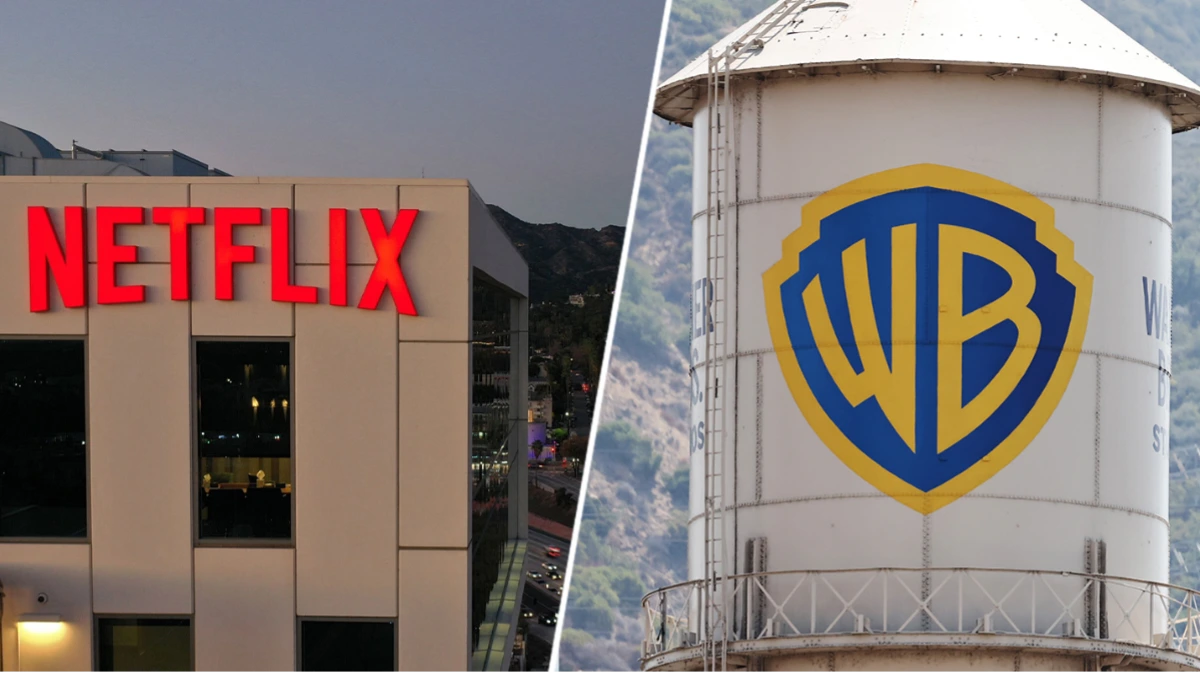
Netflix’s $72 billion deal to acquire Warner Bros. Discovery’s core studio and streaming assets stunned investors and Washington on Friday, setting off an immediate battle over whether regulators will allow the world’s largest streaming service to grow even larger.
The agreement, which would place HBO, HBO Max, and Warner Bros.’ legendary film library under the Netflix banner, triggered sharp reactions from analysts who believed such a move was unlikely.
The announcement arrived as traditional media companies face growing financial strain and intensifying competition from digital platforms.
For years, analysts predicted mergers among mid tier streamers rather than a combination anchored by the sector’s dominant player.
The scale of Netflix’s $72 billion deal prompted swift comparisons to past entertainment megamergers that reshaped the media landscape.
Warner Bros. Discovery, long burdened by debt and uneven streaming performance, had been weighing strategic options. But few in the industry expected the company to cede its flagship entertainment assets to a direct rival.
“This outcome was not even on the shortlist,” said Jason Bazinet, a Citi analyst who had assigned only a five percent probability to such a transaction.
Analysts said the merger could redefine market power in US entertainment, particularly at a moment when federal antitrust officials have taken a harder line on consolidation.
“Regulators will look closely at whether this meaningfully limits consumer choice,” said Dr. Maya Rodriguez, an antitrust expert at Georgetown University.
“Netflix’s $72 billion deal is not just about content but about controlling a larger portion of how Americans access entertainment.”
Sen. Elizabeth Warren criticized the agreement, calling it an “anti monopoly nightmare” and warning it could lead to higher prices and fewer options.
Other lawmakers urged the Department of Justice to conduct a rigorous review as the political climate continues to shift toward increased scrutiny of tech and media firms.
Netflix co-CEO Ted Sarandos rejected those concerns, telling reporters the deal is “pro consumer and pro innovation.”
Executives are expected to argue that the streaming market includes a wide array of competitors such as YouTube, gaming platforms, and social video services, reducing Netflix’s relative dominance.
According to data from JustWatch, a combined Netflix Warner Bros. Discovery would account for roughly one third of U.S. streaming activity.
That concentration raises questions about market power compared with past mergers in cable, telecom, and media.
“Even at one third, you are not looking at absolute dominance,” said Rebecca Liu, media economist at the University of Michigan.
“But Netflix’s $72 billion deal pushes the company closer to the center of virtually every major conversation about entertainment consumption.”
Industry analysts noted that Netflix plans to operate HBO Max and its own platform separately at first, a strategy aimed at signaling that consumers will still retain multiple choices rather than being forced into a single bundled service.
The news also rippled through Los Angeles, where many workers in the film and television industry expressed uncertainty about what the merger could mean.
“It’s hard not to wonder what happens to jobs when two giants merge,” said Daniel Ortiz, an assistant director based in Burbank. “We’ve seen layoffs before after big deals, and people are nervous.”
Some consumers, however, welcomed the possibility of expanded libraries. “If we get HBO shows and Warner Bros. movies in one place, that could be convenient,” said New York resident Karen Douglas. “But I just hope prices don’t go up.”
Local business owners near Warner Bros. studios, still recovering from recent industry strikes, said they hoped the merger would not disrupt upcoming production schedules.
“Any slowdown hits our neighborhood fast,” said Samir Khan, who runs a café frequented by studio employees. Analysts expect regulators to take months sifting through the agreement.
Hearings could feature testimony from economists, competition experts, and consumer advocates.
The Justice Department has signaled stronger skepticism toward vertical and horizontal mergers, though outcomes remain unpredictable.
“Approval is not guaranteed, but Netflix built this deal with regulatory arguments in mind,” said Rodriguez.
“The company will stress the fragmented nature of the entertainment market and highlight the role of global competition.”
Netflix’s $72 billion deal also raises questions for other media companies facing pressure to scale up.
Paramount, NBCUniversal, and emerging platforms could be forced to rethink long term strategies amid shifting audience behavior and escalating content costs.
Netflix’s $72 billion deal for Warner Bros. Discovery marks one of the most surprising developments in the streaming era, reshaping industry expectations and setting the stage for a prolonged regulatory fight.
As lawmakers, analysts, and consumers weigh the potential consequences, the merger underscores the rapidly changing dynamics of global entertainment and the uncertain path ahead for competitors.


