
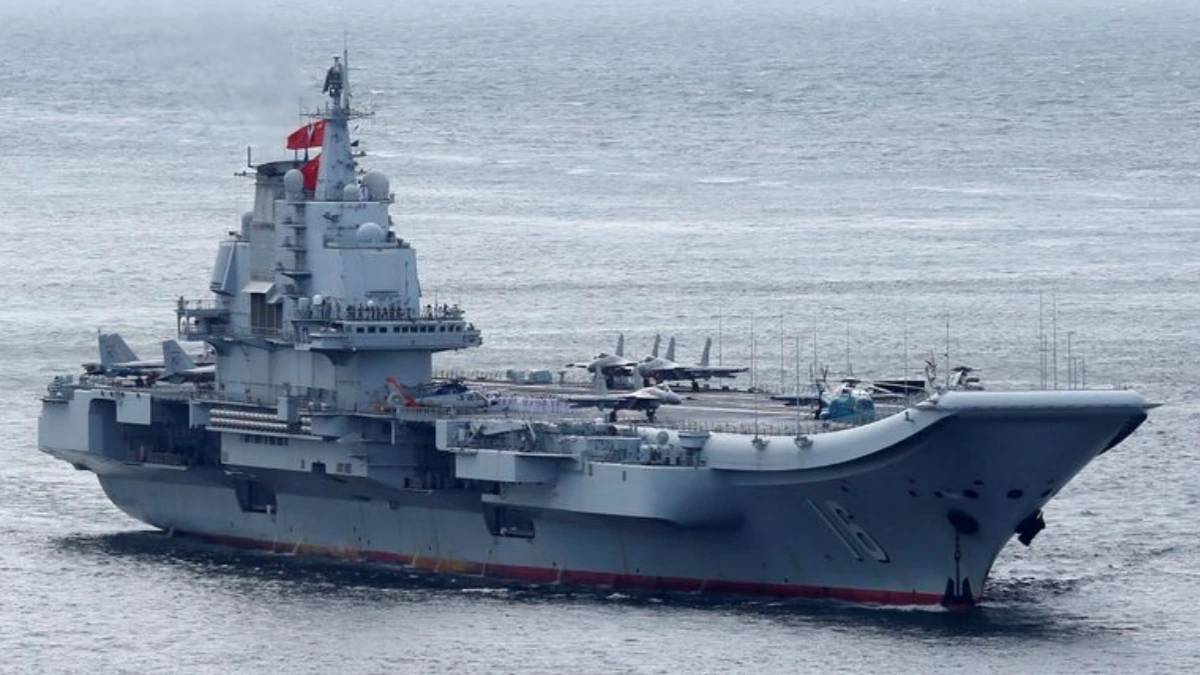
Tokyo, Japan — Japan and Australia called for restraint Sunday after Chinese military aircraft locked radar on Japanese fighter jets, raising tensions in the region amid recent remarks by Japan’s prime minister on Taiwan.
The incident underscores growing concerns over Chinese military activity near Japanese airspace and the delicate balance of regional security.
Japan’s Defense Minister Shinjiro Koizumi said the country formally protested the incident, describing it as “an extremely regrettable” and “dangerous” act that “exceeded the scope necessary for safe aircraft operations.”
The radar lock occurred Saturday near Japan’s southern island of Okinawa, where Japanese F-15 jets were pursuing Chinese J-15 fighters conducting routine carrier based exercises.
“We have lodged a strong protest with the Chinese side and demanded strict preventive measures,” Koizumi said. Our priority is to ensure the safety of Japanese airspace while monitoring Chinese activity closely.
The Chinese J-15 jets launched from the carrier Liaoning and intermittently locked their radar on Japanese fighter jets in two separate incidents Saturday, first for about three minutes in the late afternoon and later for around thirty minutes in the evening.
Japanese jets maintained a safe distance and did not take any action that could be interpreted as provocative, according to defense officials. There was no breach of Japanese airspace, and no injuries or damage were reported.
Senior Colonel Wang Xuemeng, a spokesperson for the Chinese navy, defended the exercises near the island of Miyako.
“Beijing announced these flight training exercises beforehand,” Wang said. “Japanese aircraft interfered with operations and engaged in harassment.
We urge Japan to stop slandering and strictly restrain frontline actions. The Chinese Navy will take necessary measures to safeguard its security and legitimate rights.”
The radar lock comes a month after Japan’s Prime Minister Sanae Takaichi said in early November that Japan could intervene militarily if China took action against Taiwan, a self governing island that Beijing claims as its own.
Takaichi described the recent radar incident as “extremely disappointing” but emphasized calm and measured responses. Security experts warn that such incidents heighten risks of miscalculation in a region already fraught with military tensions.
Dr. Kenji Nakamura, a senior analyst at the Asia Pacific Security Institute in Tokyo, said, “Radar lock incidents may appear minor, but they are serious in signaling intent and testing reactions.
Both sides must prioritize communication channels to avoid escalation.” Analysts note that Japan and Australia have been deepening defense cooperation amid increasing Chinese activity in the East China Sea and the Taiwan Strait.
Richard Marles, Australia’s defense minister, said, “We are deeply concerned by China’s actions in the last 24 hours. We expect those interactions to be safe and professional.”
According to Japan’s Ministry of Defense, incidents of Chinese aircraft locking radar on Japanese jets have been steadily increasing over the past three years, rising from 12 occurrences in 2022 to 23 in 2024.
Most incidents involve J-15 carrier based fighters near Okinawa and Miyako Islands. The rise in incidents coincides with stronger Japanese Australian defense coordination and increased US military presence in the region.
Local residents near Okinawa expressed unease but urged calm. “We see military planes almost daily, but hearing that radar was locked on Japanese jets is concerning,” said Hiroshi Tanaka, a fisherman from Ishigaki Island.
We hope governments handle this carefully so it does not affect our daily lives. Japanese and Australian officials emphasized measured responses.
“We will act calmly and resolutely,” Takaichi said Sunday, “while closely observing Chinese military activity around Japan.” Analysts predict that Japan and Australia will continue close coordination to monitor Chinese military maneuvers while avoiding provocative actions.
The US Japan security alliance and broader regional partnerships are expected to play a key role in deterring potential escalation. Dr. Nakamura said, Communication, transparency, and restraint are essential. Each radar lock or intercept is a test of military readiness and political resolve.
The radar lock incident highlights growing tensions in East Asia, particularly around Japan’s southwestern islands and the Taiwan Strait.
While no conflict occurred, officials from Japan and Australia stressed the need for calm and professional conduct to prevent further escalation.
The episode underscores the fragility of regional security and the importance of continued surveillance, diplomatic engagement, and measured military preparedness.


